Written by: Srećko Ignjatović
The subject of this paper is the bridge over the Sava River between the Two Brods. The bridge, which after a brief and arduous construction in 1878/79, connected the two banks, and thereby linked two entirely different faiths, nations, and cultures. The work chronologically traces three centuries of events, destinies, and dramas of ordinary people, and how a deep bond was formed between the fascinating structure and its inhabitants who have been using it to this day.
The left bank of the river forms an empire based in Vienna, and the right bank forms an empire based in Constantinople. Its inhabitants, under the authority of the aforementioned empires along the border zone, served as border guards and simultaneously as ‘cannon fodder,’ for whom they bled for years in the field. In these conflicts, many would die, and the mobilized new recruits would meet the same fate as their ancestors. Often, a smaller number sought refuge through emigration. Over time, this would lead to integration processes on both sides: in the west, through Croatization, and in the east, through Bosnianization. This long-standing process has been historically documented, with the provided text also scientifically evaluating how these processes unfolded.
Historical Period from 1697 to 1878
… “We will build an iron bridge there… Trains will run across it, pulled by steam locomotives of the Austrian Emperor—like nothing Bosnia has seen before,” he said, pointing with his riding crop toward the bank that protrudes from the Sava between *Turkish* Bridge in Bosnia and the royal Bridge in Slavonia. This is how General Filipović recounted it, standing beneath the cool shade of a massive poplar tree, which had recently thrived beside an old Turkish guardhouse. These words were listened to with confusion by representatives of the Turkish command, the bearers of the protest note that the general brusquely rejected, ordering the immediate disarmament—by force or by consent—of the crew at *Turkish* Bridge, consisting of just 45 soldiers. The crew was disarmed very quickly, after which the Austrian flag was raised and then the Ottoman flag lowered. This event took place on July 28, 1878.

Looking historically, less than three centuries ago, during the Ottoman “vakht,” both Brods belonged to the same territorial unit—the sanjak—with its seat in Slavonska Požega. As a whole, sliced through by a winding river, one could see Oriental architecture, the spires of minarets, and the robes of bearded Hajj pilgrims. In 1691, Ban Nikola Erdödy (Croatian Ban, 1680–1693) and General Hercog de Croy eliminated the Ottoman stronghold in Brod Fortress and finally freed Brod from the Turks. On the Slavonian side, the call of the muezzin fell silent, and from then on, Brod became a base for Habsburg expansion southward, while the Turkish Brod took on the role of a border guard on the Sava River, then weary from the Ottoman Empire. Nearly three centuries later, contact between the two Brods was guarded and prevented by military authorities on both sides.
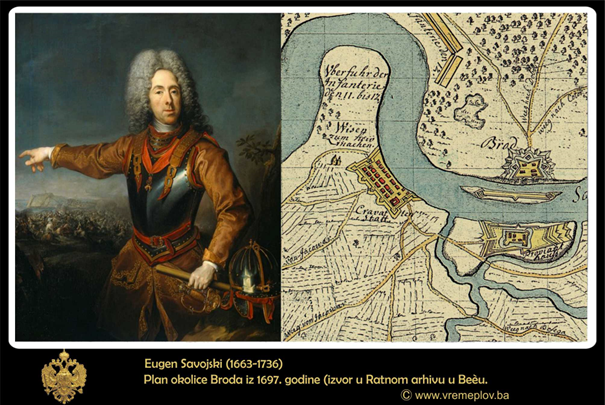
In 1697, the renowned Eugene of Savoy (Prince of Italian-French descent and commander-in-chief of the Habsburg imperial army, 1663-1736) stayed in Brod, where he prepared for an attack on Bosnia with 4,000 pikemen, 2,500 musketeers, twelve small cannons, and two mortars (German: Mörser, Hungarian: Mozsár, an old-fashioned cannon, a prang, et al.). After the great victory over the Turkish army at Senta on September 11, 1697, the Vienna court decided that a portion of the imperial army, led by Eugene of Savoy, would cross the Sava River at Brod and proceed to push back the Turks from the right bank of Bosnia. He encamped at Vijuš, the first settlement bearing that name at the site of today’s Brod (Slavonski Brod, to be precise). From October 10 to 12, he crossed the Sava River using ferryboats called ćajki, which were linked in a bridge at Ade, bypassing what was then called Turkish Brod.
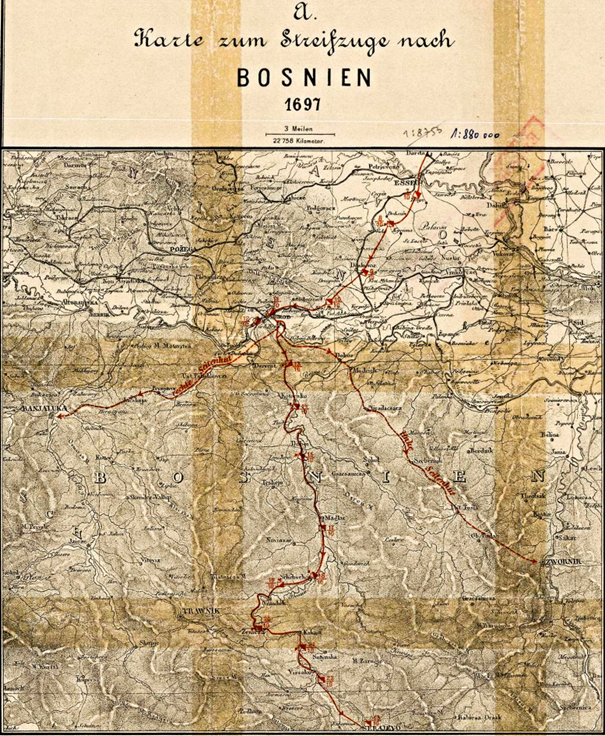
He advanced rapidly towards the confluence of the Spreča River with the Bosna River near Doboj. The fortress garrison, occupying the commanding castle above Doboj, offered strong resistance. After capturing the castle by force, as retaliation for refusing the ultimatum to surrender the city, he burned down all the townhouses and granaries.
Marching with minor skirmishes across Maglaj, Žepče, Vranduk, and Zenica on October 21, they arrive at the village of Doboj (near Kakanj, ed.) where they camped. The prince sends a cavalry captain with 200 hussars (Hungarian: huszár, light cavalry, ed.) accompanied by twenty-two cornets (cornet—standard-bearer, trumpeter, ed.) and a furir (German: Fourierschütz, soldier of the rear guard, groom), ordering them to go reconnaissance towards Sarajevo. The captain carries a letter addressed to the Sarajevans, written in German, Turkish, and Serbian. The letter states, among other things, that Sarajevo should surrender to him because, otherwise, if they refuse to obey: …“with sword and fire, everything will be destroyed, and they will not spare even children in the mother’s womb.” When that captain returned and reported that he fought with Turkish cavalry outside Sarajevo, and in the meantime, the prince had already encamped near Visočko, he again sends 240 German cavalry led by Major-Adjutant Share (Charree) and 200 hussars commanded by Oberleutnant Malinić (Mallenich) of the Serbian militia. The orders were to bring back reliable information about the situation in Sarajevo—namely, about the mobilization of the citizens and army for the defense of the city, and the response to the written ultimatum—even if it risked conflict with the enemy.
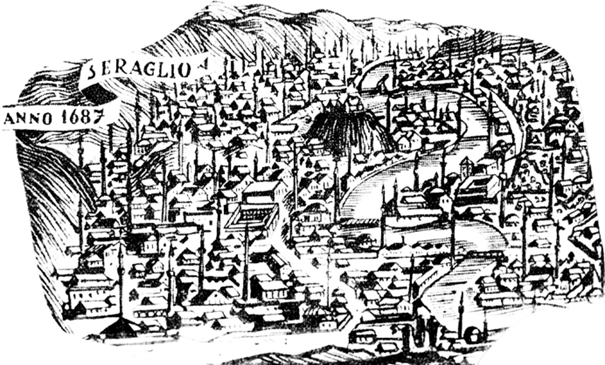
That day and night, when he received no reply, the prince ordered the army to march to Sarajevo the next morning. From Visoko heading toward Sarajevo, the troops with artillery moved along the banks of the Bosna River, passing through Ilijaš and Semizovac, then through Gornja Vogošća (today Vogošća), and over Kobilja Glava, finally reaching Koševsko Brdo. Along the way, they encountered a wounded **cornet** who told him that he had been attacked by Turks, where they slaughtered a trumpeter with swords, and he himself, holding a letter high in his hand, quickly turned back and barely escaped with his life. The prince ordered the troops to take positions on the surrounding hills and immediately launch an attack. It quickly became apparent that the Turks had no defenses, so several detachments moved into the city to plunder. During this raid, they found plenty of loot, especially in shops filled with goods that the owners hadn’t had a chance to remove. They looted the old Orthodox church and took valuable books and icons from it. In the evening, a fire broke out, and according to an Austrian report, the entire Sarajevo was burned. Nearly all the mosques were destroyed in the fire, and in 17 Sarajevo mosques, the imams and muezzins perished. The old Orthodox church was spared from the flames, but the Catholic church in the Latin Quarter was completely destroyed by fire. The next day, October 24th, the army camped to rest while smaller detachments continued looting, chasing and killing fleeing people, and capturing women and children. Christians came to the camp and begged Prince Eugene to withdraw the army from Sarajevo, which he permitted, promising to settle them on the other side of the Sava.
After carrying out his mission, Prince Eugene prepared to return. He was worn down by the advancing autumn weather and feared that rain and snow would worsen the already bad roads. Since there was no reason to hold the Sarajevo fortresses, which were guarded by Ottoman garrisons, an order was issued on October 25th to begin the retreat. That day, heavy cold rain fell, and along the thinning roads, the army marched together with refugees, captured Muslims, and Jews, among whom were Orthodox Christians with their families. The bad weather did not stop the soldiers from burning Muslim barns and houses along the road. Along the way, new refugees joined the column, pleading with the soldiers to lead them across the Save River. Somewhere near Žepče, news arrived that from the vicinity of Timișoara and Biograd (Belgrade, ed.), an Ottoman army of 8,000 men had gathered and that on October 22nd, they had begun moving through Zvornik towards Bosnia. Securing their retreat, with minor skirmishes near Žepče and Maglaj, Prince Eugene quickly marched towards Brodu, where it took twelve days of grueling marching for the army and thousands of refugees to reach the banks of the Save, arriving on November 5th, 1697.
The then commander of the Brod Fortress, Mihael Kyba, Count of Kinitzfelg, informs Savoia that the provisional bridge he arranged for his return and that of the army has been destroyed by the Turks. As retribution, he orders the place to be burned down and razed to the ground. The Austrian army, with more than 40,000 refugees from Bosnia, will transfer from the area of Poloja to the town of Beberine on the Slavonian side. Some of the refugees will settle in Brod, while the rest will move into many deserted villages in Slavonia after the Turks were driven out in the ongoing conflicts across the European parts of the Ottoman Empire.
Historically, military victories by Eugene of Savoy at Senta in 1697, Petrovaradin in 1716, and Belgrade in 1717 marked the end of the Ottoman conquest in Europe. The repeated defeats in the war with Austria, concluded by the Karlovac Peace (Sremski Karlovci in 1699) and the Požarevac Peace (Požarevac in 1718), signaled the final retreat of the Ottoman Empire from Central Europe. Through these treaties, a large part of the territories of Croatia, Slavonia, Banat, as well as Lika, Kordun, and parts of Bosnia, came under the control of the Austrian Empire. The Sava River formed the border between the two empires from its mouth at the Bosut River to the Una River.
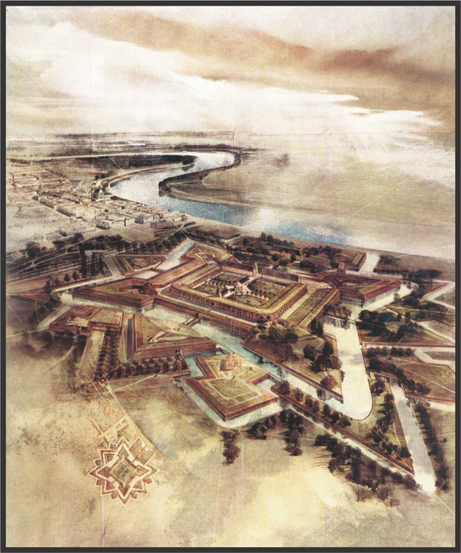
After these events, Brod and part of Posavina in Slavonia were declared the Slavonian Military Frontier, also called the Croatian and Danube Frontier. The army, under the Croatian ban, managed all affairs, including judicial matters, on the Croatian-Slavonian Military Border. Between 1715 and 1780, Austria built a large imperial and royal Slavonian border fortress, known as “Tvrđava Brod” (Fortress Brod). This star-shaped structure, made of brick, wood, and partly stone, was surrounded by earthwork to protect against potential floods from the rising Save River. The II Ban Regiment’s troops were stationed there.
Until that time, every resident along the military border was a soldier (from ages 16 to 60). During peacetime, each soldier was responsible for their own food and clothing, while in wartime, these were provided at imperial and royal expense. New settlements were built alongside the fortress, with their urban layout already established during the Ottoman period.
In 1807, the town lost its city status and was declared a village, or border settlement. Administratively, it was placed under the jurisdiction of Podvinje. As the River Sava became a permanent border between Turkey and Austria, the inhabitants of both Brods became border guards with numerous and demanding military and labor obligations. In 1820, a proclamation was issued establishing the Free Royal Municipality of Brod, and Mihael Polsater was elected as the first mayor of Brod. During Emperor Franz II/I’s visit to Brod in 1817 (the first Emperor of Austria from 1804 to 1835 and former Emperor of the Holy Roman Empire from 1792 to 1806), prominent residents presented him with a petition requesting the abolition of the village status subordinate to Podvinje and its restoration as a city. Their petition was granted, and based on the edict from the Court Military Council on November 31, 1819, and the order issued by the Central Command in Petrovaradin in January 1820, Brod was restored to city status. In 1860, the fortress was dismantled and became militarily insignificant; then in 1871, Emperor Franz Joseph I (Franz Joseph, Emperor of Austria and King of Hungary from 1848 to 1916) proclaimed Brod a city, naming it Brod na Savi (Brod on the Sava). After numerous reforms and changes, in 1881, the Slavonian Military Border was abolished. Then, during 1882, its territory was placed under the administration of the Kingdom of Croatia and Slavonia within the Lands of the Crown of Saint Stephen (Ugarska, i.e., Hungary).
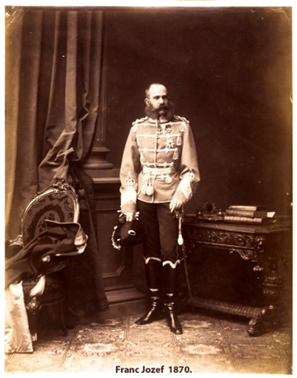
In the 1870s of the 19th century, the residents of Brod long asked the Krajina administration to establish a proper bank along the Sava River and to build a road on that designated bank. Their request was answered by Baron Filipović, who was then the administrator of the Military Frontier and the military commander based in Zagreb. As early as June 1878, thanks to a public bidding and the generous funding from the Krajina Investment Fund in Zagreb, their appeal was granted, with hopes of soon beginning construction. Historically, Baron Filipović’s move was not without strategic considerations, viewing the situation from a military standpoint rather than solely infrastructure. As an educated man of stature, he closely observed the three-year uprising from 1875 to 1878 in Bosnia and Herzegovina, Serbia, and Montenegro, foreshadowing the end of centuries-long Ottoman rule. From the available press during this time of crisis, chaos, and violence in Bosnia and Herzegovina, he learned how the “Eastern Question” was being addressed—namely, that Orthodox insurgents demanded Herzegovina be annexed to Montenegro, while Bosnia was claimed by Serbia. Meanwhile, insurgents of the Catholic denomination and other supporters aimed for Bosnia and Herzegovina to unite under Habsburg rule with the Catholic Croatian lands. He also gained insights into diplomatic solutions regarding the division of the rebellious regions between Austria and Russia. According to arrangements between the Austro-Hungarian Monarchy and Russia, their goal was achieved: with the signing of the agreement, they gained the right for military control and the mandate to govern all of Bosnia and Herzegovina. His intention would become clear to the people of Brod when, within a month or more, he arrived as a general of the Austrian army on July 25th, tasked with occupying Bosnia. At that moment, he would utter his famous phrase and thus promise the residents of Brod the construction of a road, a bridge, and a railway to Vinkovci and Sarajevo.
The occupation period of Bosnia and Herzegovina in 1878–1879
The first bridge over the Sava—if crossing on pontoon boats can be considered a bridge—was built in July 1878 so that Austro-Hungarian troops, consisting of 20 battalions, 6 companies, 8 squadrons, 8 batteries, and 8 assembly pontoon “crews” (French: Équipage, meaning crew, convoy with horses and crew for supply purposes), totaling 18,000 soldiers, 900 horses, and 48 cannons, could cross it in order to carry out the occupation of Bosnia and Herzegovina in accordance with the Berlin Congress’s decision.
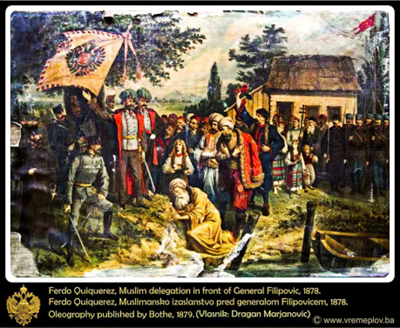
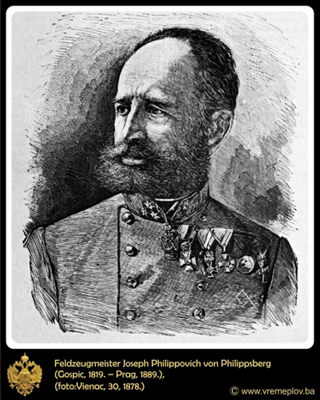
At the forefront of the infantry, shock-boundary guards, hussars, and ulaners (ulaner, a soldier mobilized during the Austro-Hungarian Empire, note the clarification) of various nationalities, languages, uniforms, and equipment, stood the commander of the occupying forces, General Filipović (Joseph Freiherr Philippovich von Philippsberg, Gospić, 1819 – Prague, 1889). He was a man of Croatian origin and name, with a Germanic upbringing and background. Before him, at 5 a.m., a unit led by a certain Franz Müller from the 27th Light Battalion crossed to the other side of the bank to disarm the Turkish garrison. Afterward, an Austrian flag was raised—brought from Brod Fortress—and then the Ottoman flag was lowered. Since most of the soldiers had been transferred by 9 a.m., General Filipović, along with Chief of the General Staff Popp, Divisionary Karl von Tegetthoff, Colonel Carl Baron Mecséry de Tsoor, and Brigadier Scotti, were the first to cross into Bosnia onto the land of the Turkish town of Brod. To the sound of Imperial music, they were “ceremoniously” greeted by residents from all three dominant Bosnian ethnic and confessional groups. The General expressed gratitude for the warm reception and after a lengthy speech, said: “…for all religions and for Muslims, equality before the law and the court is essential, and His Majesty wishes that the law be respected and justice and righteousness be upheld.” With an inspiring speech, he made it clear to those present that, as the commander of the Imperial army, he comes to Bosnia in the name of His Majesty, bringing order, peace, and civilization to this suffering province.
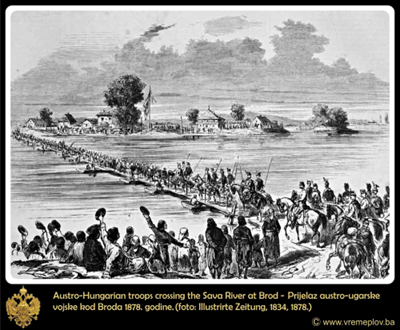
The crossing of troops between two Bridges on the Sava was not the only one. Simultaneously, the border was crossed at Šamac, Gradiška, Kostajnica, and from the south across the border near Imotski and Vrgorac. The first fiery clash between Austrian infantry and insurgents took place near Doboj. The main confrontation lasted only a short while beneath the walls of the castle. This imposing fortress has played a significant role multiple times in the history of warfare. In 1697, it was captured from the Ottoman army by Prince Eugene of Savoy, and in 1717 by General Petrach.
With the army’s entry into Maglaj, the insurgents mount a fierce resistance. On August 3rd, the Hussar Squadron of the Eighth Hussar Regiment, commanded by Captain Milinković, will fall into an ambush, and during the attack, 53 Hussars and Lieutenant Count Chorinsky will be killed by gunfire from carbines and flintlock muskets. Later, after the occupation of Bosnia near the newly constructed iron bridge, measuring 175 meters in length, a monument will be erected in memory of the fallen Hussars. On Preslica Hill, there will be a grave memorial serving as a wartime monument to all the fallen, including Count Chorinsky. Likewise, near Žepče, the insurgents will put up strong resistance, resulting in the deaths of 18 Hussar soldiers from the 47th Regiment and a Lieutenant named Wilhelm Bukin.
After 22 days of bloody fighting, General Filipović will march into Sarajevo on August 19, 1878. Immediately upon taking the city, he will establish military and civil administration over Bosnia and Herzegovina, based on the provisions of the Berlin Congress of 1878, even though de jure it remained under the Sultan’s rule until the annexation of 1908.
By issuing and proclaiming the “temporary” city charter, the Sarajevo City Council was established. The council members were elected according to their religious affiliation. The first mayor was Mustajbeg Fadilpašić (1830–1892), a Sarajevo native, who served from 1878 to 1892; at that time, he was one of the largest landowners in the country. In the early days following the city’s conquest, a summary court was established. Due to the uprising and resistance against Austro-Hussian forces, nine Sarajevo Muslims were executed by hanging on the quick tribunal, and hundreds of residents of all faiths were arrested and imprisoned in makeshift camps on the city’s western edge. About six hundred prisoners were forcibly marched to Brod on the Sava River and then transported by train to Vienna. From Vienna, they were transferred to a prison in Olomouc (in present-day Czech Republic), where, following the declaration of a general amnesty on November 15, 1878, all prisoners were allowed to return to Sarajevo, provided they walked back on foot from Bosanski Brod. Due to the cold December nights during the march and the lack of suitable shelter for rest, many died from frostbite.
Baron Filipović leaves Sarajevo on December 2, 1878. His departure is of a political nature, due to accusations from Hungarian political circles, who accuse him of intending to tie Bosnia and Herzegovina to Croatia through political organization, as the appointed leader of the occupied territory. This would ultimately undermine the fundamental balance of power within the dualistic structure of the Monarchy. Specifically, as he was preparing the civil administration of Bosnia and Herzegovina, led by jurist Vladimir Mažuranić (born in Karlovac in 1845, died in Zagreb in 1928), who was the son of poet and Ban Ivan Mažuranić (1814–1890), he drafted a plan for the administration of Bosnia and Herzegovina and sent it to Vienna. The proposal suggested a permanent guarantee of the acquired provinces, with the administration in the regions arranged in such a way that they could eventually be incorporated into the kingdom of Croatia, Slavonia, and Dalmatia. Vienna did not approve of this and returned it for revision; Filipović sent it back to Vienna unchanged. Despite this new warning from Vienna, he persisted in his decision, which led to his removal from office. During his departure from Sarajevo, a ceremonial farewell was arranged by military and city authorities. By a twist of fate, he did not return via the Bosnian valley toward Bosanski Brod, the place from which he had set out four months earlier on a military campaign toward Sarajevo. The reason was natural: the Sava River had overflowed its banks and flooded both Brod and Sijekovac, as far as Derventa. It was then said that from Sijekovac to Derventa, travel was only possible by boat. Another possible reason for his withdrawal was the news that a large group of liberated prisoners was moving through the Bosna Valley toward Sarajevo, and his lordship did not want to risk being compromised in a potential encounter with them.
Over several days of travel, both on horseback and using military wagons, he headed across Mostar to Kotor. From Kotor, or the Navy Base in Boka, he transferred by warship to Trieste and later traveled by train to Vienna. For the successful military conquest of all Bosnia and Herzegovina, regarded as the brightest episode of his military career, Baron Filipović received a series of decorations such as the Command Cross of the Military Order of Maria Theresa and the Grand Cross of the Leopold Order, awarded by Emperor Franz Joseph I. General Filipović was succeeded by Duke Wilhelm Nikolaus of Württemberg (Wilhelm Herzog Nikolaus von Wurttemberg, 1828–1891). The Duke of Württemberg led the Seventh Infantry Division with the task of advancing from Gradiska and Kostajnica through Novi, Banja Luka, Jajce, and Vitez to meet the forces commanded by General Filipović in the vicinity of Zenica.
With József Szlávy’s (1818–1900) appointment as head of the joint Ministry of Finance in the early 1880s, Hungarian political dominance in Bosnia and Herzegovina began, culminating in 1882 with the appointment of Benjamin Kállay as its administrator.
Most, whose construction was announced by Filipović, was built by a Viennese construction company, “Freiherr von Schwarz,” which won the bid for the project with a sum of two and a half million forints. Additionally, the same company will construct a standard-gauge railway (1435 mm) from Brod na Savi to Bosanski Brod (Brod – Bosnabroder Eisenbahn), measuring 3.444 km in length. This railway will connect with the standard main line of the Austro-Hungarian State Railways from Dalj to Vinkovci to Brod na Savi, which was opened on November 22, 1878. The costs for building the bridge and part of the railway were covered by an occupation loan. The start date for building the bridge and narrow-gauge railway, October 1878, marked the point at which the town officially referred to as Bosanski Brod, replacing the previous name Turski Brod. The construction of the bridge took nine months, and the bridge, along with the connecting railway, was opened to traffic on July 5, and officially inaugurated on August 10, 1879. Just a month earlier, on June 8 of the same year, the narrow-gauge railway (760 mm) from Bosanski Brod to Zenica was put into regular service. However, the bridge was on a wooden structure, and the Hungarian Ministry of Communications formed an expert commission, which in June 15, 1879, concluded that the bridge should remain in its current condition until permanent (concrete) piers could be built, and that additional data regarding the height of rising water and the necessary clearance for ships navigating the Sava should be gathered. The existing state of the bridge did not pose significant problems in initial goods exchanges: trains loaded with coal, salt, timber of fir, oak, and beech, as well as livestock of small and large sizes, arrived from the Bosnian side, while from the opposite direction, convoys carrying troops, gendarmes, finance officials, bankers, merchants, and clerks were seen. The constructed railway, Brod – Bosnabroder Eisenbahn, belonged to the Austrian military authorities, and the railway operator was managed by the Hungarian State Railways.
Period građenja mosta preko Save, Brod – Bosanski Brod, 1878. – 1879.
During the occupation period in Bosnia and Herzegovina, there were practically no suitable roads, and the few that existed were difficult to traverse. The only existing railway, Dobrljin – Banja Luka, as a completed section of the previously planned so-called “Sandžak Railway” (1872), did not cover enough territory and was not sufficiently reliable, as there were frequent traffic interruptions along it. To ensure quick deployment of troops and occupation of territory, the accelerated construction of railways for the Austro-Hungarian government became a strategic necessity. This need demanded the construction of a narrow-gauge railway from Bosanski Brod towards Zenica and Sarajevo, which would connect to the future standard-gauge railway line from Dalj – Vinkovci – Brod na Savi (opened to traffic on November 22, 1878). The Vinkovci – Brod na Savi railway built that first year would be used solely for military purposes until the future construction of a bridge across the Sava (around mid-1879), which would then allow it to be opened for public traffic. Since the Sava River flows between both Brods, it was essential to build a stable bridge that would connect these two locations via railway and road communication.
Based on the completed detailed project, September 18, 1878, is considered the first day of construction on the bridge, as the bridge’s axis was marked at that time. From September 30 to October 3, the height of the bridge, the railway embankment, and the access ramps were officially surveyed and fixed. The very next day, October 4, on the Bosnian side, construction began on the narrow-gauge railway line of 760 mm between Brod and Derventa. On October 6, work commenced on the bridge itself, starting with the driving in of pilot piles for the support beams.
Design and preparatory work for bridge construction
Since military interests required the urgent establishment of a bridge connection capable of being used under all circumstances, including road and railway traffic, an urgent construction was ordered to be completed as quickly as possible.
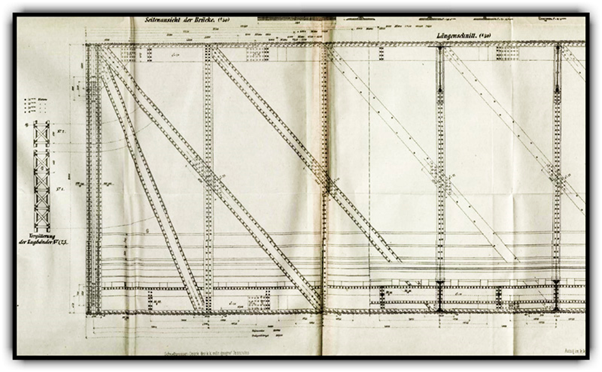
In accordance with these requirements, a general project was submitted to the Ministry of War by engineer Wilhelm von Pressel (Wilhelm von Pressel, 1821-1902), a designated German official and railway engineer of the Ottoman Empire, and former director of construction for the Imperial and Royal private company of Southern Railways. The bridge was designed so that the iron lattice girders, spanning five sections of 80 meters each, rested on wooden supports, arranged with space left intentionally open for subsequent final (concrete) pylons. To accommodate both road and rail traffic using the bridge, two alternative proposals were considered. In the first, the track was situated between the lattice girders, with overhangs for the roadway protruding outside the lattice for road traffic. The second proposal envisioned the railway and roadway being placed side by side within a two-lane width, separated by a protective barrier, both supported by the lattice girders.
The location of the bridge was determined near Brod, to the west, at the place where the river, divided by an island, splits into two branches. Considering that, based on the project, the construction of a temporary truss bridge would allow the bridge to be built in a short period of time, the Ministry of War ordered, by imperial decree on August 28, 1878, that the president of the Technical and Military Committee, Field Marshal Lieutenant Daniel Freiherr von Salis-Soglio (Daniel Freiherr von Salis-Soglio, 1826-1919), who at that time was the Inspector General of the Austro-Hungarian Army, prepare the necessary arrangements for the commencement of the bridge construction works and establish appropriate contracts. To fulfill this order, it was first necessary to develop a detailed design of the bridge.
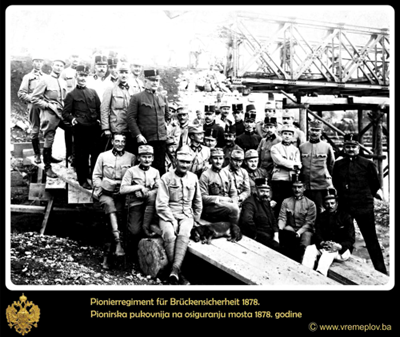
Within a few days, an appropriate bureau (Schnellpressen-Druck des k.k. militär Geographic Institutes), consisting of eight engineers mostly recruited from the ironworks, was organized as part of the technical and administrative committee. These engineers were relied upon in the construction of the lattice bridge. The development of this project, at the proposal of engineer Wilhelm Presel, was overseen by sectional engineer Franz Vabitš (Franz Vabitsch), who was assigned for this purpose by private southern railways. Meanwhile, the General Inspector Freiher von Salis personally supervised the issuance of the work orders and contract agreements, assisted by sectional engineers.
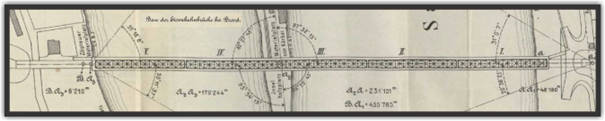
Thanks to the agility and diligence of this design office in terms of the method and organization of copying plans and drawings, they will receive significant assistance in technical resources from the Technical and Administrative Military Committee (Autograph in k.k. t. & a. militär Comite). The committee chairman already informed the relevant authorities on September 4, 1878—that is, within 8 days—that the work had already been issued to the contractors, contracts had been signed, and the detailed project plans would be completed by September 15. To give an idea of the scope of the work completed in such an unusually short period, it should be mentioned that the project included: one memorandum, 20 original plans, two graphical hydraulic representations of the Sava River near Brod, one statistical calculation, and one weight calculation. With the duplication of the project for various institutions, an elaboration was produced consisting of 392 drawings. These reproductions were carried out efficiently at the lithographic and photographic departments of the Technical and Administrative Military Committee.
For the construction of wooden yokes and all related ancillary facilities at unit prices, as well as the fabrication of assembly scaffolding for the respective steelworks, a contract was issued to the consortium Jochem, Dunz, and Anderle (Consortium Jochem, Dunz & Anderle).
The construction and assembly of each bridge section have been entrusted to the following contractors:
- I Opening: Archducal Industrial Administration in Teschen.
(Provincial Industrial Administration in Tješin – Tješin, Czech Těšín, editor’s note.) - II Opening: Ironworks Directorate in Vitkovice.
(Directorate of the Vitkovice Ironworks) - III Opening: Machine Factory and Iron Foundry of J. Körösi in Andritz near Graz.
J. Körösi Machine Factory and Iron Foundry in Andritsos near Graz
- Opening IV: Prager Eisenindustrie-Gesellschaft in Vienna (Prague Industrial Society in Vienna)
- Opening V: Zöptau and Stefanau Mining and Ironworks Association in Zöptau. (Z. and S. Mining and Smelting Association in Zöptau; Zöptau – Sobotín is located in the northern Czech part of Moravia, editor’s note).
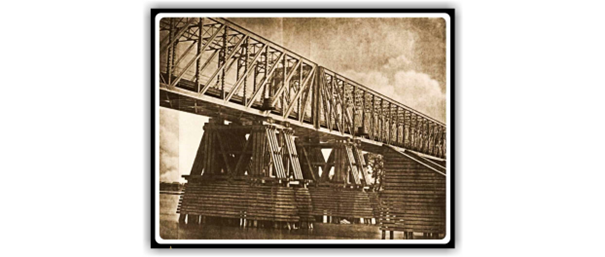
According to the detailed design plan, the layout was as follows: five iron bridge spans, each 80.51 meters long, with lattice girders standing 9.00 meters high and a roadway width of 6.30 meters. These spans rest on ten wooden trestle supports. As an extension of the iron bridge, floodgates made of wood were constructed on both sides, to which railway embankments with access ramps for road traffic were connected.
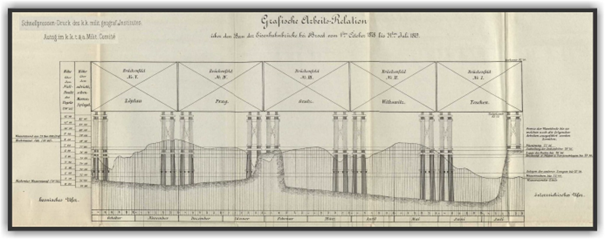
In the middle between the lattice supports, a track for the standard railway line was laid. On both sides of the track, there was sufficient space left for road traffic. The use of the bridge for both railway traffic and passage of road vehicles could only occur alternately. For this arrangement, it was appropriate to simplify the construction, consider the cost factors, and the opinion that, given the reduced capacity of the narrow gauge track, the number of trains on the standard connecting track would be so minimal that road traffic would not experience significant disruption.
In the process of designing detailed plans for steel bridge spans, a decisive factor was the fact that, given the very short deadline of six to eight weeks for their procurement, only types of steel available from all five of the considered steelworks with appropriate rolling mills could be used. Therefore, one engineer was delegated from each of these industries, and they participated in the creation of the detailed design. For the wooden frames, no final plan was drafted; instead, it was left to be completed later based on the onsite situation. Their approximate construction was planned based on von Pressel’s drawings.
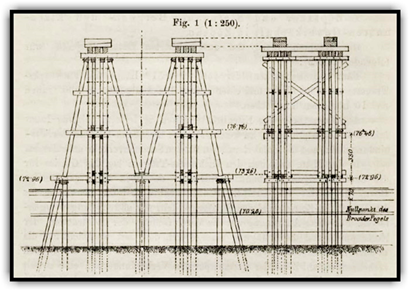
According to this project, the pilot arrangement was as follows: 40 pilots were designated for forming the frame and ensuring their stability; the load of the steel structure was supported by 4 bundles of 12 vertical pilots each. Of these 48 load-bearing pilots, half were to be cut down to a height of 2.70 meters above zero, which is at elevation 72.96 (the zero point is at height 70.26), while the other half were to be cut at a height 3.50 meters above this. It was planned to create an extension of the frame on these cut pilots by first connecting them with clamps and caps (collars), and then placing 48 posts on top of them, which at a certain height would support the grill for the steel structure’s support. Clamps and caps would ensure the necessary connection and lateral stability of this frame extension. Depending on the location of the frames, their height ranged from the bottom to the lower edge of the structure between 7 and 16 meters.
Start of work
On September 15th, the railway bridge administration was established and entrusted to section engineer Franz Wabitsch, who participated in the project design. On September 18th, marking of the bridge axes began, and on September 30th and October 3rd, the height of the bridge, the railway embankment, and the access ramps were officially fixed.
Taking the navigation into account, the elevation of the bottom edge of the steel structure has been established at 5.60 m above the normal high water level, which is 7.74 m above zero, i.e., at elevation 78.00. To facilitate the installation of the steel spans onto their final supports after constructing the permanent bridge piers, the steel structure has now been raised by 13 cm.
On the Bosnian side, the necessary land and houses were expropriated, while on the Slavonian side, the land taken was public property, belonging to a military fortress.
After purchasing equipment and materials and completing other organizational preparations in the second half of September, work began on October 6th with the driving of piles for the harness carriers. The start of the work lagged behind expectations, but by the end of October, significant progress was made, thanks to the acquired amount of necessary wood that was located at the construction site, and the equipment was also fully in line with the planned objectives.
Work stoppage
By the second half of October, continuous rainfall caused the water level of the Sava River to rise, which adversely affected the progress of the work and led to a partial suspension of activities in early November.
When the water started to rise rapidly, all work had to be halted at the water level of 6.70 meters above zero, or at the elevation of 76.96 meters. All available workers were engaged in rescuing the wood supplies being carried away by the flood. Up to that point, 355 piles had been driven for the “yokes,” and some piles had been driven for prefabricated scaffolding.
The abnormal water level and its prolonged duration caused significant damage to the Sava embankments. Among other things, on November 23rd, a major breach occurred at the Kobaš dam, resulting in flooding of the entire area behind the embankment all the way up to the “glasija” of the shipyard fortress. The peak of the high water level was reached only on November 29th, when the Sava water level measured 8.43 meters above zero at the 78.59-meter mark, whereas the normal high water level is 7.74 meters above zero at the 78.00-meter mark.
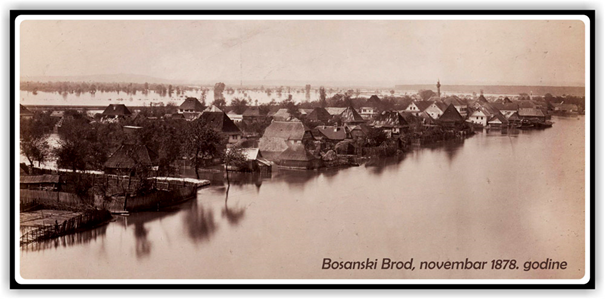
All the workers’ barracks, warehouses, tool storage, and large stockpiles of timber that had been deposited on the inner side of the embankment, prepared with great effort earlier to protect against rising water, were quickly overtaken by the floodwaters. Fierce winds caused strong wave impacts in the inundation area, breaking the stacked timber and scattering the sorted wood.
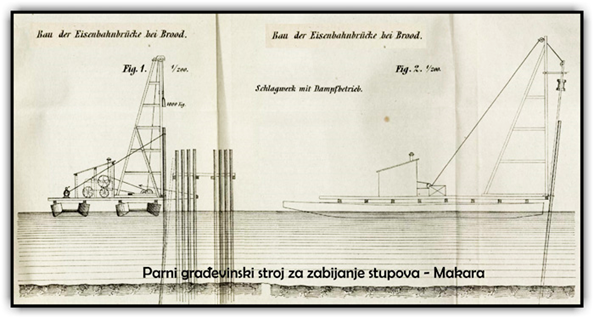
In the area along the river itself, the island, the shoreline, and the Bosnian side are heavily flooded. All equipment and the “makare” (a large mechanical axe used for breaking logs) were submerged, and the large stockpiles of timber located there were exposed to decay. The steam hammers (mechanical pile drivers used for driving pilings), which were on equipped boats, as well as the ongoing piling work, were heavily threatened by rafts, floating mills, and trees carried downstream by the swift current. One night, a raft struck and broke five piles of a single bundle started in the main river arm, and the steam hammer was saved from destruction through the extraordinary efforts of all personnel. Work had to be carried out day and night to secure supplies and equipment.
The construction manager, reporting on all circumstances, submitted a proposal to completely abandon the execution of provisional wooden poles and to immediately begin building the poles as a permanent structure once favorable conditions arise. Since this would delay the completion of the construction and, consequently, the establishment of a stable connection—which was of great importance—for years, the Ministry of War found it unnecessary to accept this proposal. Instead, it issued an order to force the construction using all available resources. The new construction supervisor was appointed Major Engineer Otto Beck von Nordenau, following the acceptance of the previous supervisor’s request to be relieved of his duties.
Since it was entirely hopeless to wait for the low water level necessary for the construction works, the only way to achieve an accelerated building schedule was through a project modification. This change had to be based on already initiated extraordinary works and the stock of timber found at the construction sites. The modification involved replacing the previously planned varied cut heights of the piles with a uniform cut at elevation 76.06. Connected to these piles with clips is a double grillage, onto which the continuation of the girder is placed. This allowed the works to proceed smoothly at a water level three meters higher than originally planned. However, due to their great height, the foundation girders had to be diagonally reinforced on the long sides with inclined piles to ensure the necessary stability along the bridge’s axis. A lower longitudinal and transverse connection of the piles is planned for later, once the water level permits.
Restoration of work
After a slight decrease in water levels, work resumed on December 16, 1878, at a water level of 7.00 meters above the zero mark, at elevation 77.26. First, the steam winches installed on the barges were put into operation, and once the remaining equipment emerged from the water, the entire working apparatus could be launched. By early 1879, piloting operations were in full swing. Despite the weather conditions, work was carried out daily into the night hours. However, the high water level made this work very difficult and time-consuming, as it was necessary to work with the greatest precision to place pilots up to 18 meters long—driven into the riverbed at a depth of nine and a half meters—accurately onto the barge at the designated spot and keep them in the correct position.
Given the state of the works and the projected duration, in mid-January, we began fitting the upper collars of the jarm plates so that, when water levels were favorable later on, we could use that time for their installation. At that time, however, most of the inundation area and the island were submerged, and the floodwaters behind the embankment had not yet receded. As a result, there was nowhere to work, so a platform was built on piles, on which the jarm collars were subsequently fitted.
Since the water level was steadily decreasing at the end of January, the prospects for quick and smooth progress of the works were very favorable, especially considering that water level observations from the previous year showed that the water level did not rise significantly.
On February 1st, work began on cutting pilots and inserting clamps at certain pontoons. However, by February 6th, the water level had risen again to 5.30 meters above zero, or elevation 75.56, which led to the suspension of work on the river pontoons and floating scaffolds. The water continued to rise steadily, flooding all areas at lower elevations, and all available labor was once again deployed to secure timber supplies. The work on the poles for the mooring posts was completed by February 15th with the driving of the thousandth pile. After the pilot installation phase was finished, ice-breaking works were carried out in front of the river pontoons as a protection for the posts against ice impact and floating debris during high water.
Installation of harness extensions and scaffolding units
Finally, after a lengthy wait of up to five weeks, the water level dropped on March 19th to 5.40 meters above zero, or at elevation 65.66. Work on cutting the pilings and adjusting the clamps resumed once again.
Just as this project was in full swing, the water that had been lowered to 4.59 meters above zero—at elevation 74.85—by March 24th, began to rise again. To avoid a possible suspension of work, which was imminent, work went on day and night, with all available labor. There was hope that, through persistent effort, they could keep pace with the rising water if they managed to complete four rows of clamps—placed one above the other transversely with wooden grates—on time, since each new row added about 30 centimeters in height. These tasks had to be carried out despite the heavy pressure from the incoming water, with the utmost care and precision, because any carelessness or negligence could have very serious negative consequences for the stability of the structure. Especially near pier No. 2, where the large number of pilings made the work the most difficult and time-consuming.
The efforts were finally crowned with success, as on March 31st the water level no longer rose. Clamps on all the harnesses had already been installed and secured, allowing work on adjusting the harness fittings and assembly scaffolding to continue without obstruction. The significance of this moment for the progress of the work was confirmed by subsequent water levels, as failure to complete the at-risk work would have halted all progress for nine weeks. On average, about 200 carpenters were employed in the installation of load-bearing harnesses and assembly scaffolding. On April 17th, the last load-bearing harness was completed, and by April 27th, the last assembly scaffold was finished.
Assembling the iron fields
The ironworks company completed the iron structures within the required 6 to 8 weeks. The transportation of the iron parts to the construction site took place only in January. The delay in transportation was caused by the high water level of the river, which flooded all the suitable places for depositing materials. Since both island cradles were completed earlier due to their location, as well as the neighboring assembly scaffolding, the installation of fields III and IV began before the scaffolding along the entire length of the bridge was finished. Only in the last days of April was installation underway on all sections. For this purpose, the assembly was carried out on the built scaffolds, and for each section of the bridge, three additional scaffold cradles were constructed between the supporting cradles. Only at section II was a larger opening left for navigation, which is why only two scaffold cradles were placed on that section, separated by 30 meters. The crossing of this opening was executed using a combined structure made of iron and wood, with a parabolic upper beam.
Long-lasting rains in the second half of April caused a resurgence of the Sava River when the construction was in full swing. A new tidal wave threatened the warehouses where steel components were stored. Despite vigorous efforts to move the steel to higher ground, it was of no use, as the Sava reached its highest level on May 7th. The entire area up to the levee on the left side was flooded, with the levee, which had been temporarily reinforced, being overtopped, and the land behind the levee was also submerged.
Ignoring this, work continued without interruption. Steel construction parts were loaded onto ships, boats, andrafts, which had to be pulled out from beneath the water. For days, workers waist-deep in water amidst heavy rain and cold wind painstakingly retrieved pieces that were over a meter submerged. The retrieved components were secured with chains and ropes to be transported to assembly scaffolding. These extremely unfavorable conditions caused significant delays, and as a result, the assembly was scheduled to take six weeks. Five different contractors from Czechia, Moravia, Silesia, and Styria participated simultaneously, employing a total of 350 specialized workers for steelwork, and 20 nail gun crews drove 140,000 nails into the construction site.
Completion of the works
During the assembly of the field, both wooden inundation bridges were completed, along with the sections of the railway embankments connecting to the bridges on both sides, as well as the passage ramp and smaller auxiliary facilities. Simultaneously with the completion of the iron sections, the laying of the upper deck began, which was finished on June 27th.

During the final days of June, the normal water level of the Sava River was maintained, allowing for the installation of the lower connection of the clamps on the bearing harnesses, which greatly improved their stability and strength. By that time, the bridge was already open to traffic. In July, the lining on the harnesses was pinned, the icebreaker was completed, the riverbanks were secured, and minor auxiliary works were carried out, with all tasks finished by the end of the month.
Load testing
Since the connecting track between the Brod na Savi and Bosanski Brod railway stations was completed at the same time as the bridge, a technical-police inspection could be carried out on July 2, 1879, which also included a load test.
For this purpose, three locomotives from the Hungarian State Railways were equipped, two weighing 36 tons and one weighing 34.5 tons. They were placed head-to-head with attached loaded Lowry couplers and passenger cars positioned on the bridge spans, where they remained for 1 to 3 hours. At section IV, the deflection was measured by leveling, and at section V, directly with a surveyor’s level. The results were as follows:
- Field I – Elastic deflection: 9 mm / Permanent deflection: 3 ½ mm
- Field II – Elastic deflection: 10 ½ mm / Permanent deflection: 4 mm
- Field III – Elastic deflection: 10 mm / Permanent deflection: 4 ½ mm
- Field IV – Elastic deflection: 12 ½ mm / Permanent deflection: 2 mm
- Field V – Elastic deflection: 14 ½ mm / Permanent deflection: 1 mm
There was no falling under the yoke.
A test drive was not conducted because only temporary supports are in place on the bridge, so light traffic was permitted. The test results were completely satisfactory, and the bridge along with the connecting track was opened to traffic on July 5, 1879.
During the train traffic, no defects were observed. The supporting beams demonstrated flawless stability, and there was hardly any sensation of shaking as trains passed by. If strict order were followed in traffic regulation, a large number of trains could cross the bridge without significantly disrupting road traffic.
Construction Overview
From the initial description, one can get an idea of the negative conditions that prevailed and hindered the rapid progress of the bridge construction. Although the construction of the bridge took nine months, this time should be reduced to the actual working time by excluding delays caused by the high water levels of the Sava River.
According to the work logs, the effective execution time of the tasks by month is:
October 1878, 3 weeks; November with no work; December 1 week; January 1879, 4 weeks; February 2 weeks; March 2 weeks; April 4 weeks; May 4 weeks; and June 4 weeks, totaling 24 weeks or 6 months.
The time spent on the type of work is:
12 weeks of piloting; 5 weeks for setting up the jibs, 6 weeks for assembling the steel structure, and 1 week for work on the upper machine.
According to the data provided, half of the total construction time was consumed by driving the piles. The proportionally long duration of these works can be explained by the conditions on the site. A large number of the piles were driven at very high water levels. Performing these tasks was very time-consuming because the piles had to be precisely aligned by direction and spacing. Driving the piles at an angle, and there were quite a few such piles, with steam-powered hammers, also took a lot of time, and some had to be repositioned and re-equipped. Finally, these heavy machinery with hammers weighing 800 and 1,000 kg were often damaged due to sudden movements and impacts, which required continuous repairs and caused delays.
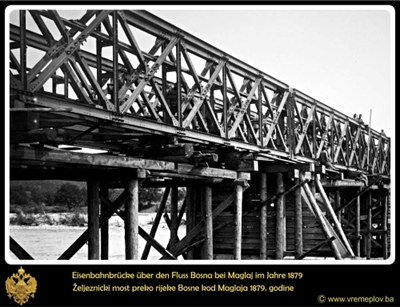
Considering that the construction was mostly carried out during the least favorable season of the year, the effective time to build a half-kilometer-long railway bridge with slight variations from the usual and with auxiliary structures cannot, in any case, be regarded as long, even if it takes six months.
According to the order from the Ministry of War, a construction company was indeed assigned a work detachment (a unit of soldiers for special tasks, op. a.) consisting of 24 pioneers. They worked in twelve-hour shifts by day and performed security duties at the bridge. Later, an additional guard from the 3rd Field Company of the Pioneer Regiment arrived, consisting of two non-commissioned officers and 10 soldiers, who secured the navigable part of the river approximately 3,000 meters in radius around the bridge.
Despite the relatively safety measures, unforeseen accidents still occurred. On January 16th, in the evening, after dark, the steamboat (loaded with bolts) “Columbus” was passing downstream, and according to regulations, it was supposed to pass between the piloted buoys number III and the begun buoy number IV (a distance of 14 meters). Despite the notice of limited nighttime navigation and a passage marked by red lights, it broke through two buoys and narrowly missed the spar buoy, without causing further damage.
On April 29th, the large vessel, accompanied by a guard and loaded with stone, was supposed to pass along the left bank of the Sava. One anchor loosened, causing the ship to turn and strike its side against two of the assembly beams of the first bridge section. The beams withstood the impact, so this mishap also passed without damage.
During the bridge construction, a high water level occurred, reaching a height of 7.85 meters above zero on May 7th, thereby exceeding the normal high water mark by 11 centimeters. As a result, the clearance for vessels was reduced because the scaffolding used for assembly was 1.70 meters lower than the bottom edge of the iron structure. This led to numerous debates and agitator efforts, sparking widespread discussion about the actual height requirements. The Hungarian Ministry of Communications formed a technical commission, which on June 15, 1879, concluded that the bridge should remain in its current state until further data could be collected regarding the anticipated high water levels and the actual necessary clearance height for ships navigating the Sava River.
It should be noted that this is the first time a steel structure of such large dimensions has been installed on temporary wooden supports. This achievement fulfilled the original goal of enabling the use of this communication route as quickly as possible, something that would not have been possible with permanent pillars.
Visit of Archduke Wilhelm to Bosnia in 1879
Austrian Archduke Wilhelm Franz Karl of the House of Habsburg-Lorraine (1827-1894) will be the first person to visit Bosnia and Herzegovina. Specifically, on June 8, 1879, the section from Zepče to Zenica was completed, and on July 14 of the same year, it was opened to traffic along the entire route from Bos. Brod to Zenica. Traffic over the newly constructed narrow-gauge railway would be exclusively organized for military purposes until May of the following year. The official inauguration of the railway for public service took place on May 9, 1880. After only two days of public operation (May 11, 1880), Archduke Wilhelm would travel by train from Bosanski Brod to Zenica. Accompanied by military escort, he continued his journey by road in a calash harnessed with imperial horses, arriving in Sarajevo on the same day. Without particular ceremonies or protocol, the visit of this high guest to Sarajevo would be private in nature and last until May 14 of the same year. The second visit of Archduke Wilhelm to Sarajevo would occur on March 25, 1889.
First visit of Emperor Franz Joseph I of Bosnia in 1885
On September 16, 1884, with the erection of concrete piers and the construction of embankments on one side for a narrow gauge track and on the other for a broad gauge, the railway and road bridge was officially opened to traffic at its full capacity. The work on raising the concrete piers and the final assembly of the bridge structure was carried out by the well-known Vienna-based company, Gebrüder Klein A. Schmol & E. Gärtner. Emperor Franz Joseph I, taking advantage of his return from military maneuvers around Požega and Pakrac, took several hours to visit the “new colony” (the Austro-Hungarian “Corpus separatum”) Bosnia and Herzegovina, and honored the occasion with his presence at the celebration marking the anniversary of the completed railway bridge across the Sava.
He arrived by train to the Brod na Savi station and walked on foot across the iron bridge, which for the occasion was decorated with Austrian flags, and at the end of the bridge with Bosnian flags. Upon stepping for the first time onto Bosnian soil, he was greeted by Johann Tomaschek, the director of the Bosnian Railways, Austrian Governor of Bosnia and Herzegovina Baron Johann von Appel (governor from 1882-1903), and Mayor of Bosanski Brod Mehmed Hafiz ef. Hodžić. On the occasion of this event, which took place on September 16, 1885, the emperor granted a pardon and issued amnesty for all individuals in Bosnia and Herzegovina who had been convicted or accused of crimes for “insulting His Majesty” or insulting members of the “former house.”
Also, as a memory of this event, the Austrian officials led by the chief, a Hungarian, of the Bosanska Brod station, erected a granite obelisk on the Bosnian side along the railway and decorated its top with imperial eagles and railway symbols: a wheel and wings. It is little known that a representative of the County Council in Derventa, a certain Miralembeg Begović from Bosanski Brod, initiated the idea with a sketch, and fortunately for him, it was accepted unanimously. The monument was printed in various versions and circulated as a postcard (“Greetings from Bosnia”) throughout the entire empire until the end of 1918, when it was also torn down.
Visit of Duke and Crown Prince Karl to Bosnia in 1888
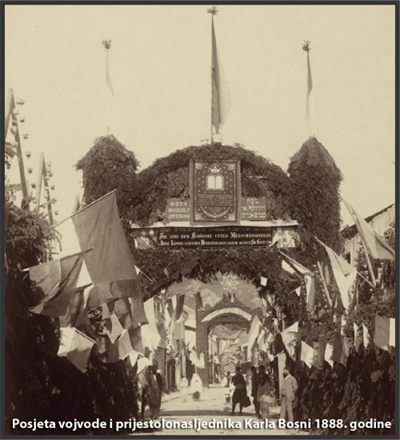
With the sound of the royal fanfare on the ground of Bosnia and Herzegovina, the Crown Prince, Duke of Austria Rudolf Francis Charles Joseph (Rudolf Franz Karl Joseph, Crown Prince of Austria, 1858-1889), son of Emperor Franz Joseph I, and his wife Princess Stephanie of Belgium (Stéphanie de Saxe-Cobourg et Gotha, 1864-1945), were ceremoniously welcomed in Bosanski Brod. On June 10, 1888, they began their joint journey to Sarajevo aboard a special royal train of the Bosnian Railways. The residents of Sarajevo warmly and generously greeted the distinguished guests on June 13, 1888, winning many friends, especially Princess Stephanie. Their stay in the “fairy-tale” Bosnia and Herzegovina lasted a full fifteen days, until June 25 of the same year. During their visit, they toured the newly opened National Museum in Sarajevo. Viewing the exhibits—from prehistoric collections to Roman artifacts found in these regions, as well as parts of the Medieval Bosnia and Ottoman-era collections—they could not hide their immense excitement and satisfaction with what they saw. On this occasion, Duke Karl and Princess Stephanie praised the staff and many collaborators of the museum, headed by Director Kosta Herman. This state institution was established on February 1, 1888, and was housed in the Pension Fund building near the Cathedral. According to the plans of architect Karl Paržik, a modern building for the National Museum of Bosnia and Herzegovina was constructed, officially opening to the public on October 4, 1913.
Benjamin Kalaj during the second wave of the occupation of Bosnia and Herzegovina
With the official opening of the bridge at full capacity in September 1884, the planned goal of establishing a strategic railway connection between the monarchy and the Bosnian valley to Sarajevo was achieved. This marked the end of the “first wave” of occupation. Based on the so-called Bosnian Law (Law on the Administration of Bosnia and Herzegovina in 1880), it was established that the future costs of the occupation system had to be covered by the occupied country’s own revenues. In practice, to make further investments in infrastructure, funds had to be secured for the maintenance of the occupying authorities.
The joint Ministry of Finance in Vienna established the Bosnian Bureau, which de facto managed Bosnia and Herzegovina. At the head of this bureau, on June 4, 1882, Benjamin Kalay was appointed (Hungarian: Kállay Béni, provincial governor of Bosnia and Herzegovina, 1839-1903). Kalay’s administration was guided by the motto of elevating the purchasing power of the Bosnian market for products of the Monarchy and creating conditions for the exploitation of the natural wealth of the occupied land. He saw the possibility of securing budget revenues in the wealth of Bosnian forests, coal mines, and other minerals. For Benjamin Kalay, Bosnia was not unfamiliar. Even while serving as Austro-Hungarian consul in Belgrade (1868-1875), he traveled extensively throughout Bosnia. In 1872, enjoying diplomatic immunity, he traveled through major towns, visited tourist attractions, river and mountain resorts, carefully noting local customs and collecting useful information about the political situation in the host country. His good knowledge of Turkish, Croatian, and Serbian languages was most helpful, as his mother came from the Magyarized Serbian family Blašković.
In order to transport the cut-down forest to the final customer, suitable transportation infrastructure had to be built. Kalaj also found a model for this. In most cases, based on the annuities for repaying bank loans used to finance the construction of railway lines, he identified interested companies that were organizationally and financially capable of engaging in the exploitation and processing of timber and the extraction of larger-scale ores. The national government committed to building appropriate infrastructure, and most of the funds were obtained through advances, payment of tolls, and annual fees from companies that, through long-term contracts, generated substantial financial gains from the exploitation of state lands.
In the exploitation of forests, mines, and railway work, tens of thousands of workers were needed. Skilled labor was brought in from European countries, while unskilled labor was local. Budget revenues, since Kalaj took command of the Bosnian bureau in 1882 up to 1910, increased ten and a half times. The development of economic activity during the “second wave” of occupation contributed to the social transformation of the population, raising their cultural, educational, and health standards. All of this also influenced the faster development of urban centers. These are facts that cannot be ignored because the increase in budget revenues achieved significant goals: employment for the population and revenue generation to support the occupying authorities and invest in infrastructure.
Most and the railway traffic that operated across it enabled the economic prosperity of both Brods. Thanks to the traffic across the bridge, sawmills of the Vienna banks established in Brod on the Sava received cheap raw materials for processing. In addition to the timber industry, which served as the backbone of the economy, the construction materials industry (brickyards), the milling industry, and the alcohol industry were also developed. With the influx of impoverished people from Bosnia, the price of labor decreased. Furthermore, livestock fairs on the Slavonian side became a gathering place for traders from Austria and Hungary, and later, in the Kingdom of Serbs, Croats, and Slovenes—Yugoslavia.
Bosanski Brod has a loading ramp for transferring several hundred workers, long magazines, and facilities for an oil refinery. The Oil Derivatives Factory in Bosanski Brod, a joint-stock company for the chemical industry “Danica” (Mineralölprodukte Fabrik in Bosanski Brod der “Danica” Aktien-Gesellschaft für chemische Industrie), was founded in 1893. The factory processes about 1,500 “vagons” of crude oil annually into products for various purposes such as gasoline, lubricants, cylinder oils, and paraffin. The production of finished products is carried out using installed facilities: six steam boilers, five steam engines with 120 horsepower, seventeen steam pumps, two dynamo machines with batteries, and two diesel engines with 200 horsepower. All products are exported to Germany, England, Italy, Switzerland, France, Bulgaria, Brazil, Persia, Serbia, and Turkey. The factory is connected to the railway station by two pipelines, an industrial track, and telephone wire. The headquarters of the management is located in Budapest, headed by General Director Adolf Schwarz, while the factory in Bosanski Brod is managed by Adolf Grünberger.
A few hundred meters south of the Sava, in 1896, a railway station was built in Mauresque style, its interior decorated with lavish woodcarving featuring arabesques and quotes from the Qur’an. It was constructed based on plans by the Czech architect Hans Neimezcek. The following year, in 1897, it was ceremoniously opened with great pomp and celebration, attended by important gentlemen from Vienna and Budapest, as well as representatives of the new Bosnian authorities and representatives of all three religions, who graciously called it ‘divine will’.
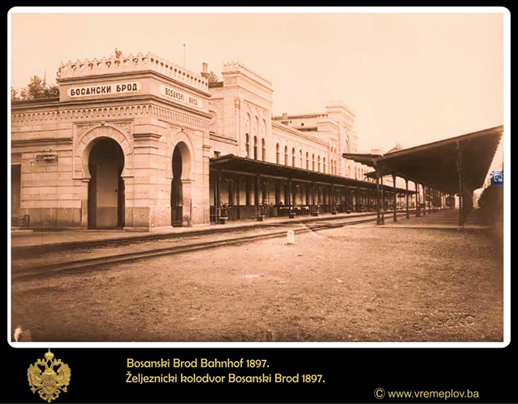
Having received orders from the Vienna Court and the resources to develop plans and drafts, the architect traveled far to the east in search of inspiration for this great and valuable project. In Afghanistan, in the city of Mazar-e Sharif, he saw the fascinating structure known as the Blue Mosque (the Shrine of Hazrat Ali Mazar-e Sharif). Enchanted by the craftsmanship of his Eastern colleagues, Hans Neimezcek immediately knew how to satisfy His Majesty and all investors with an unprecedented approach—then quite popular—namely the pseudo-Moorish style. He spent two years in Sarajevo, working on his life’s masterpiece, blending these exotic and rugged worlds through the precise beauty of the future building.
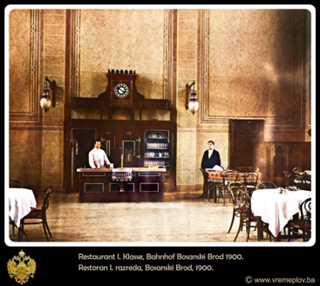
This building, named after the Austrian Ministry of Railways, “Gate of Bosnia,” has become a motif for illustrating tourist brochures as a “document” of religious and national tolerance in the countries under the imperial crown.
A tourist visit to the occupied “Imperial” Bosnian province will be attended by high-ranking officials from the Imperial residence, expert excursions from the fields of science and culture, followed by renowned writers and artists eager to explore Sarajevo, the “city of palaces,” a city of mixed architectural styles, a city almost more oriental than many cities in the heart of the Orient itself. During the visit to Sarajevo from May 12 to 16, 1894, Archduke Charles Albert of Austria-Tuscany will arrive by train from Bosanski Brod. The purpose of the visit is to observe the construction progress of the Church of Saints Cyril and Methodius in Sarajevo, which he had financially supported multiple times. The church has been constructed since 1891 and was consecrated on July 8, 1896.
Archduke Rainer (1827-1913), a member of the Habsburg-Lorraine dynasty and son of Archduke Rainer (1783-1853), and nephew of Franz II and the mother Elisabeth of Savoy (1800-1856), will visit Sarajevo on October 8, 1898.
Bosanski Brod will remain one of the main gateways of this region to the rest of Europe, and given the development of railway and road lines, it will maintain that role until the late 1950s due to the construction of the standard gauge line from Šamac to Sarajevo, or the new railway section Doboj to Banja Luka (1953), which leads towards Zagreb and Western Europe. The name “Gate of Bosnia” will definitively lose its significance in the late 1970s with the abolition of railway traffic on the Bosanski Brod – Doboj line.
Annexation of Bosnia and Herzegovina and the Emperor Franz Joseph I’s second visit
On October 6, 1908, the Austro-Hungarian Monarchy carried out the annexation of Bosnia and Herzegovina. Over the past thirty years, significant financial investments had been made into its infrastructure: road and railway constructions, as well as the building of schools, hospitals, and other social institutions. The imperial court grew fearful of losing everything they had invested due to the sudden unrest in the local political scene within the multiethnic provinces. This fear was amplified by the political movement of the “Young Turk Revolution” in the Ottoman Empire, which among other things demanded a revision of the political situation in Bosnia and Herzegovina. As the annexation escalated into a serious political crisis and brought Europe to the brink of war, the crisis was finally resolved when Austria-Hungary paid the Ottoman Empire an amount of two and a half million Turkish lira and also had to make some concessions. This effectively ended the Ottoman Empire’s centuries-long rule over Bosnia and Herzegovina. In a proclamation to the people of Bosnia and Herzegovina, Emperor Franz Joseph I announced his decision to grant them autonomy and a constitutional regime, under his sovereignty. In a subsequent proclamation to the population, where he promised that a constitution would be soon realized, it was stated that the Imperial Constitution (statute) for Bosnia and Herzegovina was solemnly proclaimed in the grand hall of the Imperial Government in Sarajevo on February 20, 1910.
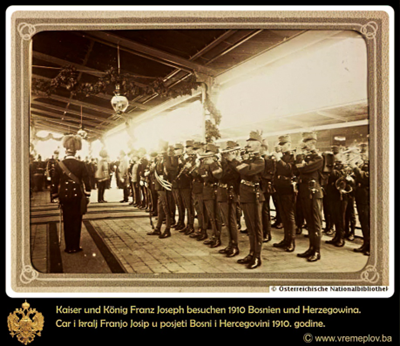
On the morning of May 30, 1910, Emperor Franz Joseph I stepped onto the land of Bosnia and Herzegovina for the second time. In Bosanski Brod, among other dignitaries, he was once again welcomed by the same mayor, Mehmed Hafiz ef. Hodžić, after 25 years. The emperor began his journey to Sarajevo aboard a private royal train operated by the Bosnian Railway from Bosanski Brod. At 3 p.m., he arrived at the “Tabak Fabrik” train station in the Marijin Dvor neighborhood (“Marien Hof”) in Sarajevo, accompanied by the firing of cannons from a nearby hill. The splendid procession in carriages, men in golden uniforms, imposing guards, elegant uniforms of court officials, and magnificent horses from the imperial stables—all left a striking impression on those present. On the second day of his stay in Sarajevo, in the City Hall, he signed a decree (a proclamation, an imperial order) establishing the Bosnian-Herzegovinian Parliament, which was to convene on June 15, 1910. Additionally, by this act, the emperor appointed Alibeg Firdus as the President of the Bosnian Parliament, with Vojislav Šola and Dr. Nikola Mandić serving as vice presidents.
Two Ferries on the Sava River during World War I
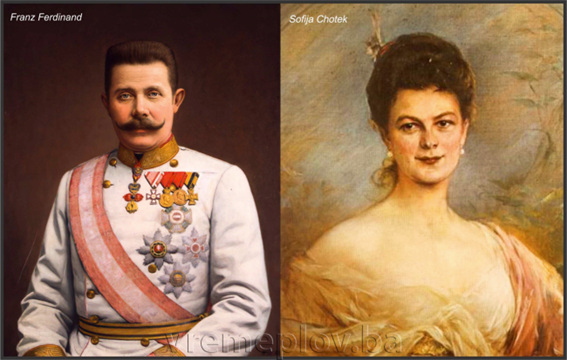
Bosanski Brod and Brod on the Sava hold a strategic position at the intersection of land, water, and railway routes, making them a crucial point for maintaining the Monarchy’s presence in Bosnia and Herzegovina concerning a potential southeastward advance, which indeed occurred during World War I. The trigger for World War I was the Sarajevo assassination, in which Gavrilo Princip, a member of the organization Young Bosnia, killed Austro-Hungarian heir to the throne Archduke Franz Ferdinand (Franz Ferdinand Karl Ludwig von Austria-Este, 1863-1914) and his wife, Duchess of Hohenberg Sophie Chotek (Sophie Maria Josephine Albina Chotek, Countess of Chotkova and Wognin, 1868-1914). This event marked the beginning of the first global conflict in human history, shaping the fates of millions of people. In the times to come, both Brod on the Sava and Bosanski Brod would face hardships and suffering, both human and material.
The year 1914 was a terrible time—poverty and hardship on both sides. There were no workers available for heavy labor because healthy men were at the front lines. The land remained uncultivated, and crops went unplanted due to a shortage of horses and people. Yields were average at best, affected by floods, frosts, and dry days. Rationing of food and other supplies was introduced, with maximum prices set for certain products. Despite regulations and penalties—both fines and imprisonment—for violations, an illegal market emerged, fueled by shortages and rising food prices. Traders, innkeepers, and shopkeepers quickly became wealthy in a short period, all at the expense of the people who had sold horses, carts, plows, oxen, mules, and donkeys to support the war effort.
Special committees for the protection of families were established, mobilized even during the war of fallen soldiers. Both Brods—those at the gates of Bosnia—demonstrated their ability for good communication. Many trains carrying starving and exhausted children, war orphans from Bosnia and Herzegovina, were welcomed in Brod on the Sava regardless of religion or nationality. They stayed there for a short time, were clothed, fed, and then sent to foster families in other parts of Slavonia, Podravina, Srijem, Bačka, and Banat.
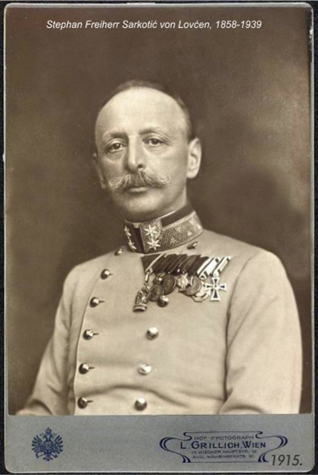
Thousands of soldiers, injured, and refugees threatened by war, hunger, and poverty arrived by train from Bosnia and Herzegovina. With the arrival of soldiers and wounded from the southeastern front, they brought dangerous infectious diseases, especially cholera, typhus, and dysentery. Most of the sick were treated at the City Hospital in Brod on the Sava, while others were transferred and treated in the lower administrative regions of Slavonia and Požega counties. To minimize the time the infected spent on the platforms of both Brod stations and to reduce contact with staff and civilians in the city, they were directly transported by narrow-gauge train to the sanatorium of the City Hospital in Brod on the Sava. On the order issued by Baron and Austrian Feld marshal and commander of military forces in Bosnia and Herzegovina, Stjepan Sarkotić (Stephan Freiherr Sarkotić von Lovćen, 1858-1939), in early 1915, a narrow-gauge railway line was constructed from Bosanski Brod to Sibinj station, spanning 9 kilometers. During the military mobilization and prior to the outbreak of the Balkan Wars in 1912, a strategic plan was developed for the future construction of a narrow-gauge line connecting Bosanski Brod, Brod on the Sava, and Sibinj. This built railway was partially implemented through the integration of narrow and standard gauge tracks from Bosanski Brod, across the railway bridge, up to the Brod on the Sava station. The rest of the narrow-gauge line was built up to Sibinj station with several siding tracks. The track gauge was up to 2.5 meters wide, with rails weighing 22 kg/m, designed to bear loads of up to 1200 kg per square centimeter. The minimum curve radius was 100 meters, with a maximum permissible speed of 12 km/h. This entire section was primarily constructed for military strategic reasons—to quickly evacuate locomotives and wagons of the Bosnian-Herzegovinian State Railway (BHLB) in case of an attack from Serbia or Italy on Bosnia and Herzegovina. What an irony! With this narrow-gauge railway, the leader and supreme commander for Bosnia and Herzegovina, Stjepan Baron Sarkotić, would take his last journey—on November 6/7, 1918—to the station in Brod on the Sava, and then, by standard gauge, to Zagreb as a prisoner of war.
On November 21, 1916, Emperor and King Franz Joseph I of Austria-Hungary (Franz Joseph, 1830-1916) died. During his reign, following the suicide of his son, Crown Prince Rudolf Franz Karl Joseph in 1889, he designated his brother-in-law Franz Ferdinand as his successor. After the assassination of Archduke Franz Ferdinand in 1914, he appointed his nephew Karl Franz Joseph Ludwig (1887-1922) as heir apparent. Following the death of Emperor and King Franz Joseph I, Karl became the Emperor of Austria (as Charles I of Austria) and was crowned as the Apostolic King of Hungary (as Charles IV of Hungary).
The End of the First World War and the Capture of General Stjepan Sarkotić in Brod
As the end of the war approached, it became evident that the Austro-Hungarian Empire would not survive. The Hungarian Prime Minister, Count Stephen Tisza, in September 1918, while traveling through the South Slavic lands of the former empire in his uniform as a colonel, also visited Sarajevo. During his journey, he sought information about the political aspirations of the peoples in these regions and aimed to influence the leadership of various parties regarding the future organization of the Austro-Hungarian Monarchy. On September 20, 1918, the leaders of the Serbian and Croatian parties in Sarajevo presented him with the well-known Memorandum advocating for the unification of Bosnian Serbs and Croats and for rejecting the imperial manifesto which stated that Bosnia and Herzegovina did not wish to be an Austrian federal part of the Monarchy.
At the beginning of October 1918, the National Council of Slovenes, Croats, and Serbs was established in Zagreb as the supreme political representative body of these peoples within the Austro-Hungarian Monarchy, with the program of unification and the creation of an independent state in the South Slavic lands of the Monarchy. Representatives from Bosnia and Herzegovina were present in this council. The imperial manifesto on the federalization of the Austrian part of the Monarchy was rejected, and the demand was made for unification across the entire ethnographic territory, regardless of the provincial or national borders in which these three peoples lived. On October 26th, in the City Hall of Sarajevo, the proclamation of the People’s Council for Bosnia and Herzegovina on unification was adopted. Following the program of unification on October 29th, 1918, a momentous event unfolded for the entire Croatian nation. That day, from the Assembly Hall on Markov Square, the Croatian Parliament proclaimed the conclusion that all existing political and legal relations between the Kingdom of Croatia – Slavonia – Dalmatia on one side, and the Kingdom of Hungary and the Austro-Hungarian Empire on the other, were to be severed. Croatia, Slavonia, Dalmatia, and Rijeka declared themselves an independent state and equally joined in the common sovereign народ (people’s) state of S.H.S. After the events in Sarajevo and Zagreb, declarations were also made in Ljubljana for Slovenia and in Zadar for Dalmatia.
Soon, neighborhood committees of the People’s Council were established in larger towns, including both Brods, with the primary task of maintaining order and peace, as well as safeguarding private and state property. In agreement with civilian and military authorities, People’s Guards were organized to secure the city. This was especially important due to the escapees from Austro-Hungarian units, referred to as “deserters,” “prisoners,” and “Shatrovci,” known collectively as the “Green Cadre,” who largely looted villages and were moving closer to Bosanski Brod and Brod on the Sava. To make matters worse, military doctors are leaving hospitals, and disturbing news comes from the epidemiological hospital, where not a single doctor remains.
After the disbandment of the hospital and other military ambulances in both Brod, chaos ensued. Soldiers without leadership or weapons, patients, prisoners (Italian, Russian, and Serbian, according to the note), and refugees, both bare and destitute, some heading into Bosnia, others crossing from Bosnia over the Iron Bridge. Likewise, it is evident that the Austro-Hungarian army was retreating from the Balkan battlefields without the necessary permits and arrangements (disorder), along with the general retreat of Austrian officials from the occupied territories. Everyone was rushing recklessly, not caring about train schedules. On foot across the bridge to the Slavonian coast, then onward on foot toward Austria.
At the beginning of November 1918, news arrived that former military governor of Bosnia and Herzegovina, General Stjepan Sarkotić, was coming to Bosanski Brod by train from Sarajevo with four freight cars and 500 armed soldiers. On November 1st, General Sarkotić handed over power to the People’s Council for Bosnia and Herzegovina, and by November 6th, he left Sarajevo, heading the same way that General Josip baron Filipović had taken forty years earlier. The People’s Council of the State of Serbs, Croats, and Slovenes (SHS) in Zagreb ordered that the general and his troops be disarmed and that the general be transported to Zagreb. Fearing that the general might resist disarmament, and with the help of the people’s guard, all available armed forces in Brod were quickly assembled. It was planned that if negotiations over disarmament failed, mines would be placed on the bridge to prevent entry to the Slavonian side. Negotiations took a long time in the restaurant of the Bosnian railway station. Later, the general agreed to the terms set, and with his officers, he was transported by train across the bridge to the Brod station. The journey in the narrow-gauge salon carriage of the Bosnian State Railways, with officers led by the general and the former head of Bosnia, marked the end of Austria-Hungary’s rule in Bosnia and Herzegovina. Subsequently, accompanied by a captain and thirty Serbian soldiers, he was dispatched from Brod na Savi station via special train to Zagreb.
Soon after this event, a Serbian company arrived in Brod na Savi, led by a colonel. At this reception for the Serbian army on Croatian soil, with three decorated flags at the front of the soldiers and military music playing “Bože pravde” followed by “Lijepa naša domovino,” the citizens, with enthusiasm and gratitude, cheered loudly, praising and celebrating this moment.
On December 1, 1918, the unification of the independent State of Slovenes, Croats, and Serbs with the Kingdom of Serbia was proclaimed, forming a unified Kingdom / Kingdom of Serbs, Croats, and Slovenes within new borders.
After the declaration, life in both Brod na Savi gradually returned to normal. With the return of some of the male workforce from the frontlines, businesses and small trades with shops, which had been operating before the war, began a new phase of activity and development. Alongside the economic revival, the educational, cultural, and social life in both towns was revitalized.
Economic Development and the Visit of the Regent/King to Dva Broda on the Sava and Bosnia and Herzegovina
After World War I, as a response to the need to alleviate the difficult condition of the state railway rolling stock and traction fleet, the first factory for wagons, machinery, and bridges was established in Brod na Savi in 1921. The town of Brod na Savi (later Slavonski Brod) was chosen for its ideal location on the Sava River, which is navigable, and for its railway connection to Belgrade in the east, Zagreb in the west, Sarajevo and Dubrovnik in the south. After World War II, in 1947, the factory was renamed in honor of Yugoslavia’s national hero, Đuro Đaković.
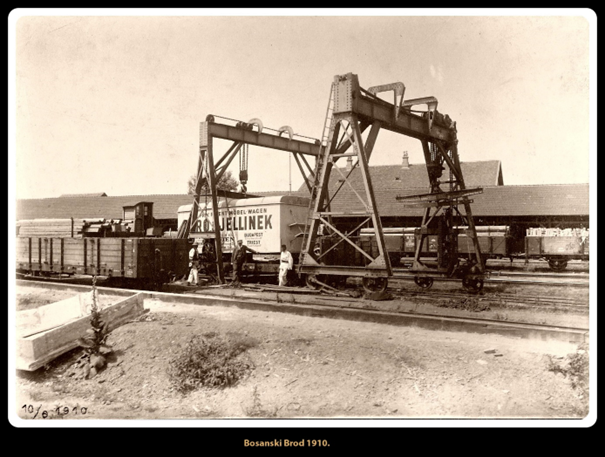
Additionally, the Bosanski Brod Oil Refinery has come under state ownership, and new, higher-capacity processing facilities have been built and renovated. By 1927, it transferred from state ownership to the ownership of the “Standard Oil Company”, which also installed distillation equipment alongside the oil refinery. Certainly, with the development of industry in both Brods on the Sava River, they became the main driving force behind the economic growth of the entire region and beyond.
Another event of great significance in the history of Brod na Savi took place on March 16, 1934. On that day, a session of the city assembly was held, during which city representatives decided to officially rename the city from Brod na Savi to “Slavonski Brod.”
The first visit of Bosnia and Herzegovina by the Karađorđević dynasty took place on September 21, 1920, by Regent Crown Prince of the Kingdom of Serbs, Croats, and Slovenes, Alexander I Karađorđević (1888-1934). From Belgrade, he traveled by road, arriving in Doboj via Zvornik. After a short stay and the playing of the national anthem, he transitioned into a court procession on a narrow-gauge track and began his journey toward Sarajevo. Throughout the entire trip to Sarajevo, starting from Doboj, Maglaj, Zavidovići, Žepče, and Zenica, he was greeted by a crowd of enthusiastic people, manifesting their gratitude and love for their “new” ruler. Upon arriving in Sarajevo, the court procession stopped at the same place, in front of the tobacco factory at Marijin Dvor, where ten years earlier, Emperor Franz Joseph had arrived. After the military band played the national anthem, he shook hands with the President of the Bosnian government, Dr. Milan Srškić (1880-1937), and then entered a luxuriously decorated and ornamented pavilion— the same pavilion where Emperor Franz Joseph once stepped in, where the most distinguished citizens of Sarajevo had gathered.
The second visit to Bosnia and Herzegovina and Sarajevo by the then-King of the SHS/Yugoslavia, Alexander I Karađorđević, took place on April 18, 1925. He spent his free time and celebrated Easter at the royal residence in Ilidža, together with his wife, Queen Maria of Romania (1900-1961).
World War II – The Bridge Destruction and Bombing of Two Brods on the Sava River
The iron bridge between the two Towns has experienced several severe destructions and rapid repairs. During World War II, it was completely destroyed three times and was damaged multiple times. On April 12, 1941, a group of Yugoslav soldiers blew up the iron section of the bridge, disregarding the capitulation of their generals. During the same period, two other bridges were also destroyed: the bridge over the Vrbasa River near Donji Vakuf (at km 59+670) and the bridge over the Pliva River near Jajce (at km 33+450). The situation of the destroyed bridge on the Sava was assessed, and it was found that the pillar at Ada (no. 4) was completely demolished to the foundation, with the neighboring pillar partially damaged. The second, third, and fourth bridge spans were destroyed, bent, and partially lying in the Sava. The Ministry of Home Defense of the Independent State of Croatia issued an urgent order to repair the bridge as quickly as possible for traffic.
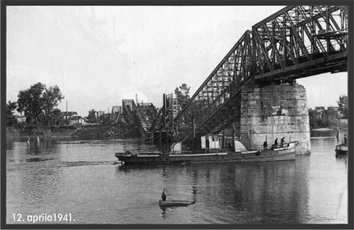
The work began on May 25th of the same year and continued uninterrupted for about three months under the joint leadership of the Directorate of the Croatian and German State Railways – Deutsche Reichsbahn, Reichsbahndirektion Wien (Sonderdezernat für Brücken-Sitz Marburg) and the organization “TOT” (Organisation Todt, OT), a German military-civilian construction organization. After the occupation, they forced captured railway workers, shipyard workers, peasants from Poloj and Vinska, and entire columns of war prisoners into forced labor. While the work was ongoing, food and grains were transported via regular rail routes to the company “Ditad” on the Sava River bank, from where they were directly transferred onto barges and shipped towards Bosanski Brod. After a swift reconstruction, armored trains, transport of cannons, shells, and military forces of Germany and NDH, along with gangs of butchers and arsonists of all kinds of uniforms and insignia, passed through day and night into Bosnia.
From Bosnia and Herzegovina, various goods were transported by freight trains, among which bauxite ore held particular strategic significance. Bauxite was the main raw material in aluminum production, essential for wartime manufacturing of German aircraft.
In its short history, this iron bridge experienced one of the saddest moments of its existence. Trains carried thousands of displaced Jews and other nations across it to death camps, on a journey from which there was no return. Many were transported in enclosed wagons that had been used for animals, without water or food, to the NDH camps and labor camps across the Third Reich.
Both Brods, during World War II, were bombed over fifty times, and not a single bridge was missed. The bombs of the largest size and weight embedded themselves in the water, causing the structure to tremble. Allied bombings lasted from April 1944 to March 1945. To the Allies, Bosanski and Slavonski Brod were simply “Brod,” and in their reports for certain attacks, they would write “Brod/North” or “Brod/South”. The targets within the territory of both Brods included a petroleum refinery, railway marshalling yards and passenger stations, a factory for locomotives and wagons, and the very steel bridge over the Sava River.
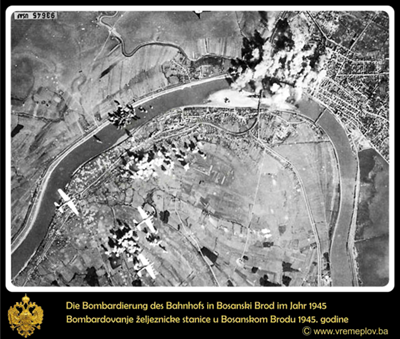
The heaviest bombing of Both Bosanskski Brod took place on January 19, 1945. After the flying fortress bombers flew overhead, releasing their deadly payload from their bellies, they left behind terrible images of terror, destruction, and tragedy—both in human casualties and in immense material damage. Some parts of the town completely vanished after the bombing. In early April 1945, the German field command in Bosanski Brod issued an order to destroy the bridge. The order was given to an ambitious, short-sighted non-commissioned officer (NCO) reservist to cross to the Slavonian side and blow up the bridge as soon as the last German and Ustaše units left Bosnia. As news quickly spread that Vrpolje, Andrijevci, Garčin, and other places in eastern Slavonia had fallen into the hands of the Yugoslav Partisan Army, it immediately seemed to that NCO that Partisans were coming and advancing on the town. Out of fear and suspicion, a dynamite shrapnel machine was put into action, triggering a tremendous explosion that shattered windows several kilometers away, accompanied by the deafening screams and wails of numerous German soldiers, burying them in the water along with pieces of tracks and torn crossbars. About a hundred Gestapo members encountered the Partisans on the Bosnian side on April 17, 1945, and surrendered there. To prevent them from reaching the Slavonian coast, the railway workers of Bosanski Brod prevented them from using boats. After three days of fighting, Slavonski Brod was liberated on April 20/21.
Reviving the land and building a new bridge between the two Brods
Following the post-war elections and the session of the Constitutional Assembly on November 29, 1945, the Karađorđević dynasty was overthrown, and the Federal People’s Republic of Yugoslavia was proclaimed. All power in the country was held by the Communist Party of Yugoslavia, led by Marshal Josip Broz Tito. Since Yugoslavia was geopolitically and organizationally divided into six republics and two autonomous provinces, Bosanski Brod was assigned to the Republic of Bosnia and Herzegovina, while Slavonski Brod belonged to the Republic of Croatia. Throughout the entire country, efforts were launched to rebuild the land, with the greatest contributions to this reconstruction organized through Youth Labor Actions. By the end of 1945, many destroyed bridges had been restored, and railway lines and roads were made operational for traffic. After meeting the basic conditions for post-war reconstruction, the country began implementing the First Five-Year Plan, with industrialization and electrification serving as the foundation for this goal. During the plan, many major economic facilities were completed, including the restoration and modernization of the “Đuro Đaković” factory and the Bosanski Brod Oil Refinery.
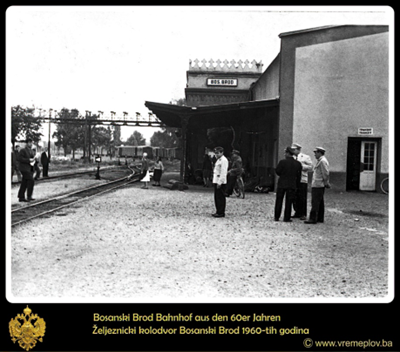
Since the iron bridge between the two Brods was immediately demolished, work on its reconstruction began right away. In fact, a temporary, upstream bridge with a lattice structure supported by wooden trestle piers was constructed. This bridge served its purpose to some extent in railway traffic, with trains running cautiously and at reduced speeds. Because of the significant safety risk to traffic, it was decided that a new bridge should be built. In 1957, construction began, marked by the arduous task of removing leftover unexploded bombs and extracting bent, rusted beams and girders. Several domestic manufacturers, including the “Đuro Đaković” industry from Slavonski Brod, built an impressive concrete and steel structure at the site of the previous bridges. The reinforced concrete parts and the lower machinery were produced by “Mostogradnja” from Belgrade. This third bridge, measuring 525.21 meters in length and incorporating over 1,260 tons of steel structure, would span the Sava River, connect the two Brods, and be officially opened in 1961.
With the construction of the bridge, a connection will be established between the two Brods, linking Bosnia with Croatia and other parts of the country through an exchange of goods that will become more extensive and efficient. Thousands of Bosnians employed in Slavonski Brod will cross the bridge by car and bus, while others will travel along the wide tracks of the new bridge by train. Many Slavonians, high school students studying in Bosanski Brod—so-called “vlakaši” or “vozari”—will transport themselves over the new bridge with their homework, school troubles, and the beginnings of their first love letters, unaware of the storms and tempests that had shaken the foundations of earlier bridges. The changing visage of the two Brods at that time, evolving faster than ever before, complemented the sleek lines of the new structure, equally cherished and needed by the Bosnians and Slavonians of this area. The narrow-gauge trains slowly moving along the temporary bridge will remain only in the memories of railway workers from both Brods. As the narrow tracks proved unprofitable, they were discontinued: from Doboj to Derventa on May 1, 1968, and from Derventa to Bosanski Brod on June 1, 1969. The new bridge between the two Brods will retain the standard-gauge railway line, which will serve as an industrial track for the needs of the Brod refinery. Since 1947, the role of the primary standard-gauge railway corridor connecting Bosnia and Herzegovina with Croatia has been taken over by Slavonski Brod and Bosanski Šamac—the towns connected by a railway and road bridge across the Sava River.
Visit to Two Bridges on the Sava River of Marshal Josip Broz Tito
The years that followed for both towns began with rapid modernization based on the foundation of worker self-management. Over several decades, the development of worker self-management yielded tremendous results both in the economic sphere and in raising the standard of living. This growth enabled faster employment, better healthcare, education, and increased access to culture for broader segments of the population. In both cities, construction operations were expanded, and mass urbanization took place, resulting in the construction of several thousand social housing units.
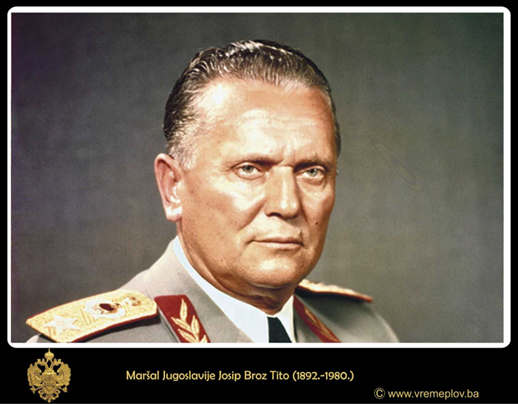
President Josip Broz Tito visited both Brods (Brods on the Sava) multiple times. Slavonski Brod hosted the president on May 17, 1953; February 12, 1955; April 17, 1964; May 26, 1967; and August 2, 1970. Bosanski Brod welcomed him on November 4, 1968. According to the protocol, organized as part of the high guest reception program, alongside the hosts as organizers, were also the city and political leaders of the neighboring “brotherly” municipality. For President Tito, both Brods were one urban and industrial entity divided by the Sava River but connected by a steel bridge—symbolizing prosperity and a comfortable life for all residents of Brod, as well as for all nations and nationalities of this region and beyond.
Political crisis and the proclamation of independence of Croatia and Bosnia and Herzegovina
Years after Tito’s death, on May 4, 1980, Yugoslavia was at a crossroads of political conflicts and confusion. Workers’ self-management was under serious scrutiny because it had not fulfilled its promised goals. The economic policies of the individual republics made decisions in their own interest, paying little attention to the economy of the country as a whole. The Party (the League of Communists of Yugoslavia), which controlled the instruments of power and held governing influence, was divided between regional loyalties and conflicts between reformists and conservatives. This division ultimately led to decentralization and economic stagnation, which awakened old national jealousies. Amid these upheavals, three major religions, closely tied to ethnic traditions, entered the political scene from the shadows, with nationalism often intertwined with religion.
With the fall of the Berlin Wall at the end of 1989, the division of Europe into blocs came to an end, marking the beginning of democratization in Eastern European countries. These events would not bypass socialist Yugoslavia. Gradually increasing nationalism led to a general crisis in Yugoslavia and the collapse of the communist system. The League of Communists started to disintegrate along federal lines. Throughout 1990, in most federal republics, communists lost in the first multiparty elections. Following the adopted declarations, during 1991 and 1992, four republics declared independence, leaving Serbia and Montenegro in the federation, effectively ending the existence of SFR Yugoslavia. Serbia and Montenegro opposed these republics’ independence and sought a final solution to the status of the Serbian minorities in the newly formed states. As the Serbs in Croatia and Bosnia and Herzegovina aimed to remain in Yugoslavia—territorially where they had already been living predominantly—they proclaimed the Republic of Serbian Krajina in Croatia and the Republic of Serbian Krajina in Bosnia and Herzegovina. Following a series of inter-ethnic incidents, armed conflicts erupted from 1991 to 1995, becoming the bloodiest warfare on European soil since the end of World War II.
The loss of Bosanska Posavina and the destruction of the bridge between the two Brods
Before the outbreak of war, during Yugoslavia, the bridge connected the two Posavinas, the Croatian and the Bosnian one, into a single community. Because many families were economically linked and had members on both sides, Slavonski Brod, by a twist of fate, would become involved in all the wartime events in Bosanska Posavina. In March 1992, the first armed clashes began in these areas, quickly spreading throughout Bosnia and Herzegovina and soon turning into a four-year war.
Bosanska Posavina, where Bosanski Brod was located territorially, was a very important target for the members of the RS Army because, by controlling this area along the Sava River, they would have a direct corridor connecting Serbia with all the occupied territories from Bosnia to Croatia. Multi-day airstrikes by JNA aircraft began on Bosanski Brod, dropping bombs on the entire city and targeting the iron bridge with rockets. The destruction of both Brods was significant, aided by artillery fire. Dozens and hundreds of Brod residents were killed and wounded. Thousands of refugees crossed the bridge—some into Bosnia, others fleeing from Bosnia. Slavonski Brod bore the greatest burden, accepting thousands of Croatian refugees from many villages and settlements in Bosanska Posavina that had been ethnically cleansed. Bosanski Brod was defended by two Croatian Defense Forces brigades from Slavonski Brod and one from Osijek, along with a brigade from the HVO (Croatian Defence Council) from Bosanski Brod.
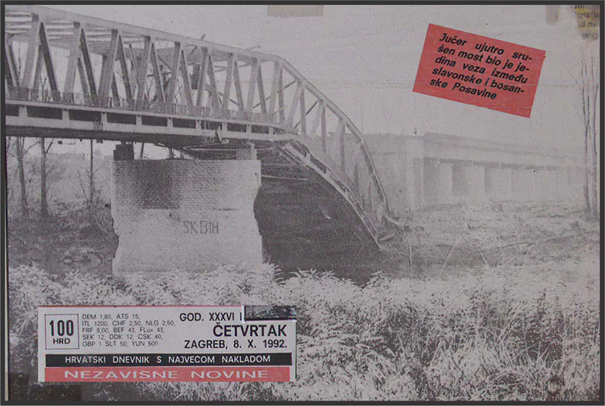
The iron bridge between the two Brods was a key military strategic point on the Bosnian Posavina battlefield. During the period of occupation and blocking of the bridge, it was mostly closed to vehicle traffic, though pedestrians could pass after prior verification. Vehicle and railway traffic flowed between Slavonski Brod and Bosanski Šamac. After it was mined and completely destroyed on April 22, 1992, the bridge between the two Brods remained the only functional bridge over the Sava River. Before the military fall of Bosanski Brod, the bridge played a significant humanitarian role, enabling the rescue of thousands of people threatened by war. On the morning of October 7, 1992, just before Bosanski Brod fell, Croatian Army engineers detonated explosives to destroy the bridge. The explosion that morning awakened citizens with a deafening blast from the demolition, so powerful that windows and doors were blown out of walls, roofs were shattered, and glass broke in the wider city area. With the destruction of the bridge, the front line up to the Dayton Agreement remained mostly peaceful and without major conflicts.
Bridge reconstruction in 1999-2000
During the war in Croatia and Bosnia and Herzegovina, all the bridges over the Sava River were severely damaged. Nearly all of Bosnia and Herzegovina’s traffic with other European countries flowed across these bridges. Due to disrupted traffic flows, it is understandable that restoring the bridges over the Sava River is a fundamental prerequisite for the upcoming economic recovery, both for Croatia and for Bosnia and Herzegovina.
Immediately after the war, the reconstruction of the bridge between the Two Brods began, with the steel truss span partially repaired and temporarily opened for traffic. These temporary repairs were carried out by Hungarian soldiers serving as part of UNPROFOR. Only in 1998 did the final reconstruction start, following a special order from the Ministry of Maritime Affairs and Communications, which established the transfer of all investor and other responsibilities from the Croatian side and from the USAID donation (United States Agency for International Development). The work was entrusted to the American company Parsons, which subcontracted the work to a consortium of domestic builders, including Đuro Đaković-Montaža d.d. from Slavonski Brod, Industrogradnja d.d. from Zagreb, and the Transport Equipment Factory (TTU) from Tuzla.
Construction began in March 1999, and the bridge was restored to its original appearance, but only for road traffic—specifically, two lanes each 3.25 meters wide and two pedestrian walkways, 1.00 meter wide. The reconstruction of the bridge definitively eliminated any possibility of railway communication, so after 120 years (1879–1999), railway traffic was permanently discontinued. Otherwise, the railway line across the bridge, before the outbreak of the war, served only as an industrial track for the refinery in Bosanski Brod. The restored bridge was reopened to traffic in March 2000.
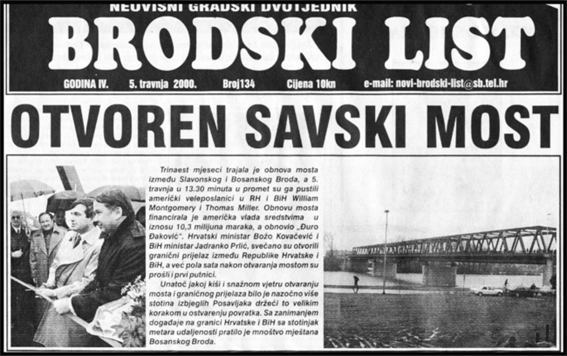
Today, these two cities share a national border and everything that the recent war left behind. Life in both Brods is quite different from before the war, as they are no longer the ‘brotherly’ towns they once were. In Bosanski Brod, there are no longer pre-war residents. The population has dispersed, changed both in size and nationality. Local authorities in both Brods emphasize that neighborly relations are good and that they maintain a respectful cooperation. Since July 2013, Croatia has become a full member of the European Union, so it can be said that Bosnia and Herzegovina now borders a ‘new empire.’ From a socio-economic perspective, Bosnia and Herzegovina today is a ‘poor country,’ politically complicated, divided, and unstable. For the new generations, an ideal opportunity is emerging—one that could serve as a reference point comparable to what neighboring Croatia has today.
In the end, chronologically, we can conclude that the strip along the border of the two Bridges once belonged to one empire (Constantinople), then the strip on the left, along the Sava River, belonged to the empire based in Vienna, while the right belonged to Constantinople. After a long period, the same strip along the border belonged to the Austro-Hungarian Empire (1878), then, after forty years (1918), it became part of the Kingdom of Serbs, Croats, and Slovenes / Yugoslavia, or the NDH (1941-1945), and from 1945 to 1991, it was part of Socialist Yugoslavia. Today (from 1991 onward), the same strip on the left belongs to an independent Republic of Croatia, while on the right, it borders Bosnia and Herzegovina. As the Republic of Croatia became a member of the ‘new empire’ (European Union), the question is how many years will pass before the same strip along the border becomes part of a ‘common empire,’ and the bridge between the two Bridges remains a silent witness to prosperity and suffering through the turbulent times of the restless and enchanting Bosnia and Herzegovina.
SOURCES
List of used literature and documents:
- Beck Edler von Nordenau, Otto Juda,
- „Der Bau der Eisenbahn-Brücke über die Save bei Brood 1878-1879“, date 1880. Pristup: Novembar 2021. godine, link: https://repozytorium.biblos.pk.edu.pl/
- Helga Berdan, Diplomarbeit „Die Machtpolitik Österreich-Ungarns und der Eisenbahnbau in Bosnien-Herzegowina 1872 – 1914“ PDF Bau einer Eisenbahnverbindung von Slavonski Brod nach Bosnisch (Bosanski) Brod in Normalspur (1435 mm): „Brod – Bosnabroder Eisenbahn“
- Fišer Tajana, Marija Terezija – život i djelo, diplomski rad. Nacionalna i sveučilišna knjižnica u Zagrebu, pristup decembar 2022. godine, link: https://urn.nsk.hr/urn:nbn:hr:137:554631
- Dragan Damjanović, Austrougarska okupacija Bosne i Hercegovine gledana očima hrvatskog slikara: Prijelaz Save kod Broda Ferdinanda Quiquereza (Austro-Hungarian Occupation of Bosnia and Herzegovina Seen through the Eyes of a Croatian Painter: Ferdinand Quiquerez’s Crossing the Sava River at Brod), 2017. Radovi instituta za povijest umjetnosti 41 (2017), 1; 199-214, link: https://www.academia.edu
- Hamdija Kreševljaković, Sarajevo za vrijeme Austro-Ugarske uprave (1878-1918), Sarajevo 1969. Izdanje Arhiva grada Sarajeva.
- Arhiv BiH Sarajevo, Fond ZVS 1915. Kut. 431., Spis 140224/VI-6 1915. signatura 282/33-2, „Zapisnik sastavljen u Bosanskom Brodu dana 1. srpnja 1915. godine“ (Dozvola za izgradnju uskotračne pruge Bosanski Brod – Sibinje.)
- Arhiv BiH Sarajevo, Fond JDŽ/HDŽ 1941. „Porušeni mostovi uslijed ratnih operacija na teritoriji ravnateljstva Državnih željeznica Sarajevo“, Telegrafsko pismo i komisijski zapisnik, Spis-Protokol br. 18700/41.
- Glasnik Zajednica željezničkih preduzeća Sarajevo, br. 5-6, 1965. „Građenje željezničkog mosta preko Save 1878.-1879., str. 21-23.
- Muharem Kreso, Iskustva odbrane Bosne i Hercegovine, Sarajevo, 2013. Izdavač: Institut za istraživanje zločina protiv čovječnosti i međunarodnog prava Univerziteta u Sarajevu, str. 294-311. Pristup decembar 2022. godine, link: http://www.institut-genocid.unsa.ba/pdf/Iskustva%20odbrane%20BiH.pdf
- Branko Nadilo. Časopis „Građevinar“ 52 (2000) 3. „Obnova graničnih mostova na Savi“, str. 181.-185. Pristup 15.01.2023. godine, link: http://www.casopis-gradjevinar.hr/assets/Uploads/JCE-52-2000-03-06.pdf
- Internet: Wikipedia The Free Encyclopedia
This humble research paper, which we present in this article, concludes with our sincere gratitude to the staff at the Archives of BiH in Sarajevo, without whose assistance in recommending the use of available library and archival materials, this would not have been possible.
Note:
Downloading a portion (up to one-third) or the entire text is permitted in accordance with Article 14 of the Code of Print and Online Media of Bosnia and Herzegovina.
If any other media outlet wishes to reproduce part or all of the original text, it can only do so with written permission from vremeplov.ba.
After obtaining permission, it is required to credit the portal vremeplov.ba as the source and to publish the link where our text is published at least once.