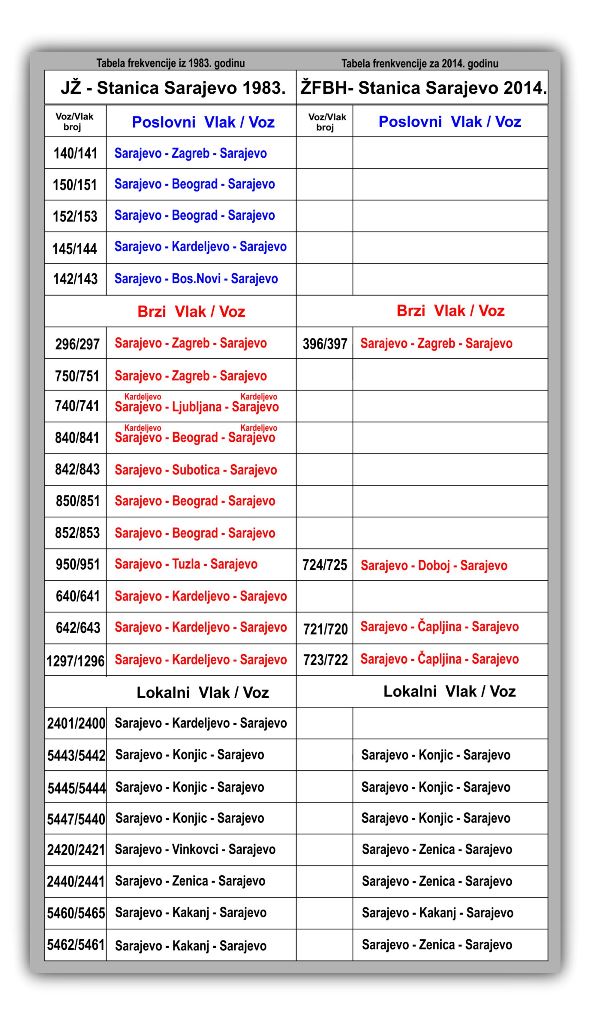
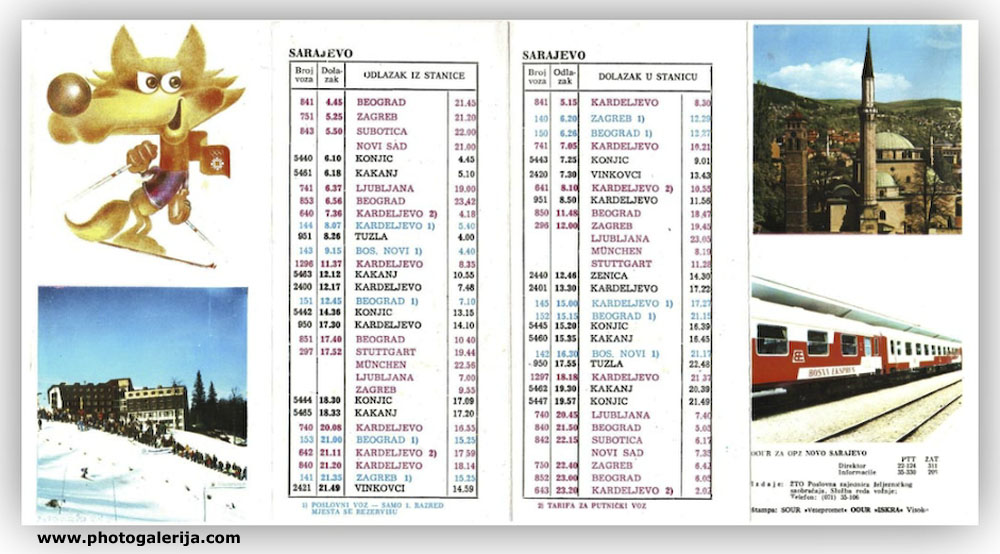
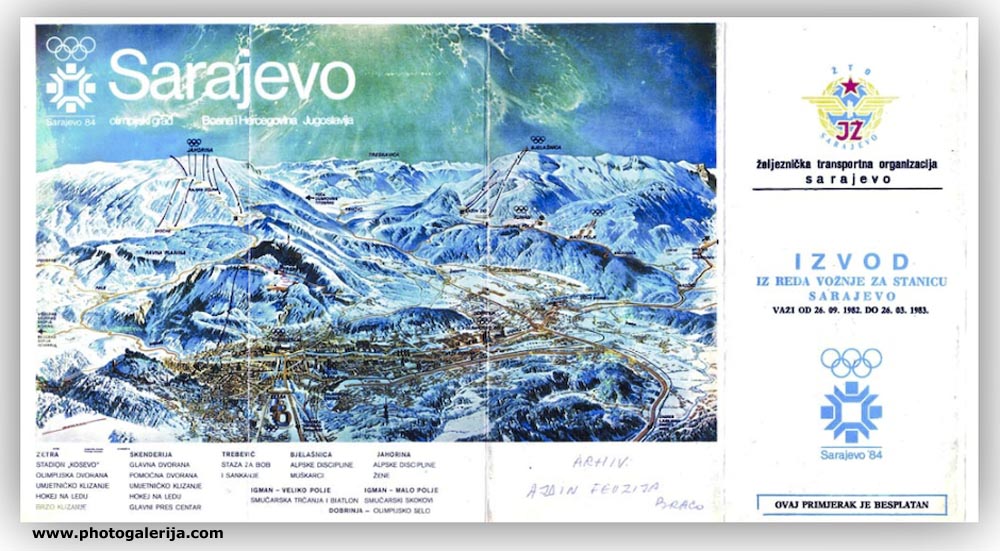
Reviewing from the archive of the Schedule of 1982/83 and the displayed frequency of passenger trains through the Sarajevo railway station, I attempted to make a comparison of the train frequency for the current year, 2014. Namely, a then-powerful and well-organized railway (YŽ – ЈЖ as a social property) is hard to equate with today’s railway in Bosnia and Herzegovina, i.e., ŽFBH and ЖРС as public goods-services serving the citizens. I mention the fact that on the Šamac – Sarajevo section, in the 1970s, approximately four million passengers were transported annually on average, while from 1996 to 2013, on all tracks of the Federation of Bosnia and Herzegovina Railways, between 650,000 and 900,000 passengers are transported annually. Or, from 100% of the revenue generated by ŽFBH in a year, only 3% pertains to passenger traffic revenue. Additionally, I note that in 2013, ŽFBH had nearly three million KM in revenue from passenger transport and a ten million KM loss due to investments in maintaining mobile assets and depreciation. The reason for this disappointing fact can be found among the owners, i.e., the Federation of Bosnia and Herzegovina government, and one should ask about the future development of the railway and its strategy as a pillar of the economy in Bosnia and Herzegovina. I present in tabular form the frequency of trains that operated (direct departures of outgoing and passing trains) through Sarajevo railway station in 1983, in “correlation” with the train frequency for 2014 passing through the same station.