Written by: Srećko Ignjatović
This research paper, among other things, contains technical data on the construction and operation of forest railways: **Forest (logging) rails, Busovačke Mountains, Busovača – Tisovac – Kozice – Kačuni – Zahorsko area** (70,210 m); **Turbe – Suho Polje – Smet – Gostilj – Ilomska**, 1912-1938 (73,900 m); **Electric industrial railway Turbe – Sawmill**, 1913-1941 (2,400 m); **Sebešić Forest-Industrial Railway**, Turbe – Sebešić, 1931 (52,500 m); **Semešnica Forest Railway** – Donji Vakuf, 1927-1939 (31,433 m); **Janj** and **Janj II** forest railways in Donji Vakuf, 1952-1954 (52,677 m).
Introduction to the Topic
Following the provisions of the Berlin Congress of 1878, Bosnia and Herzegovina would be occupied by the Habsburg Monarchy, which would remain formally under the Sultan until the annexation in 1908. Immediately, a civil and military administration was established over Bosnia and Herzegovina, and in September of the same year, intensive work began on the construction of the iron bridge between the two Brods and the first kilometers of the railway track towards Zenica, which would be put into operation on June 8, 1879. With the continuation of the railway construction to Sarajevo (October 4, 1882), the route from Bosanski Brod to Sarajevo holds a special place overall and will have a huge impetus for the economic development of Bosnia and Herzegovina in the future.
This main railway line, running through the Bosna River valley, will have several industrial branch lines built: Doboj – Usora – Pribinić (1886), Doboj – Tuzla – Simin Han (1886), Zavidovići – Kamenica (1899), Zavidovići – Olovo – Kusače (1901), Begov Han – Bistričak (1911), and Ilijaš – Misoča (1913).
A branch or main branch from the main railway line, in the basin of the Lašva and Vrbas rivers, began construction of the railway route in 1891, from Lašva – Travnik station (1893), Travnik – Donji Vakuf – Bugojno (1894), and Donji Vakuf – Jajce (1895). The branch to Jajce was designed with the intention of connecting Banja Luka with Sarajevo, while the branch to Bugojno was meant to connect with Split. The railway was land-owned property managed by the Imperial and Royal Bosnia Railway (k.k. BB), and from 1895, under the administration of the Bosnian-Herzegovinian State Railways Directorate (BHStB).
Since Central Bosnia possessed vast natural resources, including forests, in order to secure the necessary financial revenues for the provincial treasury, the Austro-Hungarian administration (the Bosnian bureau with the Joint Ministry of Finance in Vienna – ZMF) initially focused on selling specific forest areas through direct agreements and long-term contracts with individual companies and entrepreneurs. This approach created the conditions for signing the first agreements between the provincial treasury and private firms, recognizing their rights to build and operate forest railways, which were constructed at the company’s expense, within the boundaries of the contracted forest area.
Several forest railways were connected to the railway line Lašva – Travnik – Donji Vakuf (1894-1912), including the operational management track of the forest administration in Busovača (9.98 km electrically powered and 26.36 km of other tracks, including switchtracks), to Han Company (9 km, of which 5 km on steam traction), and the forest railway of the “Ugar” company near Turbe (16.7 km, of which 9 km on steam traction, and 11 km of wire railway in the first construction phase).
The first long-term contract for the exploitation of timber in the Ugar forest area was signed in 1911 with the company “Ugar – Forest Industry Inc.” and the contract for the Dnoluka forest area with the company “Dnoluka – Forest Industry Inc.” Due to poor business performance, this company would later change owners, so before we move on to the main topic, allow us to briefly outline their business biography, compiled from several published books and available archival materials from the Bosnia and Herzegovina Archives, fonds ZMS (1911-1918), DŽS (1922-1938), JDŽ-JŽ, unpublished fonds (1952-1954).
Ugar – Forest Industry Ltd. Brothers Hagenbucher, Turbe (1911-1918)
By the end of May 1911, a submissive sale of the cutting masses of coniferous timber was carried out in the neighboring Ugar forest area (4,900 hectares), within the territory of the Travnik and Banja Luka districts. A total of six bids were submitted at the auction, with the most favorable being from Hagenbucher Georg’s company, an industrialist from Linz, Austria, who was otherwise a German citizen. George Hagenbucher owned a firm in Austria called “Wholesale Timber, Steam Sawmills, and Woodware Factories a. d. Linz” (“Holzgrosshandlung Linzer Dampfsäge und Holzwarenfabrik A. G. Linz”).
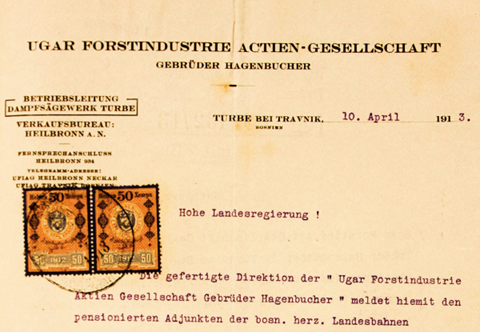
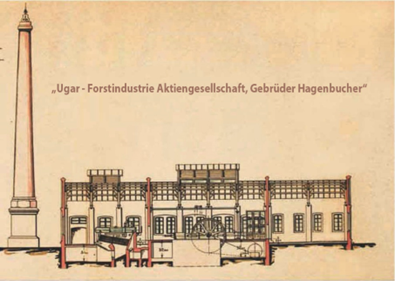
With him, a long-term contract for the exploitation of the Ugar forest area was signed in July 1911, lasting for 20 years (1912-1932). The subject of the contract was the logging of approximately 842,000 m3 from the forest on logs, with an average annual cut of about 42,000 m3. At the end of 1912, the affiliated company G. Hagenbucher was transformed into a joint-stock company under the name “Ugar – Forest Industry a.d. Brothers Hagenbucher” („Ugar – Forstindustrie Aktiengesellschaft, Gebrüder Hagenbucher“), which also resulted in the transfer of the 1911 contract. The basic invested capital was mostly held by the Hagenbucher brothers, while a smaller part of the shares was owned by a few Austrian industrialists.
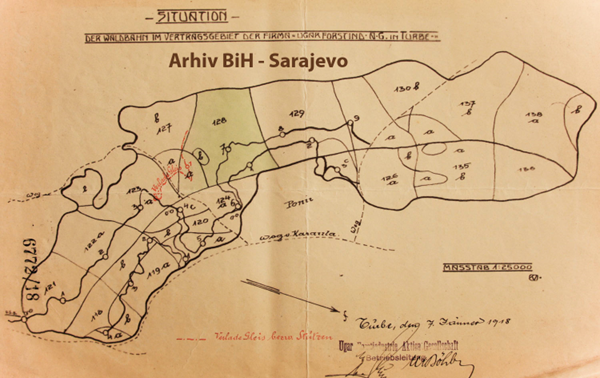
A total investment of 3,900,000 crowns was allocated to the construction of a sawmill facility equipped with operational machines, a wire railway (11.2 km), a forest railway with steam and electric propulsion (16.7 km), and a series of buildings necessary for forest handling operations. The wire railway and the sawmill were put into operation at the beginning of 1912, although later difficulties arose in the realization of forest transportation communications.
However, the preliminary logging efforts for 1912 and 1913 were executed almost entirely. All the cut timber from the forested area was fully transported by wire tramway to the sawmill facilities in Turbe for further processing. The logging preliminary for the year 1914 was completed by the company at about 18%, while by the end of the Austro-Hungarian rule in Bosnia and Herzegovina (1918), approximately 90,000 m3 of first and second class coniferous wood had been cut and taken over. Due to the circumstances and events related to the so-called Balkan Crisis and the partial mobilization of personnel (1913), as well as the start of World War I (1914), regular company operations were impeded. The cause of the resulting situation and poor business performance was that the entire package of shares would be in the hands of the Vienna-based company “Die Vereinigte Holzindustrie A. G.,” which was backed by Austrian industrialist and financier Oskar Körner.<|end_of_translation|>
Company H. Džinić / Dnoluka – Forest Industry Inc. Ltd. (1911-1914)
In 1911, in the forested area of Ugar, the Dnoluka region (823 hectares), the Travnik and Jajce districts, during a submissive sale of forest harvestable mass, the best offer was given by the company Hamidbeg Džinić from Banja Luka. That same year, a long-term contract was concluded for a period of ten years (1912-1921). The subject of the contract was the logging of approximately 200,000 m³ of first and second-class coniferous useful timber and 30,000 m³ of oak and firewood. The mentioned company did not proceed to implement the concluded contract in 1912 and 1913, justifying themselves by the fact that they could not commence logging before the construction of forest transportation communications and an industrial facility for processing wood. At the same time, the company maintained ongoing contact with the neighboring company G. Hagenbucher from Turbe for the transfer and assignment of the long-term and contractual Dnoluka area.
To avoid resistance from Austro-Hungarian authorities regarding these transactions, which had a speculative character, in September 1913, the Inokosno company H. Džinić engaged in the founding of a joint-stock company called “Dnoluka – Forest Industry d.d. H. Džinić and others” with an initial capital of 600,000 crowns. Half of the capital was owned by Hamidbeg Džinić, his brother Hakibeg Džinić, son-in-law Ibrahimbeg Čengić, and Sharif Arnautović, while the other half was owned by industrialist Serelmann Dr. Eduard and his son-in-law Horvath Dr. Mora.
Since the newly established company “Dnoluka – Forest Industry Ltd.” did not proceed with the implementation of the transferred long-term contract from 1911, at the onset of the First World War (1914), it requested a postponement until conditions normalized, which practically meant until the end of the war, utilizing provisions related to debt moratorium. In the meantime, almost all shares of the company came into the possession of the credit institute in Vienna, namely the “Vienna Credit Association for Business and Trade” (“Kreditverein für Handel und Gewerbe”), and shortly thereafter, the shares were in the hands of the Vienna-based firm “Die Vereinigte Holzindustrie A. G.” (the same applies to the shares of the company “Ugar – Forest Industry Ltd. Brothers Hagenbucher” in Turbe), behind which stood Austrian industrialist and financier Oskar Körner.
He initiated negotiations with the Federal Government of Bosnia and Herzegovina through the Joint Ministry in Vienna regarding the integration of both companies into a single entity, along with a simultaneous revision of the long-term exploitation contracts for the Ugar and Dnoluk contractual areas (1911-1912).
Ugar i Dnoluka – Forest Industry d. d. Turbe, Oskar Körner (1914-1927)
As stated, the entire package of shares of the company “Ugar – Forest Industry a.d. Brothers Hagenbucher” and “Dnoluka – Forest Industry a.d. H. Džinić and others” belonged to the Viennese industrialist Oskar Körner, who acquired them during the First World War (1914-1918). Immediately after the war, both companies were placed under sequestration, which was quickly lifted because Oskar Körner legitimized himself as a Czechoslovak citizen. As the new owner, he unified both enterprises into a single joint-stock company under the name “Ugar and Dnoluka – Forest Industry d.d. Turbe.” This agreement satisfied the Provincial Government, because in the executed transaction, it received a stronger contractual “counterparty” that offered greater guarantees regarding the fulfillment of contractual obligations and the securing of regular and continuous revenues.
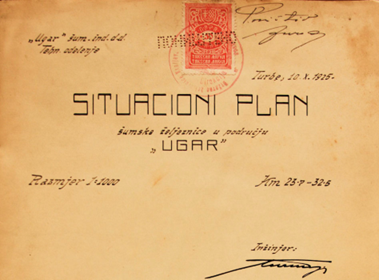
In 1920, with the Ministry of Forests and Mines in Belgrade, the Kingdom of SHS, a long-term contract was signed for the exploitation of the Ugar and Dnoluka forest areas, with the duration of the contract for the Ugar region set at 20 years, with an annual quota of approximately 42,000 m3 of conifers. For the Dnoluka area, it was 10 years, with an annual quota of around 20,000 m3 of conifers and 3,000 m3 of beechwood. For transporting the timber from the forest to the sawmill in Turbe, a newly developed transportation method was used, which was built immediately upon signing the long-term agreement. By 1927, the inherited steam railways and gravity (inclined) track were extended into new forest districts with the construction of switchbacks and cableways, reaching approximately 70 kilometers of built forest roads, 750 meters of switchback on Smeta, and 800 meters of cableway in Babanovac.
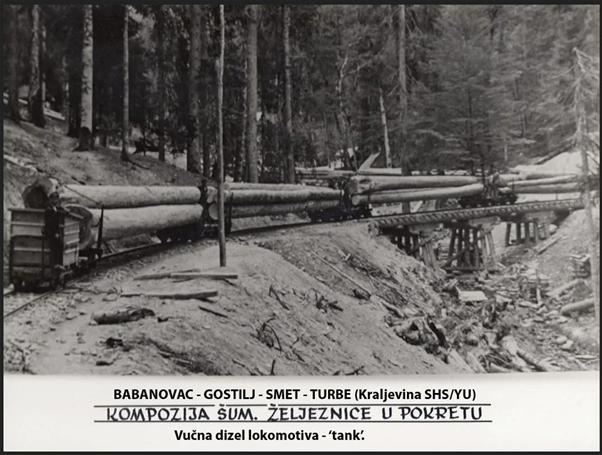
The fleet of the newly established company consisted of seven steam locomotives, 100 pairs of truck wagons for timber transport, eight flat wagons for transporting finished lumber, and ten other types of cars for transporting various goods and workers. The company expanded the inherited sawmill in Turbe (from the Hagenbucher brothers) with installed eight feeders and an 850 HP engine, adding two full feeders so that its annual production capacity reached about 60,000 cubic meters of sawn lumber, based on one shift. Between 1921 and 1927, the company utilized approximately 1,218,000 cubic meters of softwood and about 95,000 cubic meters of beechwood in the contract area of Ugar and Dnoluk, which indicates nearly three times the workforce originally specified in the contract.
The majority of the timber assortments were exported to Trieste (via the southern route to Dubrovnik, then by sea), selling the goods to the Trieste-based company “Società Anonima Forestale Triestina” hereafter referred to as “Forestale.” Due to lack of funds to regularly finance the operations of his company, Oscar Körner received cash advances from Forestale for the sold goods and products, with shares of the firm “Ugar i Dnoluka – Forest Industry d. d. Turbe” serving as collateral to cover these loans. Over time, unable to fulfill his obligations, he was compelled to transfer the entire forest exploitation business in the contractual Ugar and Dnoluka areas, including the industrial wood processing plant in Turbe and the entire fleet of vehicles, through a transaction with Forestale.
“Ugar — Forest Industry d. d. in Turbe” – “Forestale” Company (1927-1942)
Taking ownership of the company “Ugar i Dnoluka – forest industry d. d. Turbe,” the firm “Forestale” establishes and registers a new enterprise called “Ugar – forest industry d. d. in Turbe” (hereinafter referred to as “Ugar d. d. in Turbe”) and thereby takes over its entire assets and liabilities. Historically, the company “Forestale” was owned by a wealthy family from Trieste, and their son-in-law, Dr. Glass, became the director of the company in Turbe, where he lived and was a great humanitarian, thus remaining in the fond memory of the Turbe residents. To ensure the most rational amortization of invested capital, the newly established company makes efforts to supply its steam-powered sawmill in Turbe with new raw material reservoirs.
As early as February 1927, an agreement was reached between the company “Ugar d. d. in Turbe” (more precisely “Forestale” in Trieste) and the company “Slavija – Forest Industry d. d. Zagreb,” where the largest shareholder was the unavoidable (controversial) industrialist Oscar Körner. The contract involved transactions related to the exploitation of forests in the upper Vrbasa River area (Sebešić, Semešnica, Škrta Mountain with Stožer and Crni Vrh), including the purchase of Forest-Industrial Enterprise “Bistrica” d. d. (owner of the First Croatian Savings Bank) and the sawmill facility in Trnovača (“Ugar d. d. in Trnovača”) near Gornji Vakuf with three sawyers (the sawmill burned down in 1937), as well as a leased sawmill in the 1920s from the company “Braća Pansini” (along the Semešnica River near Donji Vakuf) and a built steam-powered sawmill (1928) in Donji Vakuf with a 100 HP engine and three sawyers, with an annual capacity of approximately 16,800 m3 of coniferous lumber per shift.
The business empire for the company “Forestale” knows no bounds. Namely, the company “Ugar” based in Turbe, through a business contract with the State Forest Administration in Busovača (Forestvervaltung Busovača), supplied forest timber from the area of Busovačka Mountain and the Kozica River basin using the forest tram railway Busovača – Tisovac (8,300 m) and the gravity railway (cog railway) along the route Tisovac – over the Pridolci saddle – basin of the Kozica stream (1924), at a length of 16,040 meters. One branch departs from Pridolci towards the source and up to the Modri Kamen peak for a distance of 3,000 meters, making the total length of the forest railway 27,340 meters.
At the section at kilometer 3+600 of the forest (logging) railway line Busovača – Tisovac, a forest branch line “City of Busovača – Kačuni” (1925) was built with steam power, extending 6,910 meters, and a guage (animal-powered, gravity) track Kačuni – Duboki Potok in length of 7,000 meters, for a total length of 13,910 meters. Additionally, a steam-powered forest railway was constructed between Busovača and Zahorsko area – the Kozica River basin area (1926). The length of this railway was 29,000 meters.
The total length of all forest tracks combined with the tram roads in the forest area of Busovača was 70,210 meters.
Forest manipulation was organized by the company “Ugar” with two tanks powered by diesel engines (Raupenschleper) and the lease of state steam locomotives. The cut trees (trunks for impregnation) were transported by the state railway to the “Nova Bila” sawmill, which was also part of “Ugar”’s operations. The business contract lasted from 1918 to 1941.
In 1938, along the track of the bogie road near the village of Pridolci, a tragic accident occurred resulting in the death of Bogdan Babić, the director of the Forest Directorate in Sarajevo, and former director of the “Ugar” company in Turbe (1919-1925). More details about this event can be found at the end of the article.
The company “Ugar d. d. u Turbetu” owned three sawmill plants in 1938 (Turbe, Donji Vakuf, and Han-Kram) with a capacity of 1,070 HP and 16 rotators. At these facilities, approximately 120,000 m³ of logs were processed, resulting in about 75,000 m³ of sawn timber of conifers and deciduous trees. In addition to the inherited 73.9 km of forest roads within the contractual area of Ugar-Dnoluka, as well as Semešnica and Sebešić, Kozica, and Mrkalj, the company built (extended the route with branch roads) another 98 km of forest road, 28.5 km of narrow-gauge railway, one trestle of 1,000 meters in length, and a cable car of 800 meters in length.
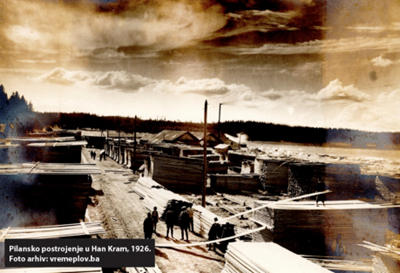
Regarding the rolling stock, it has been increased with three new pairs of steam locomotives (total of 10 locomotives), 75 pairs of truck wagons (total of 175 pairs of trucks), and 10 flat cars (total of 20 units). On all the contracted areas mentioned, the company employed between 2,500 and 3,000 workers, including managers and administrative technical staff at the headquarters (Turbe, Donji Vakuf, and Han-Kram). With the outbreak of the April war (1941), the company ceased production, and its sawmill facilities in Turbe and Han-Kram were destroyed by fire during the National Liberation War.
Besides the overwhelming competition from the company “Ugar” from Turbe, in these regions, many entrepreneurs found their opportunity by setting up small water- and steam-powered sawmills. We’ll list some of them: Mrkonja Ramo, Heljdo Omer, Karalić Rasim, Kazas Džemil, and Metakalo Mijo, all in the Karaule area in the Lašva river basin. Budimirović Jure in Doco on Lašva, on the Opara (Trenica) river, and Putićevo (Travnik). Finally, the sawmill of the State Monopolies Directorate in Travnik, part of the tobacco factory in Travnik.
The Fate of the „Ugar“ Sawmill in Turbe After the War (1945)
In December 1942, the sawmill in Turbe was burned to the ground. Only bare walls and iron equipment with machines remained. As a result of war damages during the country’s reconstruction, one hall was equipped as a workshop (Mechanical Shop) for maintaining forest transport equipment (wagons, wire ropes, and others), and services were also provided to other companies.
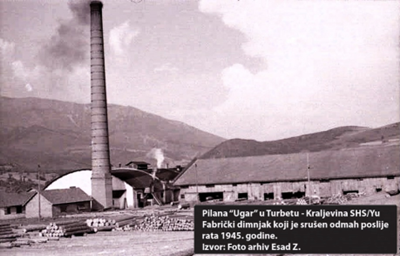
By decision of the Workers’ Council of the company PDI “Sebešić” in Travnik, at the session held on December 23, 1954, a decision was made to establish the Crafts Enterprise “Metalorad” in Turbe. In addition to this company, two more were formed on the site of the former “Ugar” sawmill: Wood Handling “Sebešić” in Turbe and the “Lašva” Brick Factory and Tileworks in Turbe (1947). All these companies used an industrial railway built back in 1911 to the Turbe station. With the cessation of passenger traffic in 1973 and freight traffic in 1975, the narrow-gauge Lašva – Donji Vakuf railway was discontinued, along with the industrial track from Turbe station to the sawmill.
Construction of the “Ugar” sawmill facility in Turbe
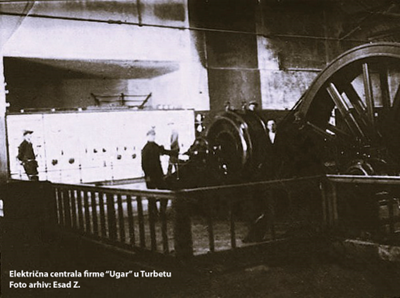
As mentioned, the company “Ugar” – Forest Industry Inc. in Turbe, Brothers Hagenbucher, began operations in 1912 with the exploitation of the Ugar forest area. The felled trees were transported by rail with steam propulsion to the main storage in Gostilj and from there carried by cable car (Seilbahn) to the main storage within the sawmill complex in Turbe. The length of the cable car was approximately 11 km, powered by electricity from a central station in Turbe. For this purpose, a transformer station was built, which, in addition to starting the cable car, illuminated the railway station and the workers’ colony.
Namely, on the Gostilj plateau, next to the railway station with accompanying facilities, a boiler room for steam engines was built, along with a repair workshop as part of the complex. A workers’ settlement was constructed with all accompanying infrastructure. Beside the workers’ cafeteria, there was a general store, a butcher shop, a bakery, and other service facilities.
The Turbe railway station was located at kilometer 36+392 of the main line Lašva – Donji Vakuf, near the left bank of the Lašva River. The total area of the building was 130.00 m2 with ten rooms. Adjacent to the station, a warehouse with an area of 48.00 m2 was built, along with an office and a freight platform—ramp. On the western side of the warehouse, a residential building with a total area of 36.00 m2 was constructed, consisting of three rooms. A water tower was also built, equipped with one water supply for steam locomotives, with an area of 38.50 m2 and a water intake capacity of 64 m3 per 24 hours. Technically, water was supplied via pipes by natural gravity from the Čulan stream intake. On the station platform, cross tracks were constructed, including three totaling about 425 meters in length, and one (mainline passing track) about 136 meters long. From Turbe station to the locomotive roundhouse, an industrial track (Schleppbahn) was built, 1,100 meters long, which then branched out at the locomotive roundhouse, extending 1,300 meters, bringing the total length of the industrial track (1912-1913) to 2,400 meters. This track, powered by steam, was put into operation in November 1911. The entire construction and land lease, as well as maintenance, were the company’s responsibility. In practice, the route of the industrial track ran parallel to the main line toward Donji Vakuf, splitting at kilometer 37+500. Near this point (at km 37+520), there was an ‘open’ track crossing a lattice bridge (length 20.97 m) over the Lašva River (near the confluence with the Komaršica River into the Lašva). Near the iron bridge, to the right, was a road bridge (the state road Travnik – Turbe – Donji Vakuf). To the right, at a distance of one to two meters, was a wooden bridge of the industrial track, 14 meters long. Close to these bridges, at the road crossing, a barrier was installed to control the factory train. To the right of the wooden bridge was a worker’s canteen and a ‘Cash Office’ (Kassung/Schatzmeister), to allow workers’ wages to be paid outside the factory premises. Many workers preferred to leave their wages at the canteen, which was surrounded by smaller trading posts and markets for household necessities, ‘fasunga‘. Transporting processed lumber out of the mill yard (loaded onto state cars) was done by the company’s steam locomotive. From March 1913, the route was electrified and opened for traffic in November of the same year. Since then, the haulage was performed by electric locomotives (owned by the company). It should be noted that electric railways already existed in the region, such as in Drvar (Cellulose Factory, Steinbeisbahn) and Zavidovići (Krivaja, Eissler i Ortlieb). The steam sawmill in Turbe (Dampfsägewerk), with accompanying facilities, warehouses, and track systems, covered about 8 hectares of land. Part of this area (around 500 meters) was directly adjacent to the right bank of the Lašva River, providing continuous water supply for the steam boilers. On the opposite bank, across the built production halls, a colony (Arbieterkolonie) was established with four houses for the machine operators (Meisterhäuser), and on the left side of these buildings was a structure for managerial staff and plant director’s residence (Direktionsvilla). To the right, seven single-story buildings accommodated workers (foreigners, settlers, with families). On this site, cultivated fields were arranged for the residents of the colony, including a central field where oats were sown for horses owned by the company. These horses were used for hauling felling logs in the forest via constructed forest vľak (dirt roads) to the loading station. In 1926, the company donated this field to the ‘Ugar’ Sports Club, where a football, tennis, and athletics field was built. Within the factory complex, a railway workshop was built (for housing and maintenance of a steam locomotive and an electric locomotive) as well as a building for repairing and sharpening woodworking tools, band and circular saws, and others (<
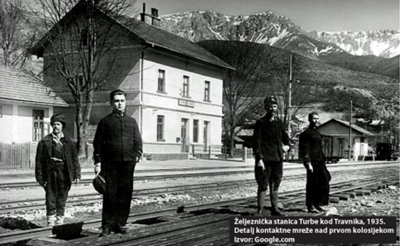
On the station platform, auxiliary (crossing) tracks were constructed, including three with a total length of approximately 425 meters and one (main line pass-through track) of about 136 meters. From the Turbe station to the mill circle, an industrial track (Schleppbahn) was built, 1,100 meters long, which then continued and branched out on the mill platform for a length of 1,300 meters, bringing the total length of the industrial railway (1912-1913) to 2,400 meters. This constructed line, powered by steam, was commissioned for operation in November 1911. The entire construction of the industrial track, along with the lease of state land and maintenance, was covered by the company.
In essence, the route of the industrial railway track ran parallel to the main line toward Donji Vakuf and diverged at km 37+500. Near this spatial kilometer (at km 37+520), the ‘open’ tracks featured a steel lattice bridge (L=20.97 m) over the Lašva River (close to the confluence of the Komaršica River into Lašva). Nearby the steel bridge, on the right, was a road bridge (the state road Travnik – Turbe – Donji Vakuf), and just to the right, a wooden bridge for the industrial track, L=14 m. Immediately adjacent to these two bridges, at the road crossing, a barrier was installed to secure the operation of the factory train. To the right of the wooden bridge was the workers’ cafeteria and the ‘Cashier’ building (Kassung/Schatzmeister). The employer’s reason for this arrangement was to allow workers’ wages to be distributed outside the company premises. Many workers left their earnings in the canteen, and nearby, there were small shops and a market for household provisions, called ‘fasunga‘.
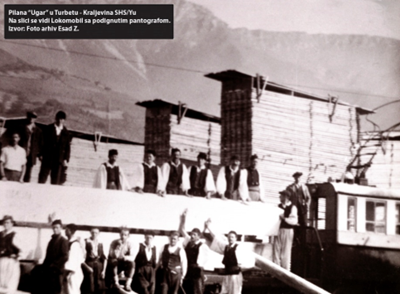
The transport of processed timber from the sawmill yard (loaded onto state-owned wagons) was pulled by a firm’s steam locomotive. Since March 1913, this route was electrified and put into operation in November of the same year. Since then, the gross hauling has been performed by electric locomotives (Locomobil owned by the company). It should be noted that electric railways already existed in these areas, specifically in Drvar (Cellulose Factory, Steinbeisbahn) and Zavidovići (Krivaja, Eissler and Ortlieb).
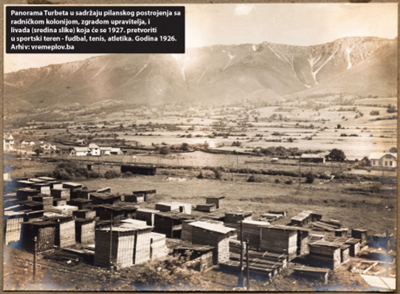
The timber mill in Turbe (Dampfsägewerk), with accompanying facilities, storage, and track systems, occupied approximately 8 hectares of land surface. A portion of this area (about 500 m1) was directly adjacent to the right bank of the Lašva River. This was due to the need for continuous supply of water to the steam-powered factory boilers. On the left bank, opposite the constructed production halls, a colony (Arbieterkolonie) was established with four buildings for housing machine operators (Meisterhäuser), and to the left of these buildings, there was a structure for accommodating senior management, specifically the plant manager (Direktionsvilla). On the right, seven ground-level buildings served as housing for workers (foreigners, immigrants, with their families).
In this area, agricultural gardens were parceled out for the needs of the colony’s residents, and at the level of the central part, there was a field where oats for the company’s horses were sown. These horses were engaged in pulling the timber in the forest via constructed forest tracks (dirt roads) to the loading station. In 1926, the company donated this field to the “Ugar” Sports Club, where a field for football, tennis, and athletics was built.
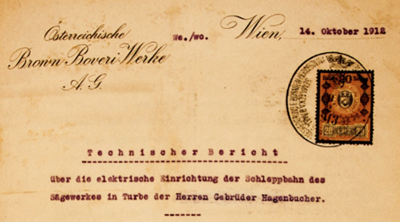
Around the factory, a railway workshop was built (to accommodate and maintain one steam and one electric locomotive) and a building for the maintenance and sharpening of machine cutting tools, tracks, circular saws, etc., (Sägehalle). A cable car (Seilbahn), installed gantry cranes, and other wood processing machines were powered by electrical energy. Specifically, the owner George Hagenbucher engaged a Swiss company, “Oesterreichische Brown Boveri – Werke” A.G. Vienna (a Swiss company “Brown, Boveri & Cie”, manufacturer of low and high voltage devices), which operated a dynamo-machine driven by an installed steam engine (850 HP) to produce electrical power. From there, energy was transferred via transformer to alternating current of 85 kW A/10000/220 V for machine operation, and direct current of 250 kW A/1000/55000 V for electric railway use.
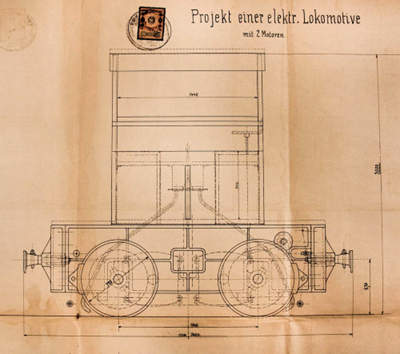
During construction work (1912), wooden poles were erected and support brackets (Ausleger) were mounted on them; overhead wires were installed, consisting of round copper wire (diameter 5.3 mm), strung at a height of approximately 5 meters. The converter from the sawmill brought direct current of 500 V to the locomotive via the overhead line. The locomotive’s pantograph (Bügel Stromabnehmer) transferred electricity through the wheels to the drive motor, while the tracks served as the return conductor. The insulators were porcelain with grooves designed for a working voltage of 5000 V. The locomotive was built for a gauge width of 760 mm, with a service weight of 4,700 kg, an axle distance of 1,340 mm, wheels with a diameter of 750 mm powered by two engines (2×11 HP) running at approximately 530 revolutions per minute, of type B3a.
The electric railway in Turbe operated until the outbreak of World War II. Although it did not carry passengers, occasionally, with the exception of locals during religious festivals or in traffic situations when it returns ‘empty‘ wagons from the station to the factory during the morning or afternoon shifts.
Construction of Transport Communications of the “Ugar” Company (1912-1941)
- Turbe – Suho Polje – Smet – Gostilj – Ilomska (1912./1938. L=62 km)
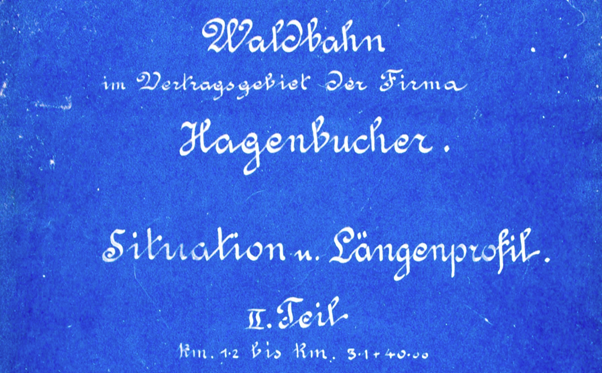
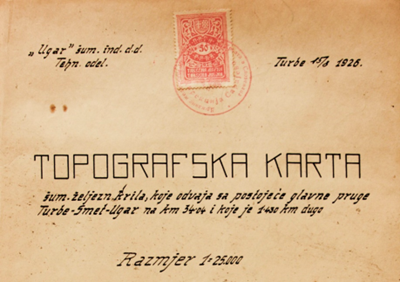
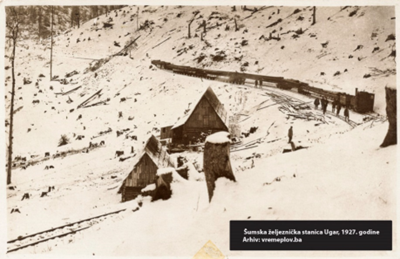
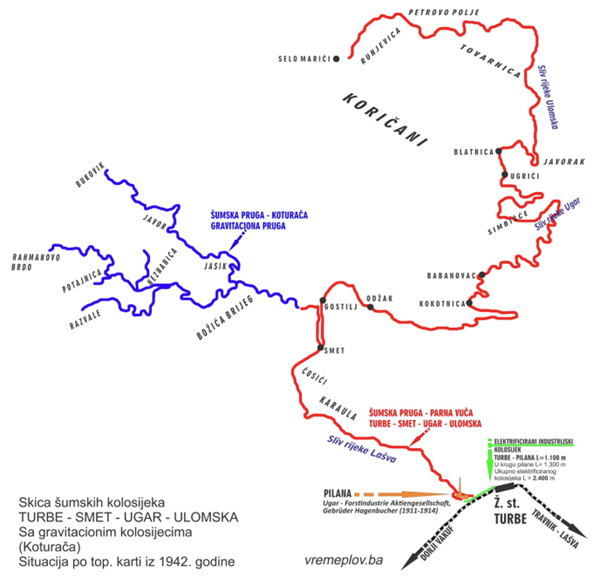
The forest railway on steam power, width 760 mm, Suho Polje – Gostilj (Suho Polje – Smet connected by cable car) – Ponir with branches and further along toward the sources of the Ugar and Ilomska rivers, was constructed gradually with a total length of 9,600 meters from early 1912 until the end of 1918.
A rail line of 9,200 meters in length was constructed on this route, making the total length of the main railway and branch lines 18,800 meters. Based on the signed Agreement in 1920 regarding permission for further construction of the forestry railway, between the company “Ugar” and the Ministry of Forests and Mines of the Kingdom of SHS, construction works for the forestry railway commenced in 1925. This railway ran from the sawmill in Turbet through Karaule to the station at Šantići. From the Šantići station, the route is in a ‘dropper’ (800 m) construction on a trestle to Smeta, totaling a length of 11,900 meters.
Construction of the railway from Gostilj onwards continues from km 9,600 meters as follows: 14,100 meters up to 1923; 8,800 meters in 1925; 2,000 meters in 1926 (work begins on the wing railway track, the switchback, Gostilj – Dnoluka, with a total length of 29,500 meters plus branch lines of 16,000 meters, making a total of 45,500 meters), along with one unloading siding of 1,500 meters at the Ugar station platform; 7,000 meters in 1927; 16,000 meters in 1930 (including branch lines in the Ilomska River basin, 10,400 meters, and the funicular cableway, length 900 meters); 4,500 meters in 1932. In total: from Turbe (Sawmill) to the furthest point, on steam power, the entire length is 73,900 meters, plus 55,900 meters of wing tracks (switchbacks), which sums up to a total of 117,900 meters with one cable car of 900 meters length. Additional sidings of about 2,400 meters and industrial sidings within the sawmill complex of 5,500 meters can be counted, bringing the final total of all constructed tracks to 138,600 meters.
It should be noted that along this route, dozens of wooden bridges were built with masonry abutments made of stone in cement mortar and supporting wooden arches. The most difficult section was between space kilometer 26+812 and 40+493. Shorter bridges ranged from 5.00 to 7.00 meters in length, while longer ones measured from 10.00 to 28.00 meters. According to the contract with the Ministry of Forests and Mines of the Kingdom of SHS (1920), the construction of main and auxiliary structures from solid materials was not permitted; only wood was allowed. The contract for the exploitation of the forest railway was valid until 1940.
- Šumsko-industrijska pruga „Sebešić“, Turbe – Sebešić, 1931. god. (52.500 m)
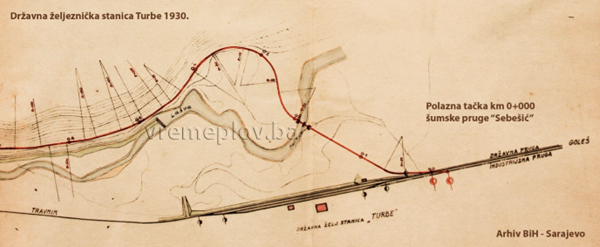
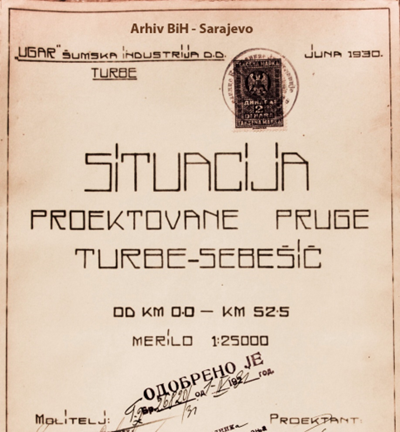
Work on the construction of the industrial steam railway, gauge 760 mm, Turbe – Sebešić (Sebešić forest area) began in April 1931. The zero kilometer point (connected to the industrial track built in 1912, intersecting with the state railway) was located behind the Turbe station. The route passes near the Lašva River and develops technically along the right bank with a maximum incline of up to 16 0/00 above the village of Bojne above Travnik to the “Travnik – Bojna” level crossing, then descends into the Zagorska River valley. [end]
The route at km 25+600 reaches the settlement of Rankovići, where a sidetrack (station track) has been built and leads to the junction or saddle of Šikot. It runs along the left bank of the Zagorska River to the crossing over the state road Dolac – Rostovo – Donji Vakuf (at km 26+500). Then, the route crosses to the right bank and ascends with a maximum gradient of 30°/00. At spatial intervals from km 25+600 to km 45+00, three sidemeters, Bistro, Lisac, and Šikot, were constructed. From km 45+00, the track descends with a maximum gradient of 10°/00 into the Mutnica valley (Sebešić area) down to km 52+500, where there is a sidetrack track. The end point was the Sebešić station, which was destroyed by Partisan sabotage on September 9, 1942.
The minimum curvature radius of the track R=40 m, the lower machine width of 3 m, thresholds (L=1.60 m, 13/15) made of oak on steeper inclines while the rest are from pine. Rails, depending on technical specifications, are 9.3; 10, and 12 kg per meter. The structures, bridges, and culverts were built from pine wood. The supports of the bridges, according to conditions, are made of stone in mortar or concrete. All passing points (stations) are connected via telephone. Traffic was carried out according to a precisely established timetable and schedule. It is interesting to note that almost the entire population, i.e., landowners, gave their consent and approval regarding the construction of the railway without major disputes. The minority that could not agree was subjected to expropriation through the authorities in Travnik.
The forest track “Sebešić” almost came into contact with the forest track “Trenica” near the same-named forest area. This track was built and put into operation in November 1947, with a length of 7,700 meters (Nova Bila – Trenica) and served as a forest manipulation line (also the “Sebešić” track) for the company ŠIP “Sebešić” from Travnik. The entire transportation of timber assortments from Turbe (the Ugra and Semešnica areas), as well as from the Trenica area and the basin of the Bile, Jasenica, and Zaseočki streams (forest track “Jasenica”, constructed gradually from 1952 to 1956 over a length of 16,000 meters), was managed by ŠIP “Sebešić”. From the Nova Bila station, an industrial siding branched off towards the “Sebešić” sawmill, measuring 5,180 meters, as well as a military-industrial siding, 6,900 meters long. In 1962, the wood impregnation enterprise in Vitez operated as part of ŠIP “Sebešić” from Travnik.
Finally, it can be stated that the upper machine of the track (sleepers, rails, and other track equipment) used for the construction of the forest railway “Trenica” and “Jasenica,” as well as industrial spurs to the sawmill in Travnik, was mostly transported from parts of the dismantled “Turbe – Gostilj – Ilomska” railway because forest transport communication was carried out by road trucks. This confirms the fact that approximately 70% of steam locomotives, in 1946, were engaged in work at PDI “Janj,” PDI “Sana,” and “ŠIPAD” in Drvar (Grmeč).
- Šumska pruga „Semešnica“ – Donji Vakuf, 1927.-1939. (15.646 m)
In 1927, in Donji Vakuf, a new sawmill was built, which at the time was part of the company “Slavija” d.d. (for the wood industry, specializing in import of goods headquartered in Zagreb). The conceptual projects for the sawmill plant and the industrial railway for forest exploitation in the upper Vrbasa river area were carried out by the technical bureau of the company “Slavija” in Zagreb. That same year, industrialist and financial expert, as well as majority shareholder of “Slavija,” Oskar Körner, through diplomatic negotiations with the company “Forestale” from Trieste, which was in fact the owner of the previous (failed) company of the former owner Oskar Körner, “Ugar” d.d. in Turbe, drafted an agreement concerning the transaction of the company “Slavija,” now in favor of future operations within the company “Forestale” from Trieste, or “Ugar” d.d. in Turbe.
Since work on the new sawmill was ongoing, construction on the future railway route of the industrial railway “Semešnica” began. The zero kilometer was located within the sawmill complex. The route runs along the national railway Donji Vakuf – Bugojno, creating a radius of 180° over approximately 400 meters in length, and continues parallel to the national railway Donji Vakuf – Jajce. At the kilometer marker 3+300 of the industrial railway, the route diverges from the national railway (near the confluence of the Semešnica River into the Vrbas) and continues along the right bank of the Semešnica River basin. At km 4+320, on the left bank, was the steam sawmill known as the “Russian Sawmill,” owned by citizens from Italy ‘Brothers Pansini.’
This was the first water-powered sawmill on the Semešnica River, built at the end of the nineteenth century, with the sawmill facility operating on steam power by early 1901. Its owner was Samuel Hugo Feldbauer. He installed two rollers in the sawmill plant along with an appropriate number of auxiliary machines. The capacity of the sawmill was 7,500 cubic meters of processed timber.
The owner of the sawmill, at his own expense, built a railway track called a ‘cogwheel’ for animal-powered operation. The length of the ‘main’ route was 8,000 meters, with one branch of 2,000 meters. Research into this construction provides no information on whether the route ended near the state station Donji Vakuf. Some data indicate that the route followed the basin of the Semešnica River and, at its confluence with the Vrbas River, a wooden bridge was built (crossing the Vrbas) and near the state railway, a storage area was established for further transportation.
Since he lacked sufficient funds to build a forest railway powered by steam, thereby restricting transportation of wood by the state-owned cars, and due to the blackmailing policies of the forest treasury through auctions, he declared bankruptcy before the outbreak of the war (1914), which led to his liquidation by the then authorities.
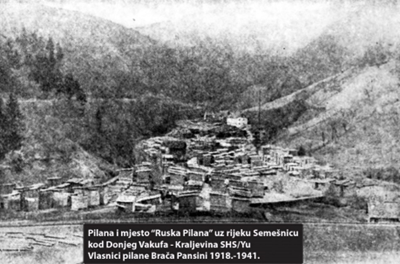
After the war (1918), the sawmill was transferred to the ownership of the company “Brothers Pansini.” In the twenties, the sawmill was leased out to benefit the company “Ugar d. d. in Turbe,” and there, raw materials from its reservation forest area in the Semešnica region were processed. In 1934, the “Ugar” company requested permission to build a connecting track, starting from station km 4+320, which would lead and connect with the industrial track of the steam sawmill “Brothers Pansini” for a length of 558 meters. Unfortunately, no document has been found that speaks about the commissioning of the said track.
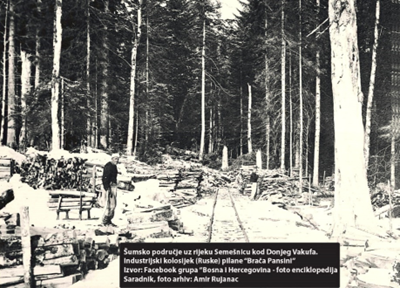
[KADA THE COMPANY BUILT ITS OWN PLANING MILL IN DONJI VAKUF, AT THE END OF THE THIRTIES, THE MANAGEMENT OF THE MILL REMAINS IN THE HANDS OF THE OLD OWNERS, “BROTHERS PANSINI”, UNTIL THE OUTBREAK OF THE WAR (1941). AS THE FIRST HOUSES NEAR THE MILL ARE COMPLETED AND THE SETTLEMENT EXPANDS, THE THEN AUTHORITIES GIVE IT THE NAME “RUSSIAN MILL,” WHICH IT STILL CARRIES TODAY.]
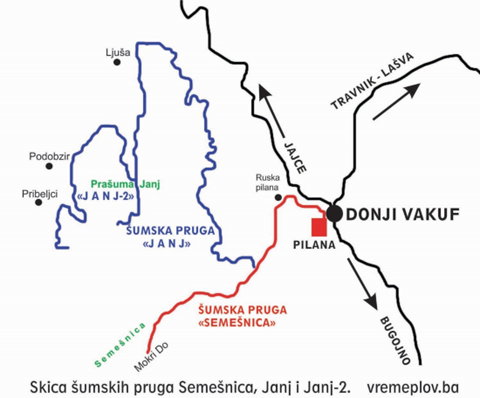
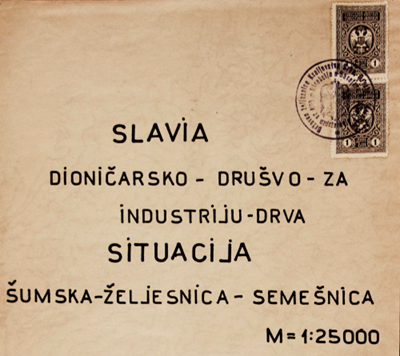
The continuation of the “Semešnica” route extends all the way to station kilometrage 7+200 (1928) before continuing in 1932 to kilometer 15+646 as the final point of the route. The section from the ninth kilometer to the end was very challenging. Between the physical km 9+320 and 9+523, a temporary siding (203 meters long) was constructed. At this location, a woodshed was found, which has since been converted into an official station named “Semešnica.” Adjacent to this facility, a fuel depot (covering the area for one locomotive) and a blacksmith shop for maintaining steam locomotives will be built.
Just one kilometer further (km 10+140), a wooden bridge with a length of 66 meters was constructed, followed by a tunnel at km 10+260 with a length of 102 meters. At the spatial km 10+730, a wooden bridge with a length of 54 meters was built, then at 11+720 a wooden bridge with a length of 36 meters, and before this bridge (km 11+790), there is a tunnel with a length of 90 meters. Further along at km 11+900, there is a wooden bridge with a length of 36 meters, and at km 12+050, another wooden bridge of the same length. In 1932, a branch (passing track, freight track) measuring 1,030 meters will be built from the farthest point at 15+646.
Starting from km 7+030, a branch line will be constructed, crossing a bridge to the left bank of the Semeshnica River, called the “Stolovaš” Forest Railway (1928). The first kilometer is steam-powered, and a 1,000-meter-long siding has been built as an extension. The route continues with steam operation up to km 6+700. In 1932, the route of the “Stolovaš” forest railway extends all the way to its final point at km 13+700, facilitating logging operations in the Stolovaš, Bijeli Dol, and Perizovac areas.
The “Stolovaš” forest track was challenging for builders. Specifically, four bridges were constructed along this route. The first bridge (at km 3+900) was 33.00 meters long with two spans of 5 meters and three spans of 7 meters. The second bridge (at km 4+600) was 26 meters long with two spans of 6 meters and two spans of 7 meters. The third bridge (at km 5+100) was 19 meters long, with two spans of 6 meters and one span of 7 meters. The fourth bridge (at km 5+800) was 33.00 meters long with two spans of 6 meters and three spans of 7 meters. All supports of the bridges were made of stone with mortar, and the load-bearing arches (piers) were made of wood. At the spatial km 5+800, a loading sidetrack (and passing siding for locomotives) was built, measuring 360 meters in length.
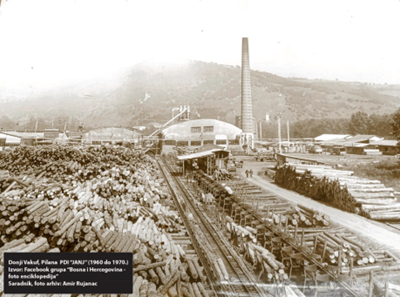
With this construction of the forest railways “Semešnica” and “Stolovaš,” owned by the company “Ugar d. d. in Turbe” in Donji Vakuf, ultimately by 1941, the totals are: Main line 15,646 meters, side lines with turnouts 14,730 meters, freight tracks 1,390 meters, and industrial tracks within the sawmill complex 697 meters, making a total of 32,463 meters.
In the July 1940 issue of “Borba,” readers are informed about the planned development of the Janj Forest Management Enterprise (PDI “Janj”) regarding the construction of new railway lines, truck roads, and dry ‘rice‘. For example, extending the railway by 9 km and, next year (1941), another 8 km. In Duboka, work is underway on building ‘rice‘ which will be approximately 16 km long, and in the settlement of Smiljarno, about 4 km. The truck road in Porička Rijeka, which is rapidly being built, will connect the main road with the forest railway. In Stolovaš, the switchyard is being reconfigured so that the new switchyard will enable easier and faster operation, thereby increasing exports by 38%. The observation is that, due to the outbreak of the war (1941), the plans are set aside and will wait for better times.
Construction of the “Janj” and “Janj II” Forest Roads After the War (1945) in Donji Vakuf
After the end of the war (1945), the sawmill in Donji Vakuf was registered and operated under the name Wood Industry Enterprise (WIE) “Janj” in Donji Vakuf. This enterprise continued building the extension of the forest railway (former “Stolovaš” railway) toward the forest area Janj, over a length of about 26,000 meters (1952-1954) up to the Kupreška River. The exploitation area includes the watersheds of the Kupreška River, Rječica, and Mrakodol (Obljac – Grbavica area), covering 8,160 hectares with an estimated felling volume of approximately 1,400,000 cubic meters. The construction of the forest railway (extension) will form the main economic unit of the Janj area, with a transportation route toward Donji Vakuf.
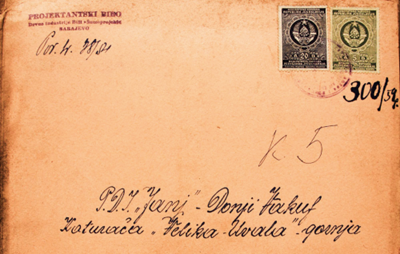
The entire constructed route, from the PDI “Janj” industrial platform to the end, is 45,000 meters long and is called the “Janj” forest railway (from Semešnica to km 15.646 meters). This main route will have a branch railway built on steam power, “Janj II” (1954), approximately 8,000 meters long, extending from the spatial km 41+000. Further extensions include the cableway “Velika Uvala,” the lower section of 5,700 meters (from the edge of Petrovačka meadow to Jarak Krivodol), and the upper section (left and right) with a total length of 8,100 meters. This lower cableway will be connected with the “Mrakodol” siding, which is 1,000 meters long.
This construction of forest railways owned by PDI “Janj” in Donji Vakuf ultimately results in the elimination of the track: the main track is 45,000 meters (previously 15,646 m + 28,354 m), the branch tracks with switchyards 37,530 meters (previously 14,730 m + 22,800 m), the freight tracks in the forest and industrial tracks within the sawmill area about 1,580 meters (previously about 2,090 m + 520 m), bringing the total to 85,140 meters.
The entire route of the “Janj” and “Janj II” railways ceases operation with the discontinuation of the narrow gauge Gornji Vakuf – Donji Vakuf (passenger service on 28.05.1972), with the suspension of freight traffic, gradually, in the year 1974, followed by Donji Vakuf – Travnik – Lašva on June 1, 1975.
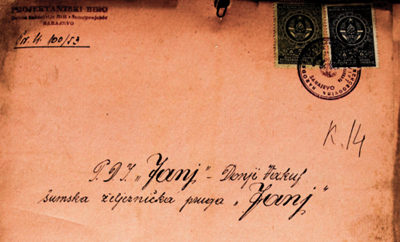
Based on the above data, a free summary can be made of all the built steam-powered forest roads that were exploited or were part of the “Ugar” company, including those inherited with animal-powered traction (animal and gravity), chokes, cable cars, and tracks within the mill complex. This summary does not include the narrow-gauge railroads in Busovača, the tracks within the town and the sawmill in Han Kram, or the tracks built after the war (1945) in Donji Vakuf.
The length of the railway tracks on the steam (locomotive) powered line is 188,553 meters; the tracks of the animal-driven (gravity) incline are from 45,500 meters; the switchbacks are from 1,000 meters; plus a cable car 900 meters (Ugar – Ilomska). The total length is 235,953 meters.
Locomotive Fleet of the “Ugar” Company in Turbe, 1911-1941.
As mentioned, the company “Ugar d. d. in Turbe” (part of the “Forestale” company) owned ten steam locomotives in the years 1927-1941. This data is confirmed by the archival document “List of industrial locomotives at the railway directorate in Sarajevo” from 1932. The listing for “Ugar d. d. in Turbe” states:
- „Beograd“ – broj ‘1’. Krauss Comp. Linz, Österreich, serija, broj kotla 1371/1924. Od 1946. u PDI „Sana“, 1961. Šumsko gazdinstvo Ključ, od 1965. „Borja“ Teslić
- „Sarajevo“ – broj ‘2’. Maschinen-Gesellschaft Heilbronn, Deutschland, serija, broj kotla 602 ‘L’/1913. Iz fabrike isporučena iste godine u Turbe. Poslije rata(1914.-1918.) u radu ind. pruge „Vrbanja“-Banja Luka. Poslije rata (1945) u PDI „Sana“-1946. i svoj radni vijek završila u Rudniku „Kamengrad“- od 1962. do xxxx godine.
- „Ugar“ – broj ‘3’. Krauss Comp. Linz, Österreich, serija, broj kotla 1250/1921. Godine 1949. radila u PDI „Maglić“, od 1961. Šumsko gazdinstvo „Sutjeska“ Foča.
- „Ulomka“ – broj ‘4’. Machinenfabrik Otto Hoffman Zehdenick, Deutschland, serija, broj kotla 150/1920.
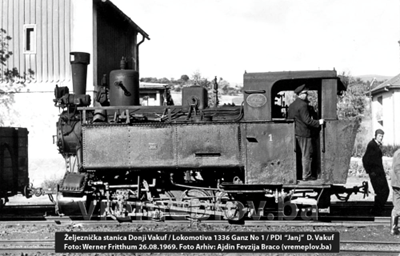
- „Gostilj“ – broj ‘5’. Henschel und Sohn, Kassel, Deutschland, serija, broj kotla 4125/1894. Otkupljena od F.A. Möller, Stützengrün (750 mm). Radila u PDI „Janj“ i u šumskom području Šipovo (kasirana 1964. godine).
- „Turbe“ – broj ‘6’. J.A. Machinenfabrik Maffei & Co München, serija, broj kotla 3514/1913. Preimenovana u naziv „Mariška“ PDI Janj na pruzi „Janj“ 2.
- „Travnik“ – broj ‘7’. Orenstein & Koppel, Berlin, serije, broj kotla 7913/1919. Otkupljena od Montana Bergbau GmbH Wien, širina kol. 750 mm.
- „Dora“ – broj ‘8’. Krauss Comp. Linz, Österreich, serija, broj kotla 6258/1909. Naziv dobila po imenu supruge od Georgea Hagenbuchera.
- „Hedica“ – broj ‘9’. Krauss Comp. Linz, Österreich, serija, broj kotla 5737/1907. Otkupljena od Una Holzindustrie „Una“. Od 1948. radila u PDI „Sebešić“.
- „Mađarica“ – Od 1933. serija 181-003. Budapest MAV, serija, broj kotla 3273/1913. Ova lokomotiva otkupljena od Direkcije željeznica u Sarajevu 1933. godine. Godine 1949. radila u PDI „Maglić“, od 1961. ŠG „Sutjeska“ Foča.
According to the source Reimar Holzinger Boswald, ‘pospichal.net’, (they probably worked for “Ugar” starting in 1936) so that the list also includes locomotives:
- Lokomotiva, Serija, broj kotla 7082/1914. (750 mm), Orenstein & Koppel, Berlin, Završila svoj rad u ŠIP „Grmeč“ 1946.-1965.
- „Roga“, broj kotla 1259/1923. Krauss Comp. Linz, Österreich. Radila za firmu Đuzepe Feltrineli u Sjetlini i kasnije za „Ugar“ u Turbetu. Od 1946. ŠIP „Grmeč“.
- „Travnik“, serija od 1933. 181-004. Budapest MAV, broj kotla 3274/1914. Bila u vlasništvu „R&K für Bauleitung der Petrovaradiner kuk Gürtel-Straßenbahn“ da bi, vjerovatno krajem 30-tih u vlasništvu „Ugar“ u Turbetu. Od 1946. radi za PDI „Janj“ – Donji Vakuf i od 1961. u Šipovu.
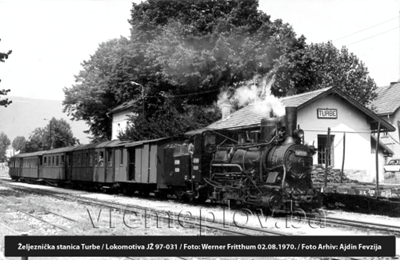
Description of the PDI “Sebešić” locomotive
On the industrial railway line Turbe – Sebešić, from 1931/32 until the war (1941), mainly locomotives from the above list operated. We will conduct a roster after the war (1945).
- Lokomotiva serije 11930/1953. Arnold Jung Locomotive Works. Od 1961 radi za ŠIP „Grmeč“ i Drvar“ i radni vijek (do 1974.) završava u PDI „Janj“ u Donjem Vakufu.
- Lokomotiva serije 184-001/1916. Krauss Locomotive Works München. Isto opsluživala i industrijsku prugu Turbe – Preduzeće „Metalorad“ (plato bivše pilane).
- Lokomotiva serije 189-005/1887. Krauss Comp. Linz, Österreich. Jedna od najstarijih parnih lokomotiva (preživjela dva svjetska rata). Vjerovatno je, pored pruge „Sebešić“ vozila i trasom Turbe – Preduzeće „Metalorad“.
- Lokomotive serije: 5594/1947; 5597/1947; 5600/1947; 5669/1948. Proizvedene u fabrici Budapest MAV. Ove lokomotive vozile su za Rudnik „Abid Lolić“- Bila i RMK „Zenica“.
Description of the PDI “Janj” Locomotive in Donji Vakuf
Since the outbreak of the war (1941), the locomotives “Dora”, “Mariška,” and “Travnik” were operating for the company “Ugar d. d. in Turbe” – Donji Vakuf. We will compile the list after the war (1945).
- „Veseljka“, serije 176-002/1883. Krauss Comp. Linz, Österreich. Broj kotla 1265/1883. Prvu vožnju obavljala na izgradnji uzane pruge Metković – Mostar (1884-1885). Vjerovatno, zbog starosti mašine, od 1949.-1962. godine vozila u službi manevre u krugu pilane u Donjem Vakufu.
- Lokomotiva serije 189-021/1893. Krauss Comp. Linz, Österreich. Broj kotla 2843/93.
- „Milka“, serije, broj kotla 4125/1894. Henschel & Sohn, Henschel-Werke.
- Lokomotiva serije 490.003 – broj kotla 2078/1908. Budapest MAV. Vozila na prugama Steinbeisbahnpod brojem ’49’.
- „Duboščica“, broj kotla 4412/1900. Krauss Locomotive Works München. Bila u voznom parku „Krivaja“ – Zavidovići.
- „Udarnik“, serije, broj kotla 2155/1909. Budapest MAV. Bila u vlasništvu Drvne industrije „Slavonija“, zatim u Pakracu i Našicama(Hrvatska) i Majdan – Bosanski Novi.
- „Zvečevo“, serije, broj kotla 1336/1923. Krauss Comp. Linz, Österreich. Vozila u Pakracu i Samobor (Hrvatska).
- „Mavag“, serije, broj kotla 5671/1948. Budapest MAV. Vozila u Šipovu, Bugojno i Koprivnicu.
- „Esma“, serije, broj kotla 347/1952. „Đuro Đaković“ Industrija lokomotiva, strojeva i mostova Slavonski Brod.
- „Julka“, serije, broj kotla 11929/1953. Arnold Jung Locomotive Works. Vozila u Šipovu i Jajcu.
- Lokomotiva, serije, broj kotla 4924/1926. Vozila u Šipovu.
Railway Accident on the Forest Railway of Busovača Mountains near Pridolci
From the state railway station of Busovača to the town of Busovača, a horse-drawn cable car (incline of 2°0′/00) was built. From the town of Busovača to Zagrađe and further to a steeper slope, there is also a cable car with iron rails. At the incline of 6°0′/00′ and further toward Duboka, a wooden track with beechwood rails of 760 mm gauge was constructed. This transportation ‘structure’ was unique in Bosnia and Herzegovina at the time (1895). [END TRANSLATION]
The length of the mentioned road with winged branches is about 10 km. The descent of loaded carts was carried out using gravity forces all the way down to Zagrađe, or the Town of Busovača. Segments with wooden rails were often a site of frequent runaway loads, and sometimes during the transportation of forest workers. The further transport to the Busovača station was performed by horses.
In 1901, the forest railway was reconstructed with a higher quality implementation, using steam traction, from the Busovača station to the City of Busovača, specifically Tisovac (8,300 meters). From Tisovac, the route of the gravity railway (cog railway) extends over the Pridolci saddle – the Kozice stream basin (1924) for a length of 16.040 meters. From Pridolci, a branch of the cog railway was built toward the village of Izvor, up to the peak of Modri Kamen, covering a distance of 3,000 meters. The section of the route from Pridolci to the City of Busovača would prove disastrous for engineer Bogdan Babić (1885-1938), who was then the director of the Forest Directorate in Sarajevo and former director of the “Ugar” company in Turbe (1919-1925).
On January 12, 1938, engineer Bogdan Babić, together with the head of the Busovača Forest Office, traveled to the Pridolci area to determine a ‘plan’ for 1940, specifically to hand over the forested area of Busovača for timber exploitation to the company “ŠIPAD” from Sarajevo (the Directorate from Drvar had moved to Sarajevo). Learning about this, representatives of the “Ugar” company paid two forest workers from the Ravan village to oil the rails with bacon and lard, and to cut thinner branches of hornbeam and serviceberry at a sharp bend.
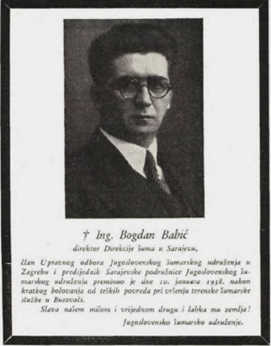
When the two of them (along with the other guests) were returning in wagons, due to a sudden increase in speed, they began braking, and at the first curve (at the ‘assassination’ site), they plunged into the abyss. Today, this curve is called “Babić’s Gibbon.” The seriously injured engineer Bogdan Babić with a fractured spine was transported that same evening by train to a hospital in Sarajevo. Unfortunately, after seven days of treatment, he died in the same hospital. The authorities at the time conducted an investigation and found evidence at the accident site that had a tragic impact on the late engineer Bogdan Babić. Thus, the “ŠIPAD” plan failed, and the company “Ugar” continued exploitation, preparing for 1940.
References:
- Branislav Begović, 1978. „Razvojni put šumske privrede u Bosni i Hercegovini u periodu austrougarske uprave (1878—1918) sa posebnim osvrtom na eksploataciju šuma i industrijsku preradu drveta“,
- Branislav Begović, 1985 „Šumska privreda Bosne i Hercegovine za vrijeme monarhističke Jugoslavije (1918.-1941.) s posebnim osvrtom na eksploataciju šuma i industrijsku preradu drveta. Sarajevo“,
- Dževad Juzbašić, 1974. „Izgradnja željeznica u Bosni i Hercegovini u svjetlu austrougarske politike od okupacije do kraja Kállayeve ere“,
- Fran Ž. Kesterčanek, Kroz Bosnu i Hercegovinu, Šumarski list Br. 9. i 10. Zagreb, 1. rujna 1897. God. XXI)
- Časopis – Naše Šume, broj 38-39 avgust/kolovoz, Godina XIV Sarajevo, 2015. Šumarija Busovača str. 66-72 In memoriam – Bogdan Babić, 1885-1938.
- Arhiv vremeplov.ba – Popis industrijskih lokomotiva pri Direkciji željeznica u Sarajevu iz 1932. godine,
- Arhiv BiH, Podaci o stanju državnih i privatnih šumsko industrijskih željeznica Direkcije Sarajevo 1926. godine, DŽS 1926. sig.16027/I
- Arhiv BiH, fond DŽS 1924., 1925., 1926., 1927., 1928., 1929., 1930., 1932.
- Državni arhiv BiH Sarajevo, neobjavljeni fond, JDŽ/JŽ 1952.-1954. Projektantski Biro Drvne industrije BiH „Šumoprojekt“, Sarajevo, skice, situacioni planovi, pruga „Turbe – Ugar“, „Semešnica“, „Stolovaš“, „Janj“, „Sebešić“ i dr.
- Web portal vremeplov.ba, foto-arhivski fond.
- Facebook grupa; Bosna i Hercegovina – foto enciklopedija, saradnici: Amir Rujanac, Sead Luzić, Zoran Tarade, Damir Halilagić i drugi. Ustupljene fotografije sa komentarima.
- Izjava svjedoka: Zolota Esad i dr.
Photo Gallery
This modest research paper, which we present through this article, concludes with a sincere thanks to the staff at the Archives of Bosnia and Herzegovina in Sarajevo, without whose assistance in recommending the use of available library and archival materials, this work would not have been possible.
Note:
Reproduction of part (up to one-third) or the entire text is possible in accordance with Article 14 of the Code of Press and Online Media of Bosnia and Herzegovina.
If another media outlet wishes to reproduce a part or the entire original text, it can do so only with prior written permission from the portal vremeplov.ba.
After obtaining permission, they are obliged to credit the source as the portal vremeplov.ba and, at least in one place, publish the link where our text is published.