Written by: Srećko Ignjatović
The further we move into the present day, the more the events of the past fade away. These events fade even though they are connected through oral tradition or what was recorded by chronicles of that time. What has been preserved through the oral tradition of a few individuals who are no longer alive today, and what was recorded in chronicles, is scattered across various newspapers and magazines, which are now difficult to find in archival institutions.

Writing about the history of the forest railway in Begov Han is a hefty undertaking, especially when it comes to linking and organizing the historical 자료. The duty of collecting historical 자료 is not an easy task and requires a lot of time.
By presenting historical events through available literature and archival documents, we were able to delve into its history, which actually serves as the starting point of our discussion.
Out of love for research and a desire to learn about the history of forest railways in Bosnia and Herzegovina, we present a brief fragmentary overview of the industrial development of Begov Han and its surroundings.
The foundational literature for this work includes books:
- Branislav Begović, „Razvojni put šumske privrede u Bosni i Hercegovini u periodu austrougarske uprave (1878—1918) sa posebnim osvrtom na eksploataciju šuma i industrijsku preradu drveta“, 1978.,
- Branislav Begović, „Šumska privreda Bosne i Hercegovine za vrijeme monarhističke Jugoslavije (1918.-1941.) s posebnim osvrtom na eksploataciju šuma i industrijsku preradu drveta. Sarajevo, 1985.“
- Dževad Juzbašić, „Izgradnja željeznica u Bosni i Hercegovini u svjetlu austrougarske politike od okupacije do kraja Kállayeve ere“, 1974.“
The Occupation of Bosnia and Herzegovina (1878) and the Construction of the Public Land Railway
The Austro-Hungarian occupation of Bosnia and Herzegovina was carried out based on the provisions of the Berlin Congress of 1878. Establishing military and civil authorities, the primary task of the Monarchy was to exploit the entire economic resource of Bosnia and Herzegovina. The occupation administration viewed the forest wealth of Bosnia and Herzegovina as an important source of public financial income for investment purposes and for its maintenance. The construction of railway lines will occupy a special place and will have an enormous incentive for the economic development of Bosnia and Herzegovina.

In order to facilitate the placement of timber on the foreign market, mainly semi-finished wood, a railway line will be built between Bosanski Brod and Sarajevo (1882) and another from Sarajevo to Metković (1891), serving as the main transportation artery of the country.
The construction of public land railways was not sufficient to directly open up large forest complexes and enable their intensive utilization. To achieve this, significant investments were needed not only in establishing facilities for processing wood but also in building forest communications, namely forest railways.
By the end of the nineteenth century, interested companies emerged that were organizationally and financially capable of undertaking the exploitation and processing of larger quantities of timber. In this regard, the Provincial Government of Bosnia and Herzegovina in Sarajevo, especially Kallay, sought to recruit private capital.
As a result of active mobilization of private entrepreneurs by Kallay, conditions were created for the signing of the first agreements between the land royal treasury and private companies, and they were recognized rights to build and operate forest railways, which were constructed at the company’s expense, within the limits of the designated forest area.
Forest railway companies, which were connected to the main line along the Bosnia River valley, included: Usora – Pribinić near Doboje, company “Marpurgo & Parente” from Trieste (1886); Zavidovići – Kamenica (Gostović Forest Area), company “Gregersen & Söhne” (1899); Zavidovići – Olovo – Kusaće, company “I. Eissler & Brüder from Vienna and Louis Ortlieb from Munich” (1901); Begov Han – Bistričak, company “Bosna & Konz” (1911); and Ilijaš – Misoča, company (ex F. Steinmetz, 1910.) “Buttzzoni & Venturini” (1913).
Population Description and Construction of the Žepče – Zenica Railway
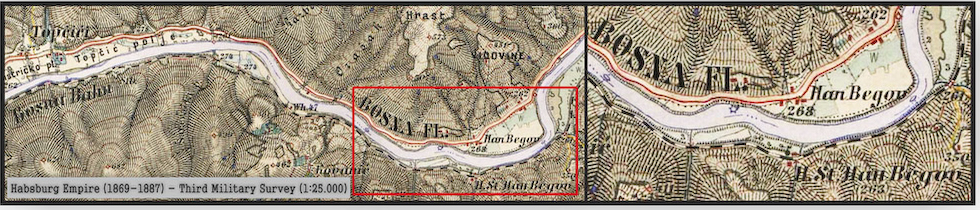
At the time of the census in June 1879, Begov Han (as a village or smaller settlement) was not included in the survey, even though cartographers on old maps (from the late 19th century) marked it as “Han Begov.” It is likely that the census takers could not categorize it because they found a ‘building’ with one story, converted into a han with auxiliary structures and a smaller number of peasant houses.
It is assumed that the current state combined is included in the list of the nearest inhabited place, Golubinje. Begov Han (according to the census) was located in the territory of two districts. The left bank of the Bosna River belonged to the District of Travnik (settlement Golubinje), while the right bank belonged to the District of Žepče, where the railway route would pass and a future sawmill would be built. Today, Begov Han is categorized as a settlement and belongs to the Municipality of Žepče. (Census from June 1879. Source: Statistics of places and population of BiH, Imperial and Royal Government Printing House, Sarajevo 1880.).

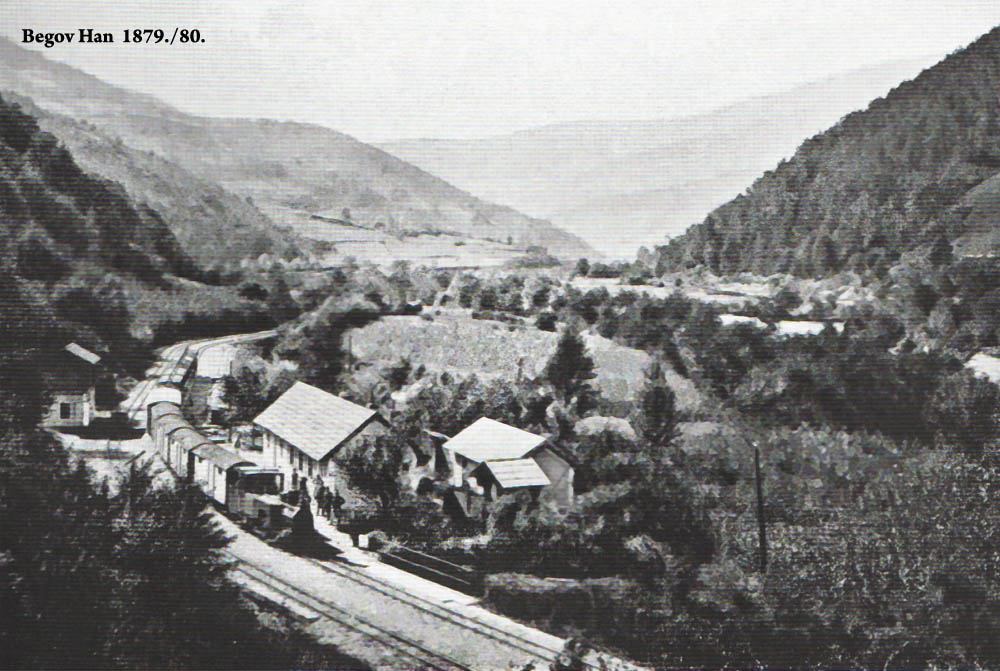
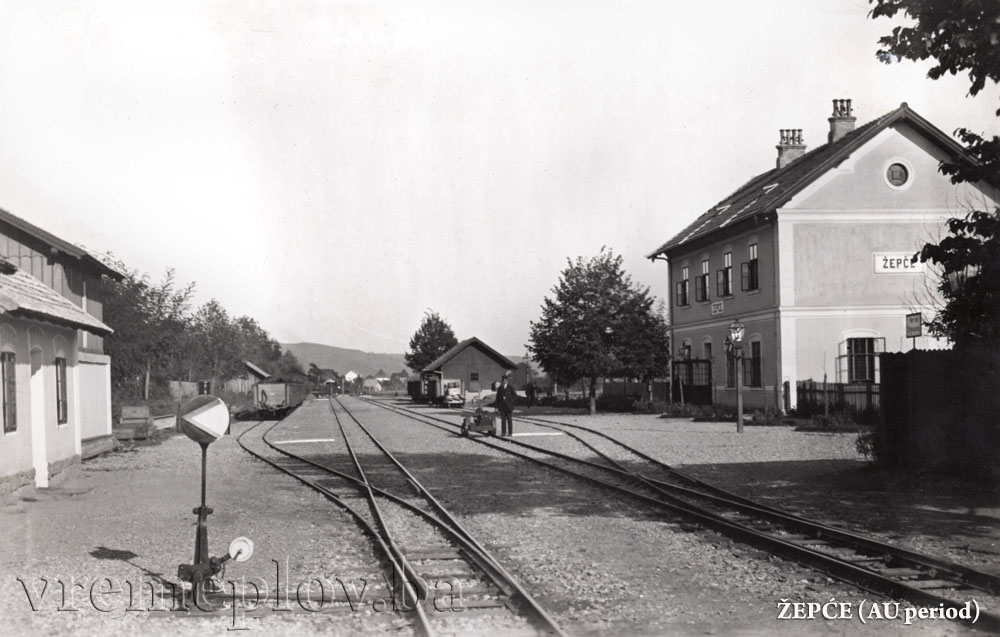
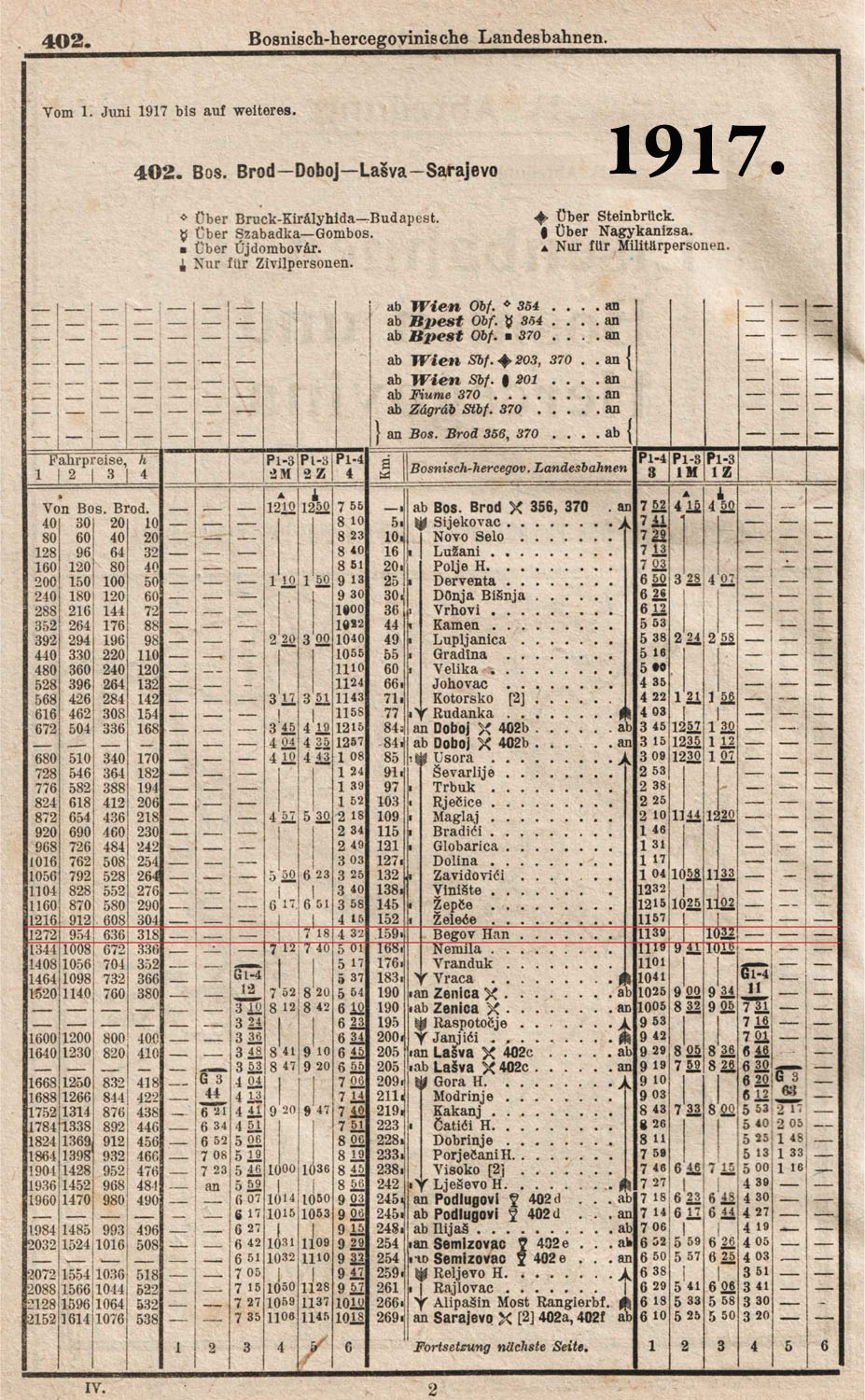
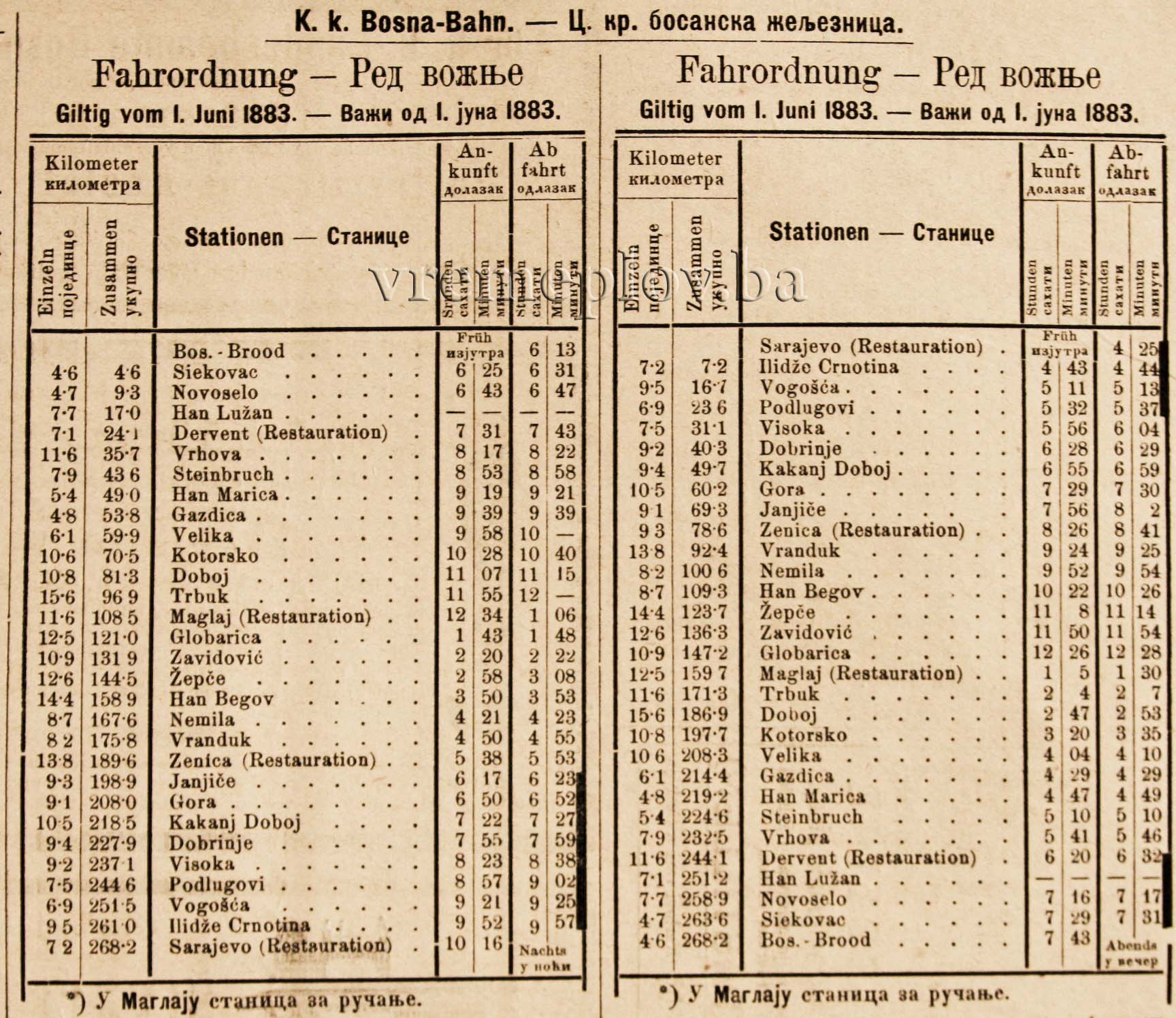
Construction of the narrow-gauge railway began from Bosanski Brod on September 20, 1878. By the end of November of the same year, the transportation of military equipment to the Derventa railway station had already started. In January 1879, the track reached Doblje, in February to Maglaj, and in April to Žepče.
In early spring, the year 1879, in front of the project office k.k. Bauleitung der Eisenbahnstrecke, Bos. Brod – Zenica, trigonometric terrain surveys were conducted (right bank of the Bosna River) between the construction area of the settlement Želeća and Nemila. When entering the measured details into the ‘Elaborate situational map’, a polygonal point was established, i.e., the site of the future railway station building. However, it was necessary to input the name of this point. The answer was received from the local mukhtar (Turkish: mùktār/ muhtar, neighborhood head in the city or village elder), who indicated by hand, on the left bank of the Bosna River, a “commercial” building owned by a certain Salih-beg, known among the people as Begov Han (formerly Han Begov). Thus, they entered the name Begov Han.
Otherwise, the local ‘muktars’ and ‘knezovi’ were always present with the team of officials during field surveillance, mostly related to land expropriation. With their signatures, they guaranteed the accuracy of the technical survey of the parcel and the fair compensation paid to the landowner being compensated.
In May of that same year, intensive work began along the route from Žepče to Zenica on preparatory and finishing works for the lower track of the future railway in the gauge of 760 mm. At the end of May, by laying wooden sleepers with steel rails, conditions were created for a “Technical-Police Inspection” and the issuance of a decision in the form of “The use of the track for public traffic is approved.” The grand opening and commissioning of the first narrow-gauge railway in Bosnia and Herzegovina, Bosanski Brod – Zenica, was held on June 8, 1879.
Start of Exploitation of the Bistričak and Pepelari Forest Area
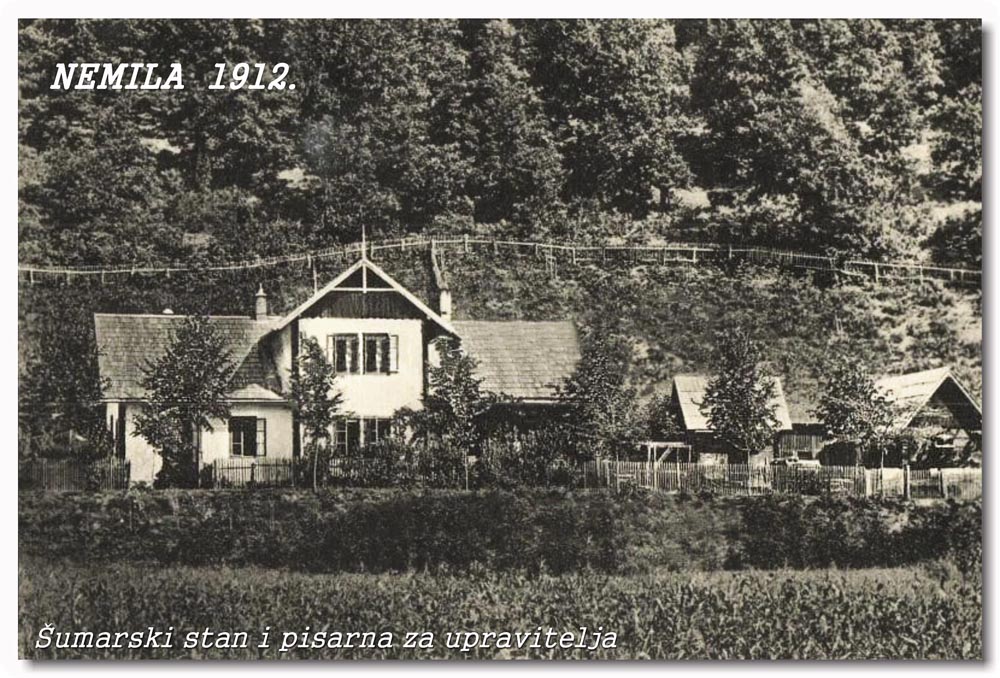
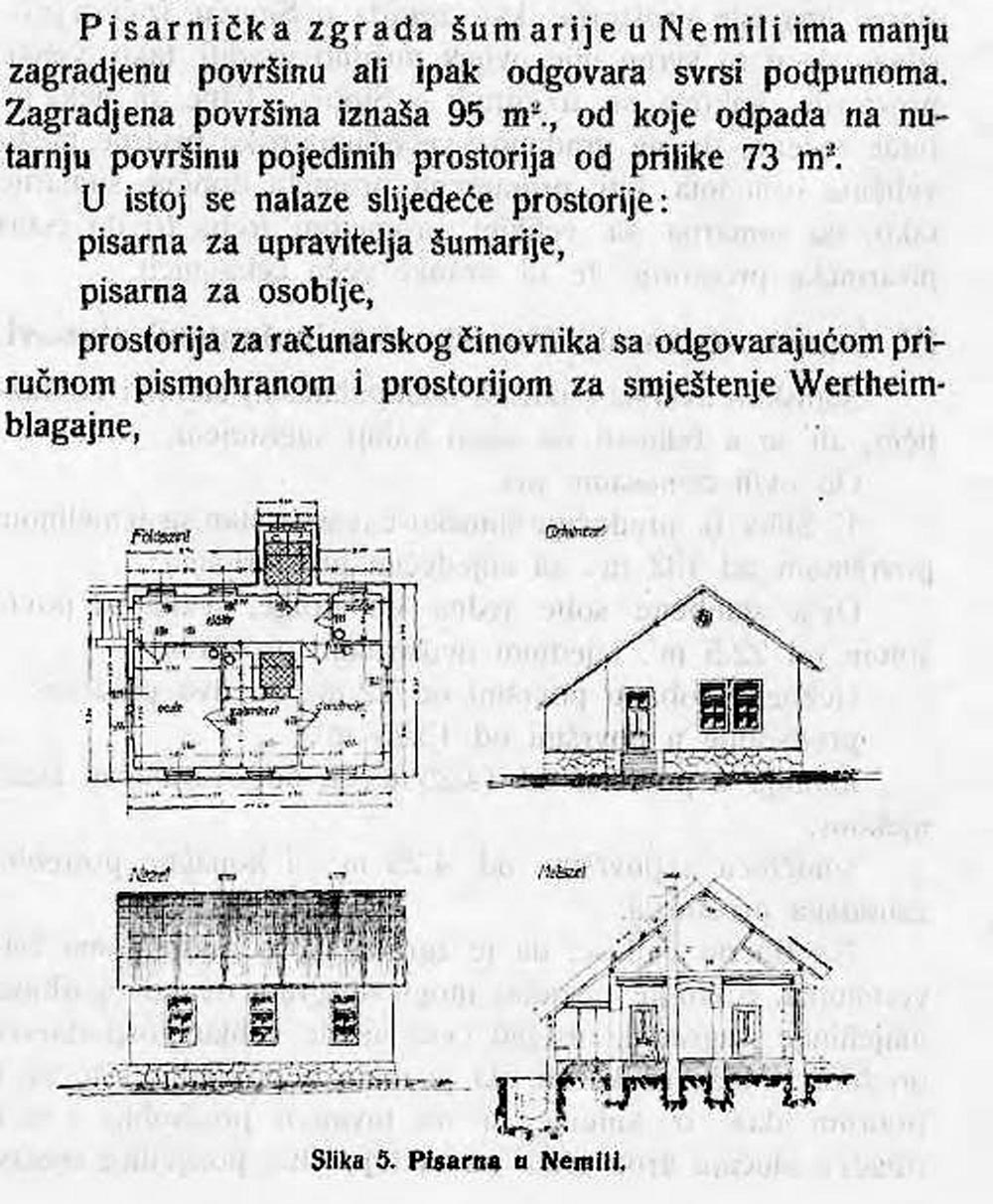
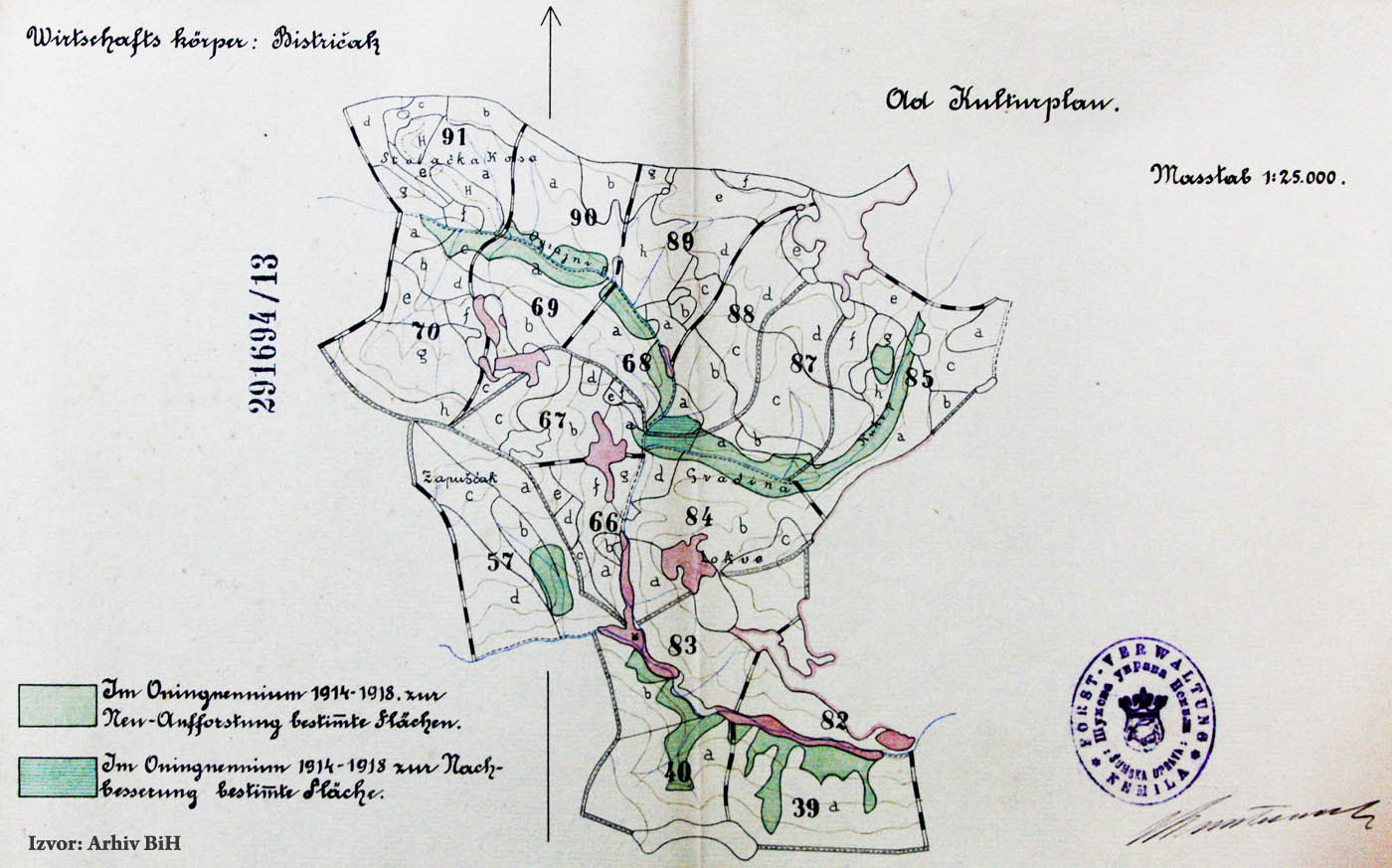
Begov Han was located in the forested area of Bistričak and Pepelari, which were under the supervision and management of the Forest Directorate in Nemila. For these occasions, in 1912, a Forest Station with an office for the manager and a smaller Forest Service building would be constructed. It will be a long time before these forested areas are treated as exploited zones, which will then be defined through long-term exploitation contracts. Until then, the territorial treasury of the Forest Directorate in Nemila, on a smaller part of the forest surfaces, was utilized at its own discretion, primarily for supplying fuel (charcoal) for the needs of the Vareš iron industry. [end]

The first example of an exploitation contract will be made with Ibrahim Džinić from the Doglodi municipality. (Source: ABH FDŠS no. 3811 ex. 1934 – box. 36.). Along Bistričak stream, he will build a water-powered sawmill, and he was cutting timber in the forested area of Bistričak; however, he could not realize larger-scale exploitation due to poor transportation connectivity. This will also be the case with many private companies, even though they were very interested and had significant capital.
With the construction of the state railway line, conditions were created for the building of branch (forest) tracks. Since larger investment funds were needed for this type of communication, many domestic mixed companies did not dare to undertake such an endeavor. The only solution could be realized through direct foreign investments, that is, investments involving foreign capital.
The Company “Mahmud Beg Fadilpašić & Co.” From Sarajevo
At the beginning of July 1911, an auction was held for the sale of coniferous and deciduous timber in the forest area of Nemila, covering approximately 8,067 hectares. The most favorable bid was submitted by the company “Mahmud Beg Fadilpašić & Co.” from Sarajevo. The consortium, led by the landowner from Sarajevo, Mahmud Beg Fadilpašić, consisted of seven local men from reputable trading families. In November 1911, the Government of the Land entered into a long-term contract with this company for twenty years of exploitation of the forest in the Nemila area (Nemila-Bistričak and Nemila-Pepelari), which contained about 1,243,000 cubic meters of sawable wood mass. The contract included optional sales of oak and beech firewood, and in case the company was not interested, this wood would be managed by the forest administration of Nemila to produce charcoal for the needs of the Vareš iron industry. (Source: ABH FDŠS No. 11055 ex 1922 – box 6).

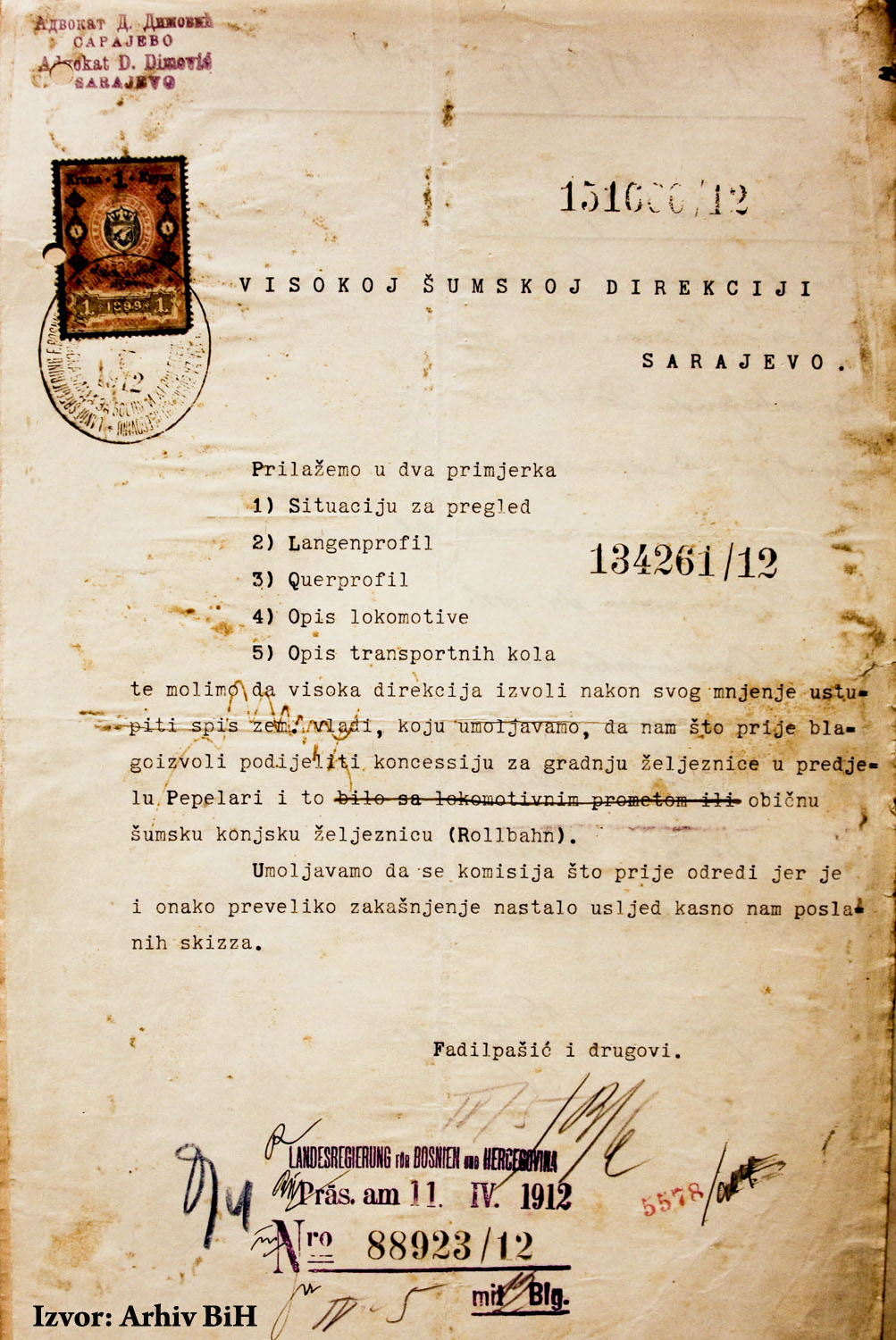
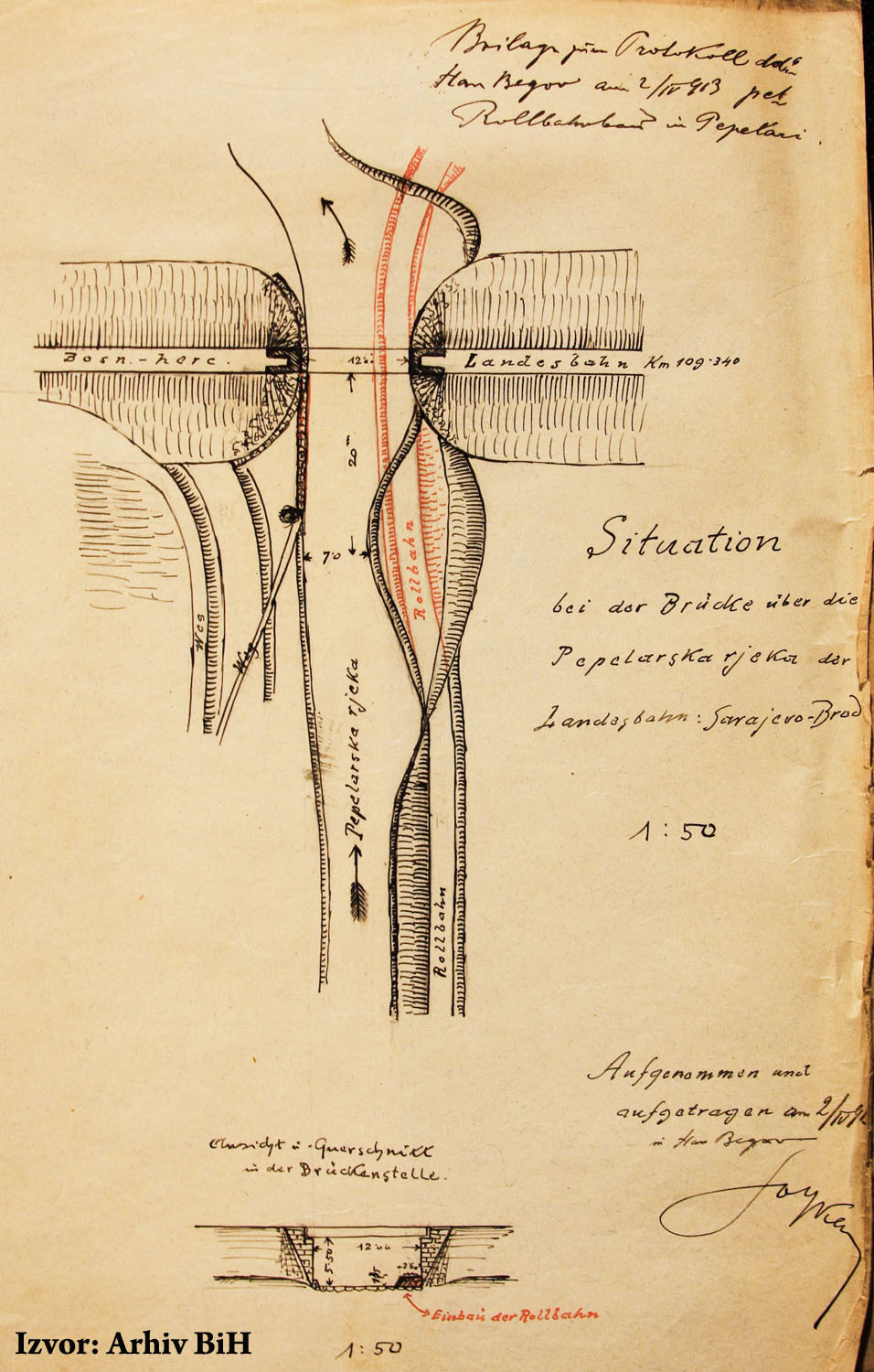
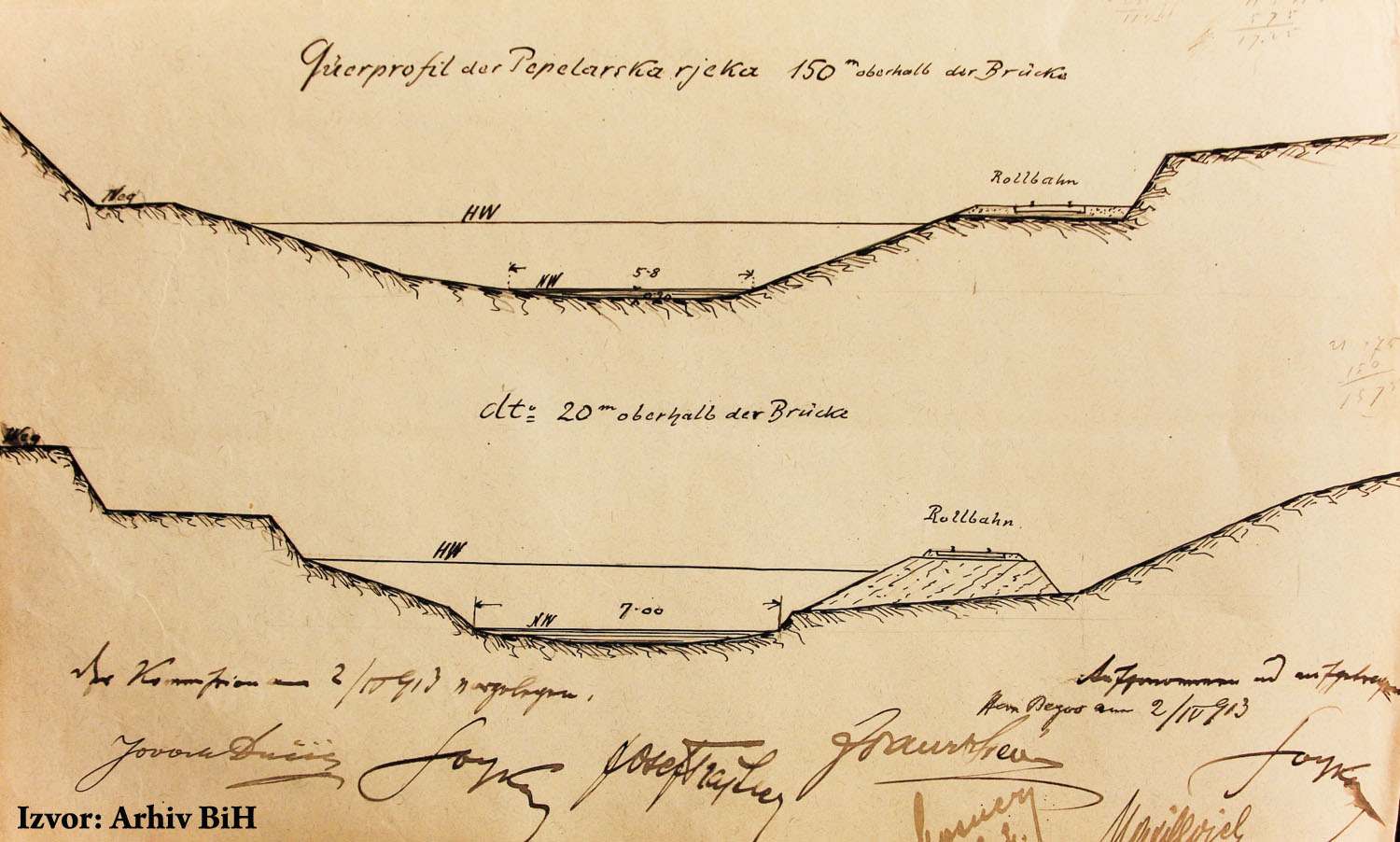
The implementation of the contract began in 1912. Preparations were made for the construction of an industrial plant in Begov Han and the development of plans for the future railway forest route along the Bistričak stream (“Bistričaktalbahn”) and the forest gravity railway (“Rollbahn ‘Pepelari'”) in the Pepelarska River basin. From the very beginning of its operations, the company found itself in a severe financial crisis due to difficulties in securing a loan for investment investments related to the construction of the network of forest communications and the industrial plant. As a result, the company was forced to involve foreign capital. The salvation from bankruptcy was found at the time of establishing and registering a joint-stock company called the Industrial and Commercial Joint Stock Company “Bosna,” Begov Han (“Industrie – und Handelsaktiengesellschaft ‘Bosna,’ Han Begov”) in 1913.
Industrial and Trading Joint Stock Company “Bosna”, Begov Han
The joint-stock company “Bosnia” will carry out the transaction of seized assets and the transfer of all long-term contracts of the former company “Mahmud Beg Fadilpašić & Co.” with its initial capital (Austrian capital). At the head of the newly established company was an Austrian, while the previous partners in the consortium became shareholders. The transfer and ratification of the agreement were completed in January 1914.

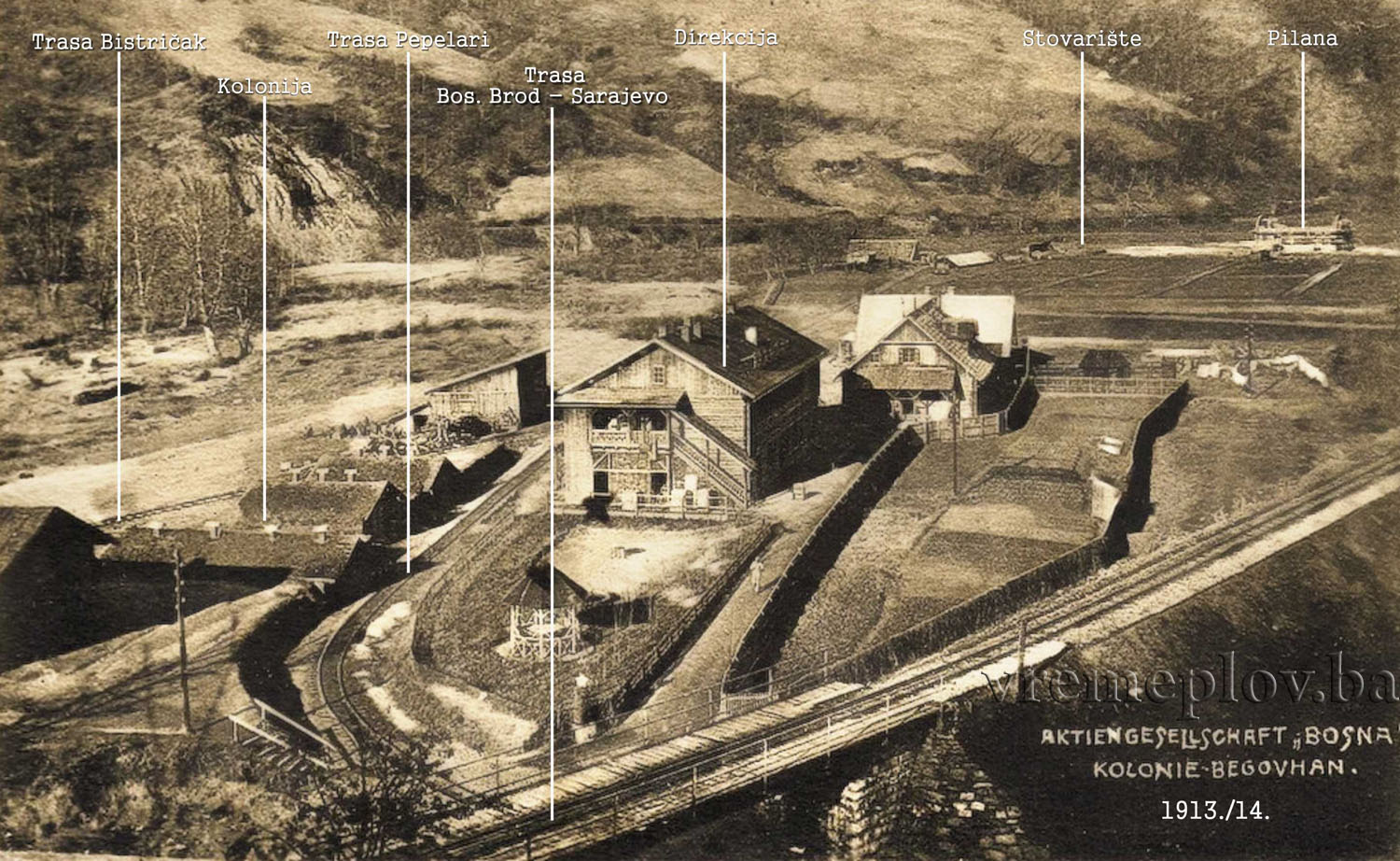
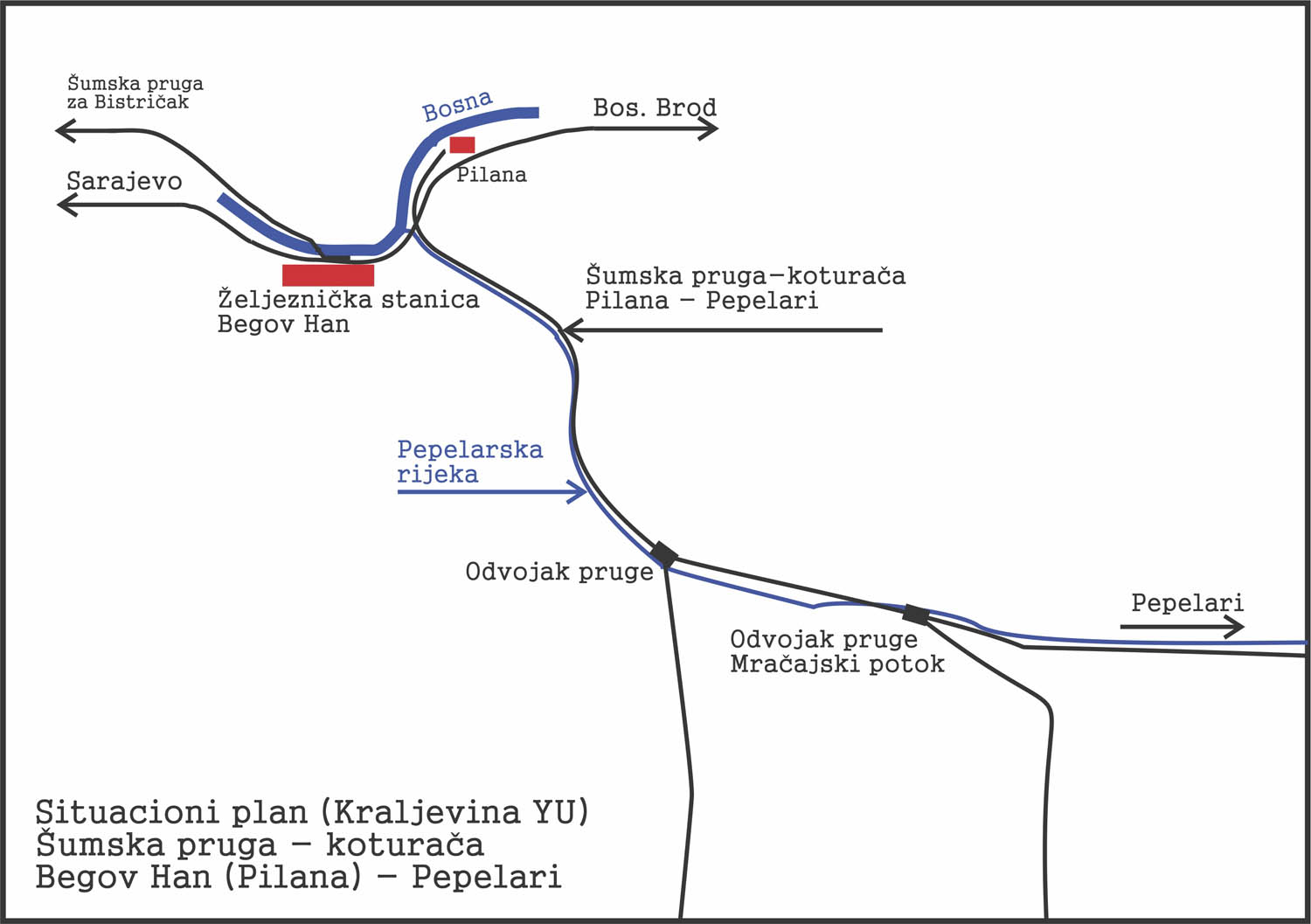
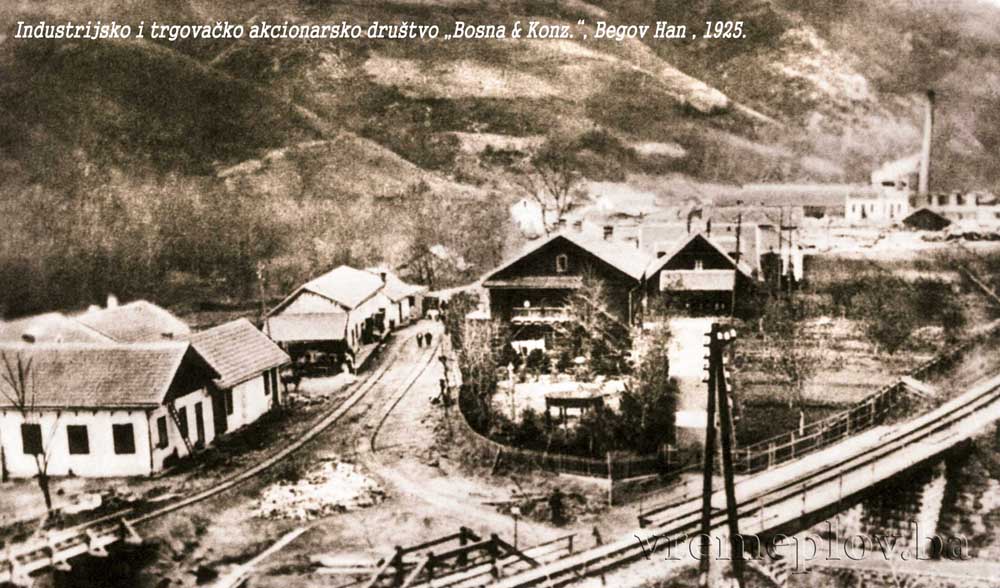
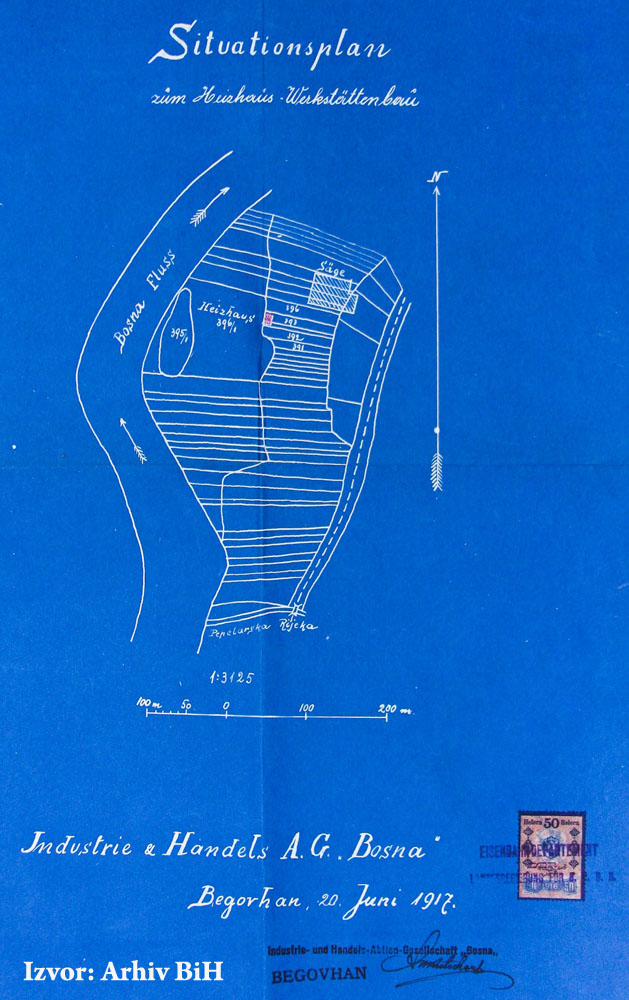
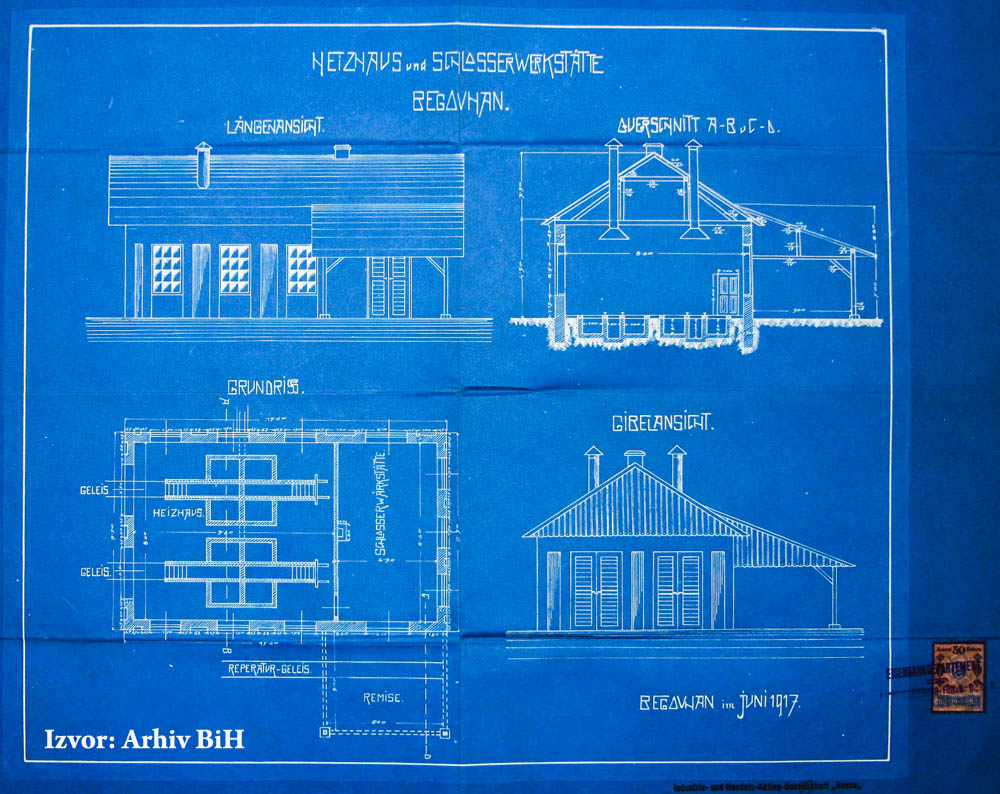
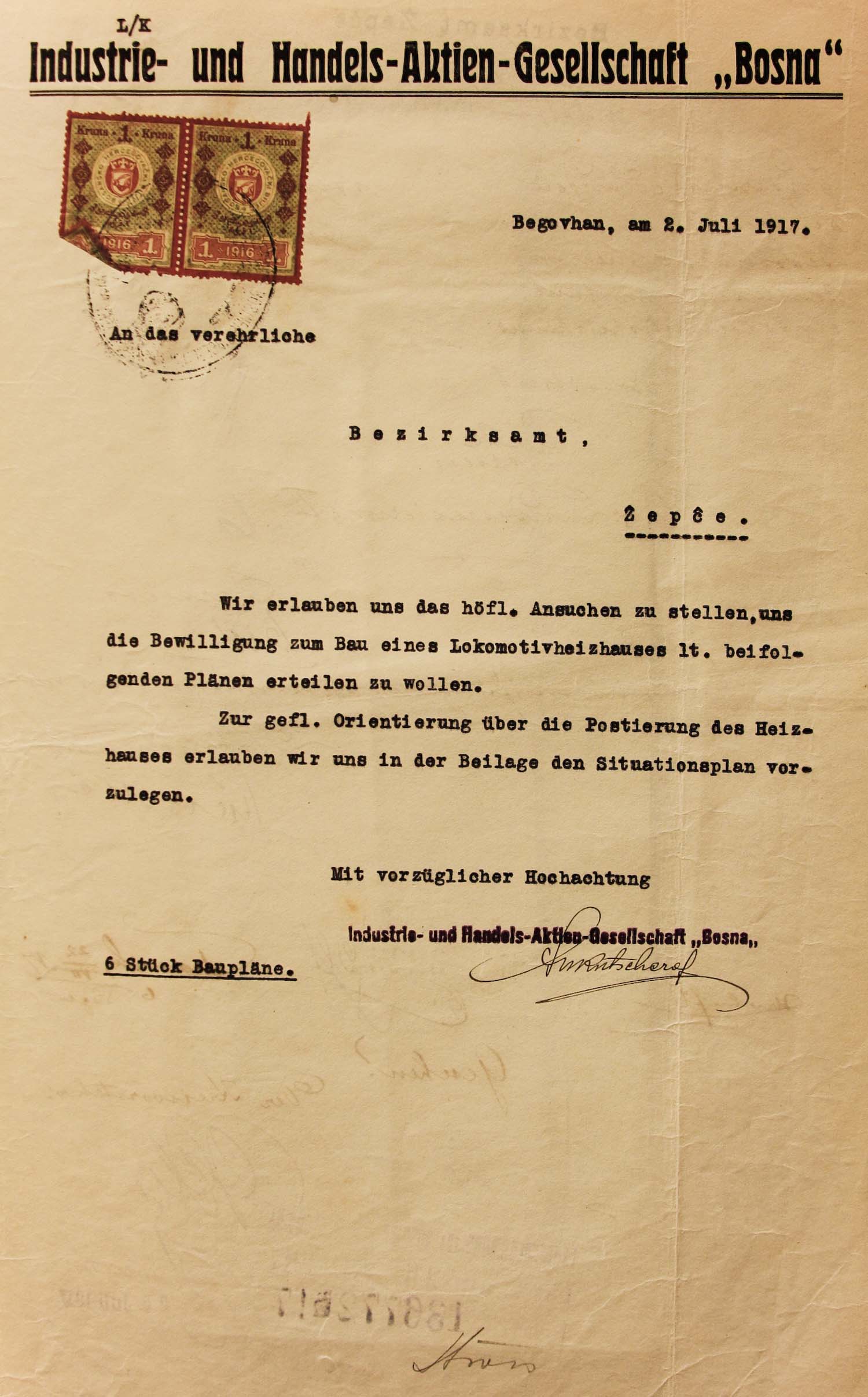
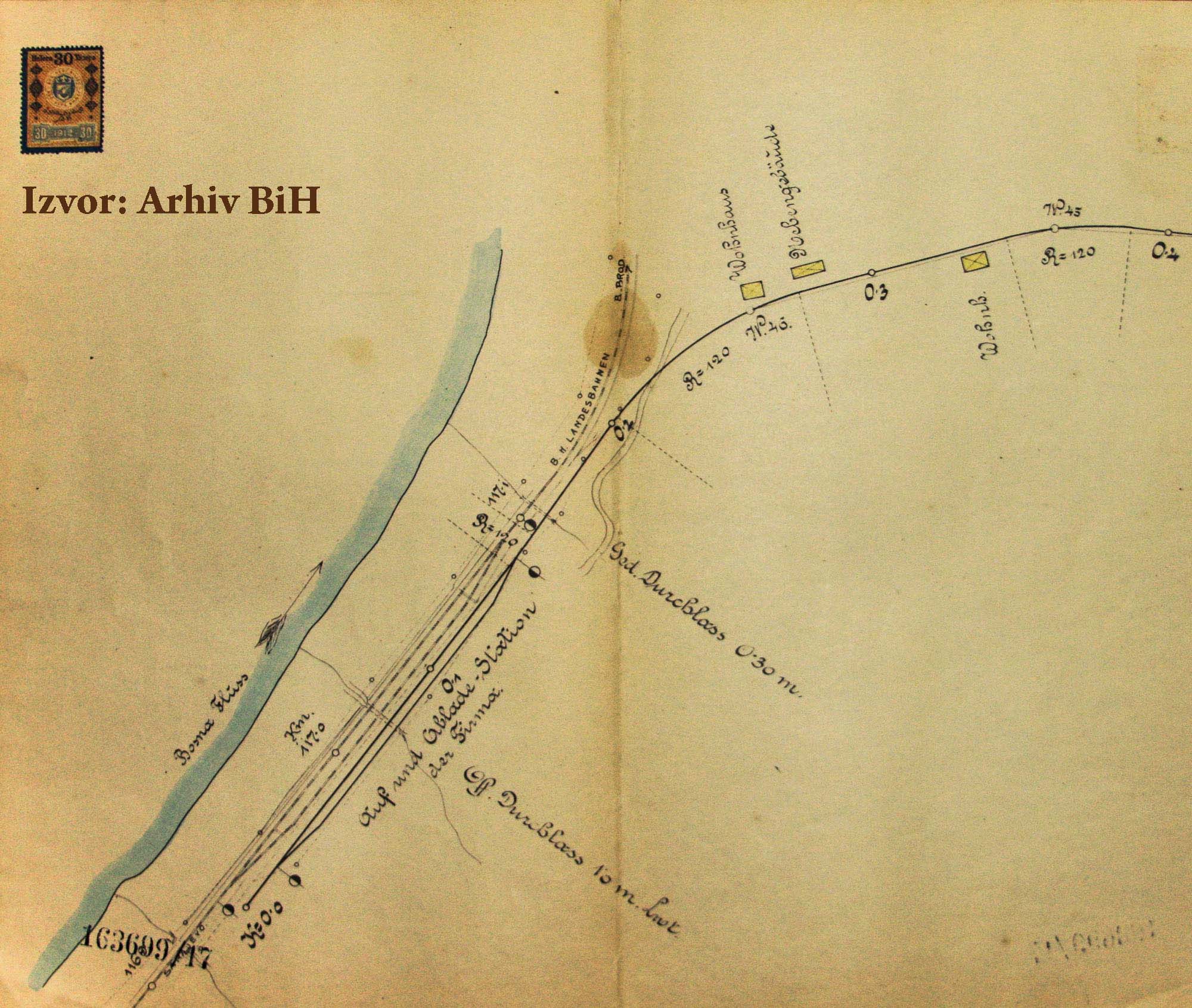
Immediately after the transaction (in 1913), the company Industrial-Trade Inc. “Bosna” ([“Bosna & Konz.”]), began construction of a steam-powered sawmill, where it plans to install four full loaders and build a railway transportation system with a gauge width of 760 mm for the purpose of transporting wood from the contracted areas. The profile of the zero kilometer mark of the company’s railway, toward Bistričak, was aligned parallel to the state railway at the Begov Han station. West of this profile, an industrial track will be built, spanning over a wooden bridge above the Pepelarska River (the bridge owned by the sawmill) and leading to a storage site with a built sawmill and an auxiliary siding. By this track, there is a technically connected link to the tracks leading toward the locomotive depot with capacity for two locomotives.
Among the employed foreign workers who performed more complex jobs, the industrialist’s (Austrian capital) primary interest was in seeking cheap and stable labor.
The solution in implementing a “staffing” policy could only draw from the local population as the sole source of human resources. Their employment marks the beginning of a gradual stratification process of the rural population. However, although torn between the land they farmed and industry, they were offered opportunities to earn cash. Hard-earned money was mostly spent on fulfilling increasing financial obligations to landowners and the state.
Employment outside of agriculture, but never at the expense of leaving the land uncultivated, gradually pulled rural residents out of centuries-old backwardness and subsistence farming, and to some extent, improved their standard of living.
Investments made by the company “Bosna & Konz” in the construction of a sawmill and planned roads can be freely attributed to being the initial spark of a “small” industrial revolution in this region, which resulted in the urbanization that developed around the sawmill facilities. Naturally, it is essential to mention that the local government also participated in all of this, based on the planned policies of urbanization and industrialization of underdeveloped areas in the occupied country.
Unfortunately, the field of education and literacy was marked by tragic conditions. The then-government was deaf to and lacked awareness of the need to educate the children of workers and children from the surroundings of Begov Han. This opportunity would only be granted in the year 1921 (Kingdom of Serbs, Croats, and Slovenes) through the construction of a school building called “People’s Elementary School in Begov Han.”
Construction of the “Bistričak” forest railway and “Pepelari” switchback in Begov Han
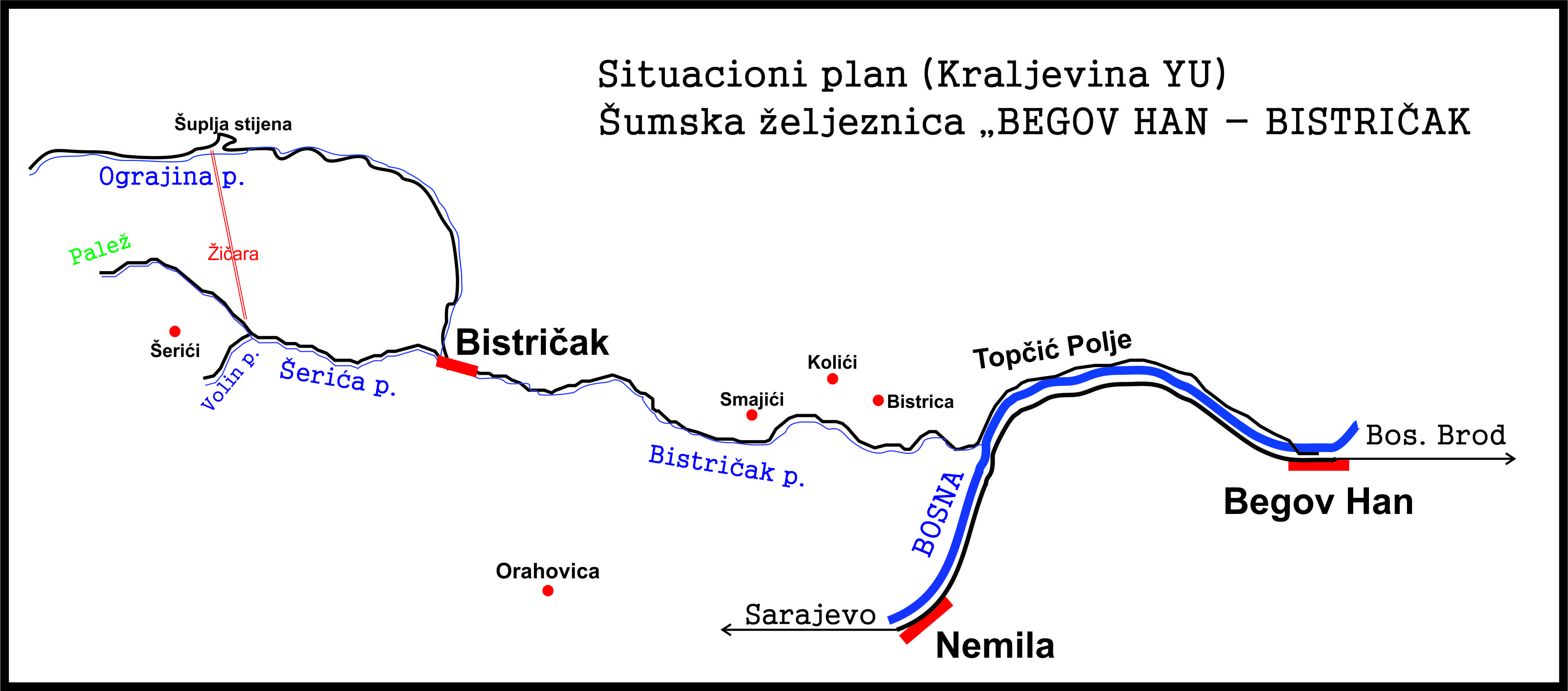
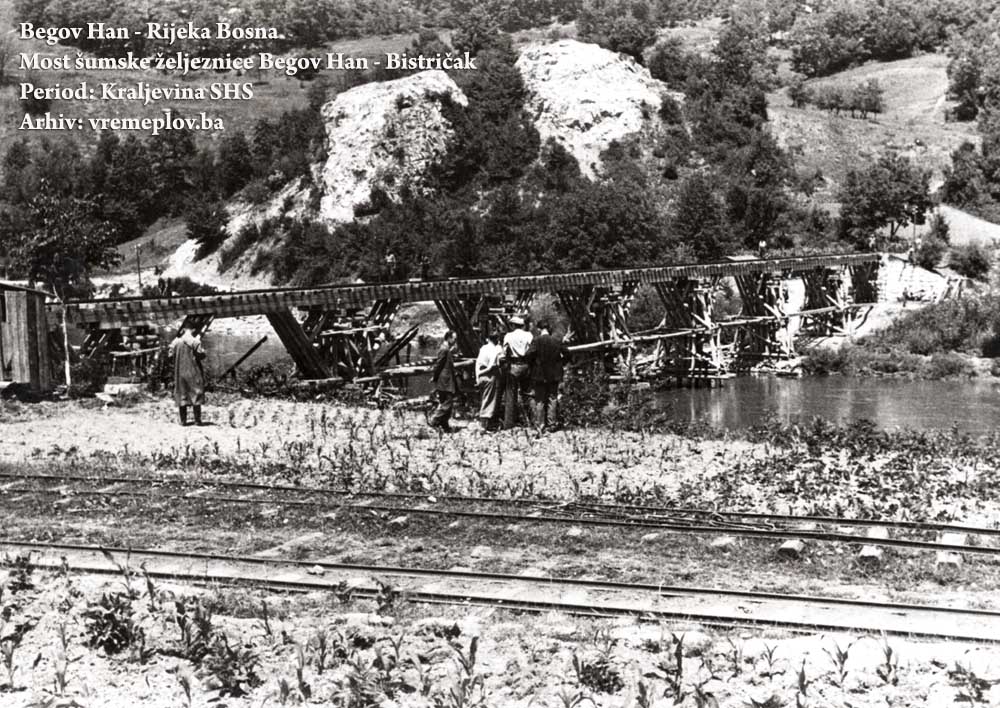
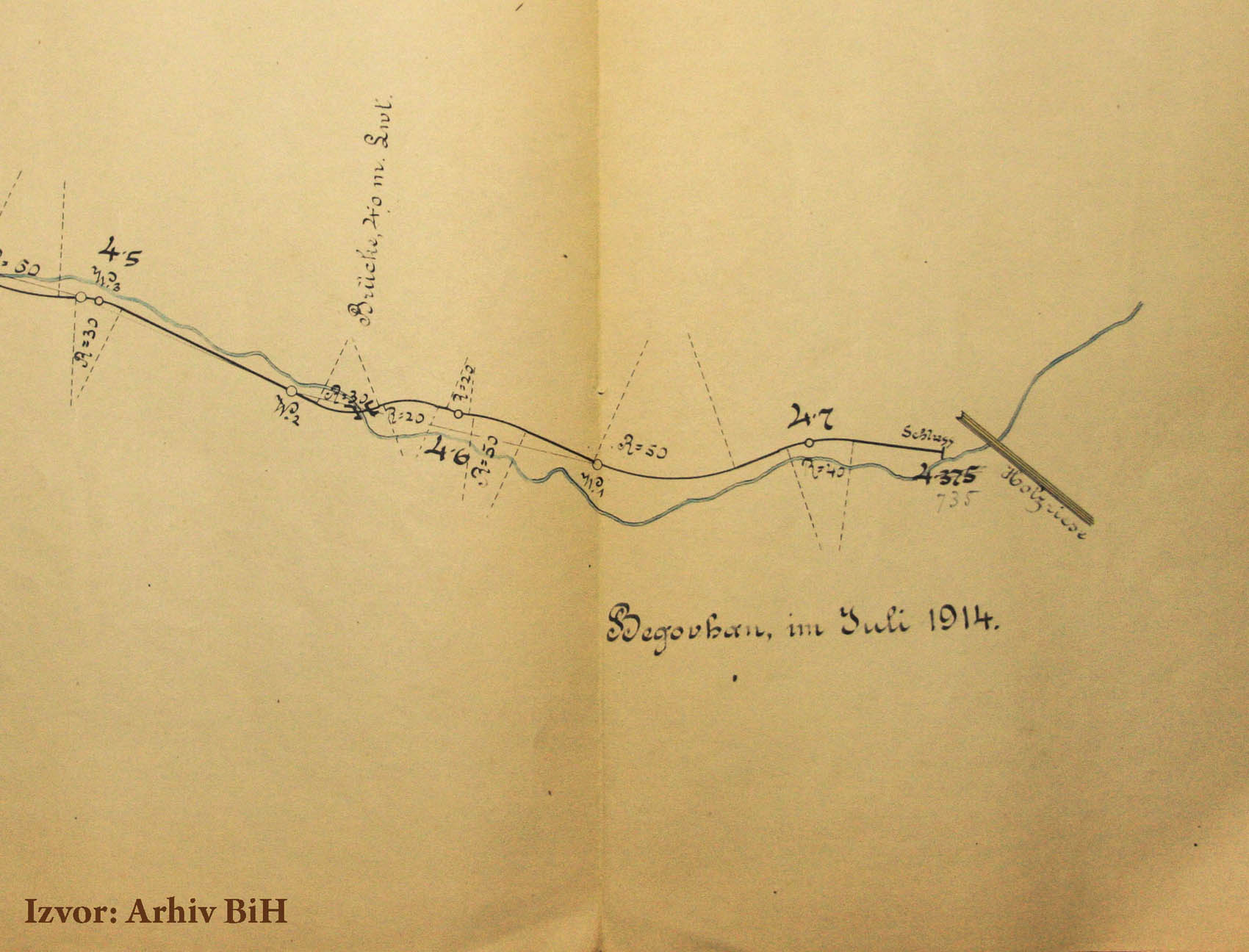
Construction of the northern forest route towards Bistričak from the initial profile (Begov Han station) runs upstream on the right bank of the Bosna River for about 200 meters, then continues right over a built wooden bridge, and leads to the left bank of the river. The route then crosses Topčić Fields all the way to the mouth of Bistrički Creek into the Bosna River, continuing along the left side of the stream’s basin to a location historically called Bistričak under a “working name.” At this site, a small workers’ settlement with auxiliary buildings, a workers’ cafeteria, and a clinic will eventually be built.
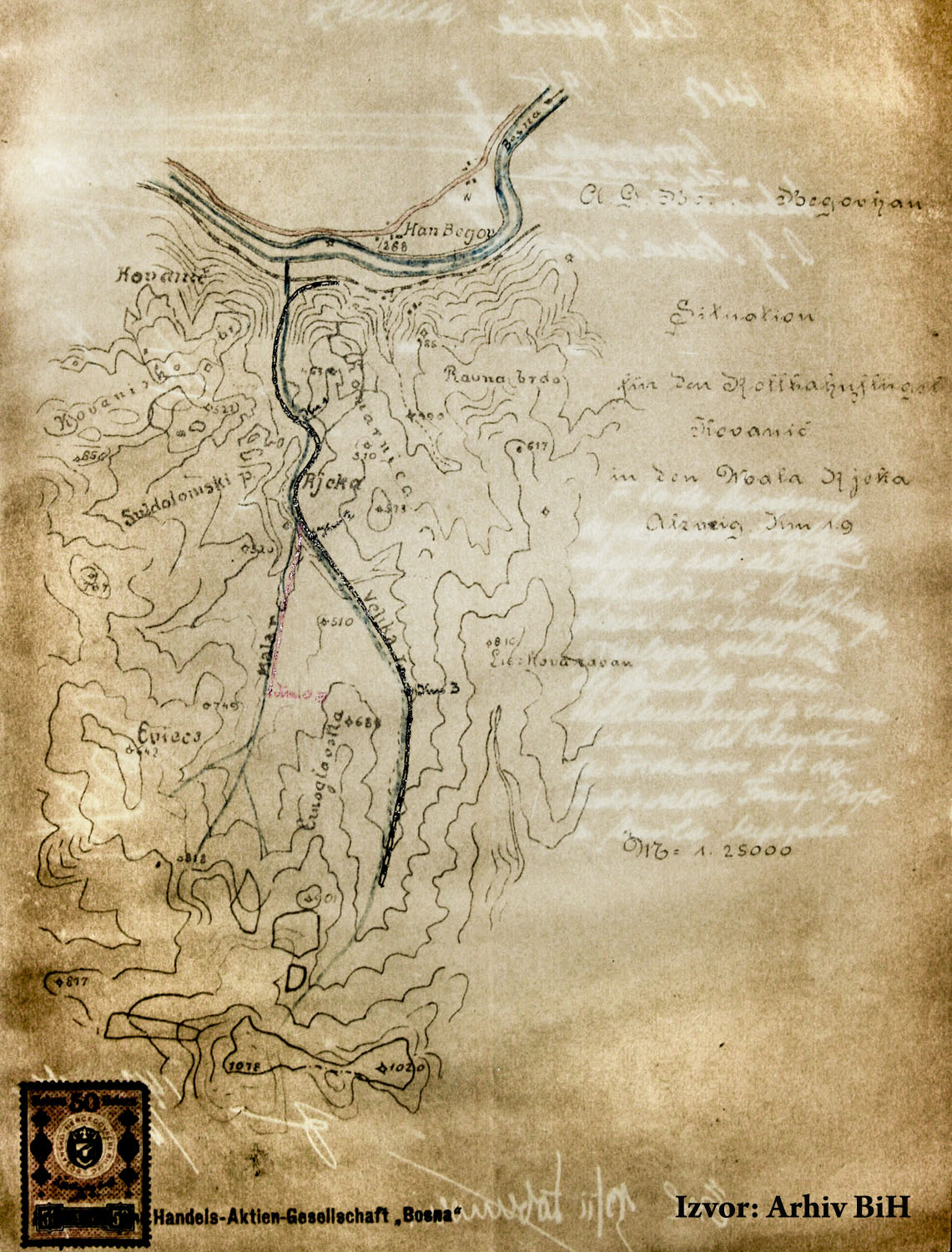
The necessary railway infrastructure will consist of a station building with station tracks, a water reservoir with a gravity-fed water tower supplied by the Ograjina stream, as well as a locomotive shed with a workshop for servicing locomotives and freight cars, and a wood storage for locomotive fuel. From this location, the track will branch in two directions: one along the Ograjina stream to Šuplja Stijena, and the other along the Šerićki stream. Since the contractual forest area extended further beyond Šuplja Stijena, and due to the challenging terrain, the project (which due to difficult access prohibited further track construction) was adjusted with the decision to lower the wood cut via steam cable car over Ljeskov Vrh to Šerić, where the forest railway’s loading ramp was located. According to available data, this forest railway with locomotive-powered branches was approximately 19.4 km long.

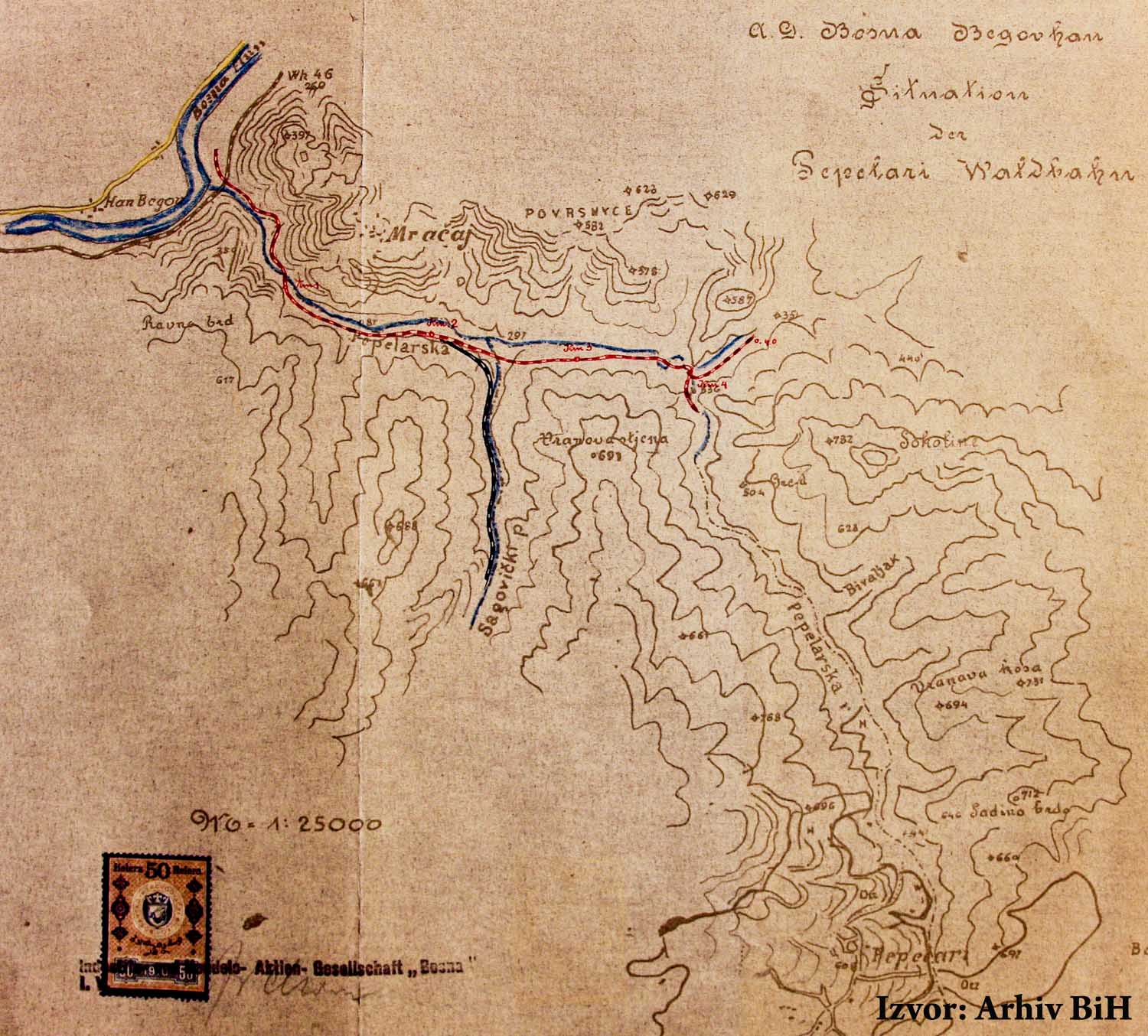
Along with the construction of the “Bistričak” railway, the building of the forest gravity railway “Pepelari” (track gauge 760 mm) from the sawmill in Begov Han was initiated, then beneath the railway overpass of the state railway, and it ran along the right side of the Pepelarka River basin to the location called Pepelari. This railway with branches, until the outbreak of the war (1941), was approximately 33 km long.
According to some sources, the company “Bosna & Konz.” from Begov Hana built a forest railway approximately 9.0 km long and a gravity railway (a gravitation incline) about 4.1 km in length, powered by animals, during 1912-1916, totaling around 13.1 km.
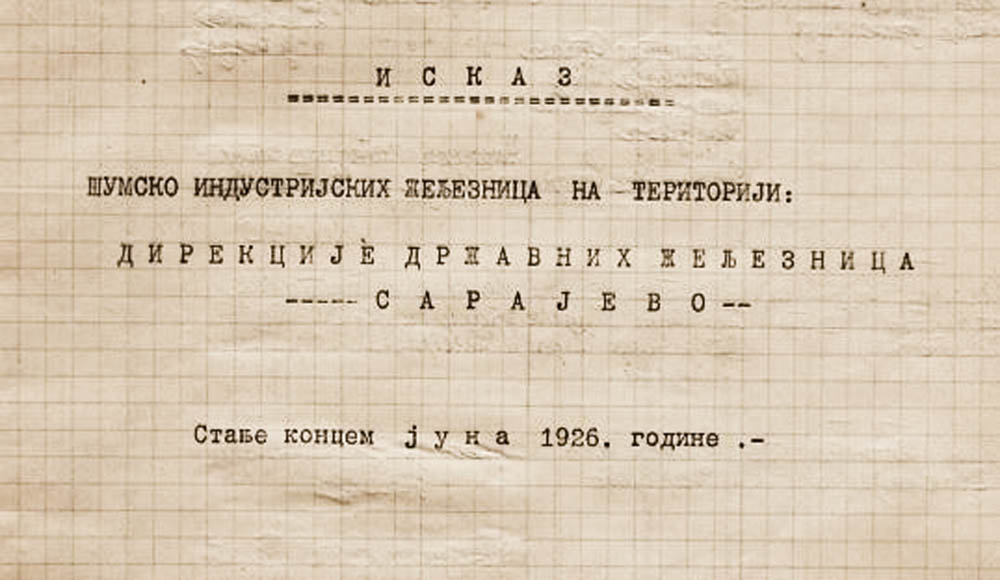
An overview of the archival documentation (Report on forest industrial railways within the territory of the State Railways Sarajevo, June 1926) indicates that the company „Bosna & Konz.“, based on entered data, for the forest railway „Pepelari“ states: Pepelari River 11.550 km, branch line Mračajski Potok 4.450 km, network of tracks for animal-powered locomotives 2.700 km, within the sawmill area (planer) 1.400 km, and the track from the planer to the profile (109.648 km) of the state railway 0.250 km, totaling approximately 20.350 km (Source: author’s personal archive).
Construction of the forest railway – “Želeća Potok” cableway
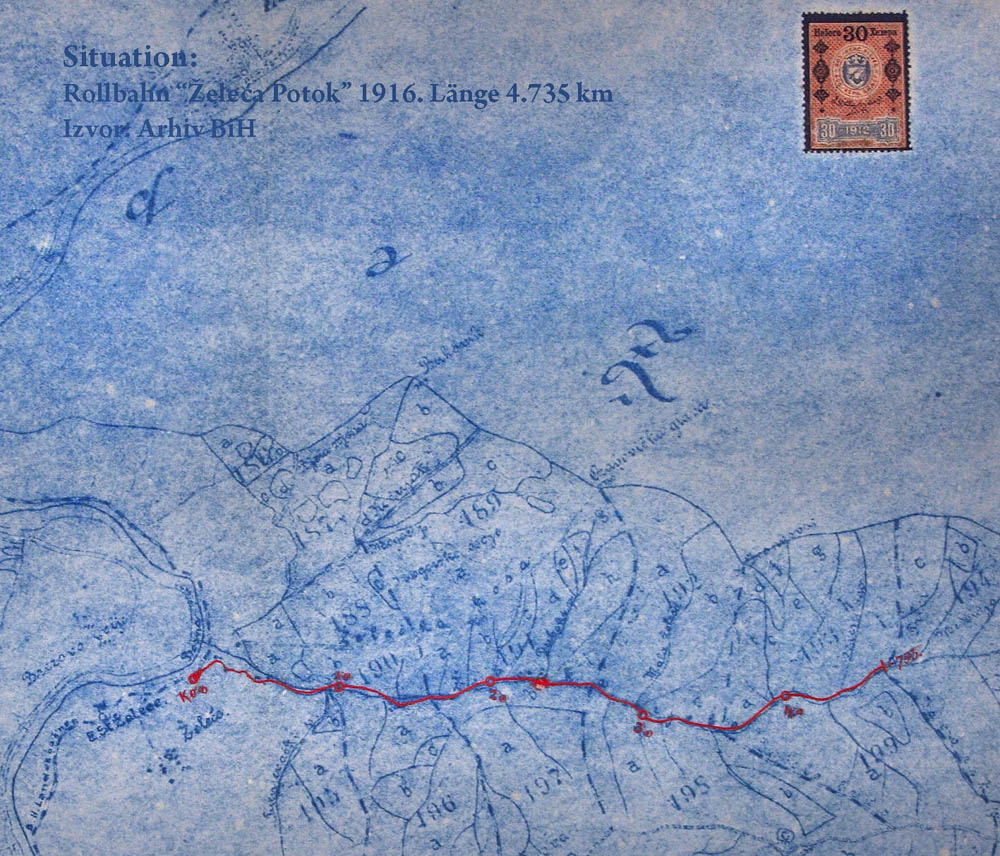
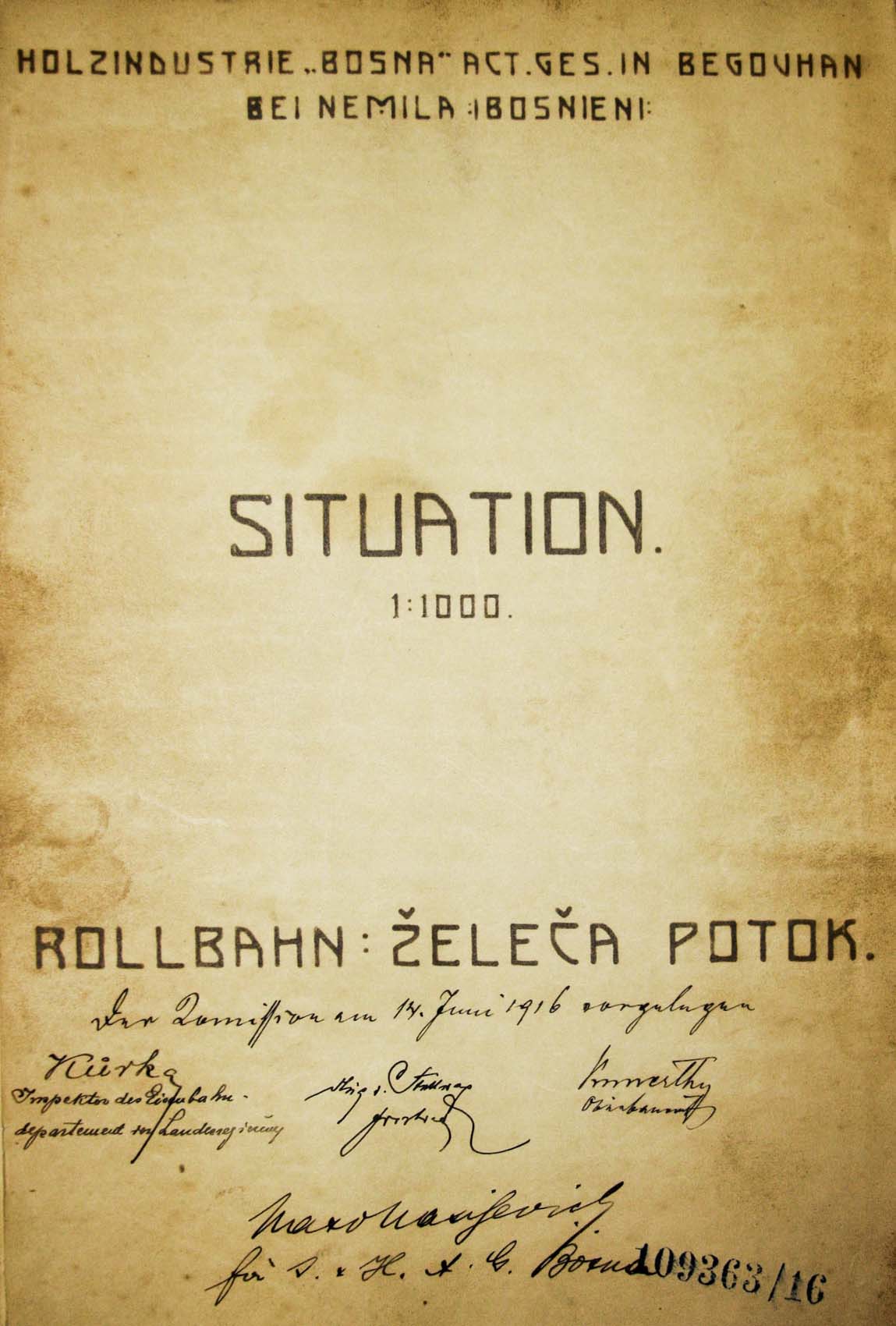
It is little known that the company “Bosna & Konz.” built a forest railway called the Rollbahn “Želeća Potok”. It was designed during World War I (1916) and put into operation in 1917. The length of the railway was approximately 4.735 km. The initial profile ran parallel to the station line of the state railway in Želeća (at km 102.842), where a freight loading and unloading ramp was constructed. The route up to the profile at km 2.800 was built with locomotive power, while the remaining part of the route was operated by horse-drawn carriage. The locomotive operation was carried out by the “Usora” locomotive (KrLi 2412/1889), operated by a certain Joseph Sećen, a pensioner.

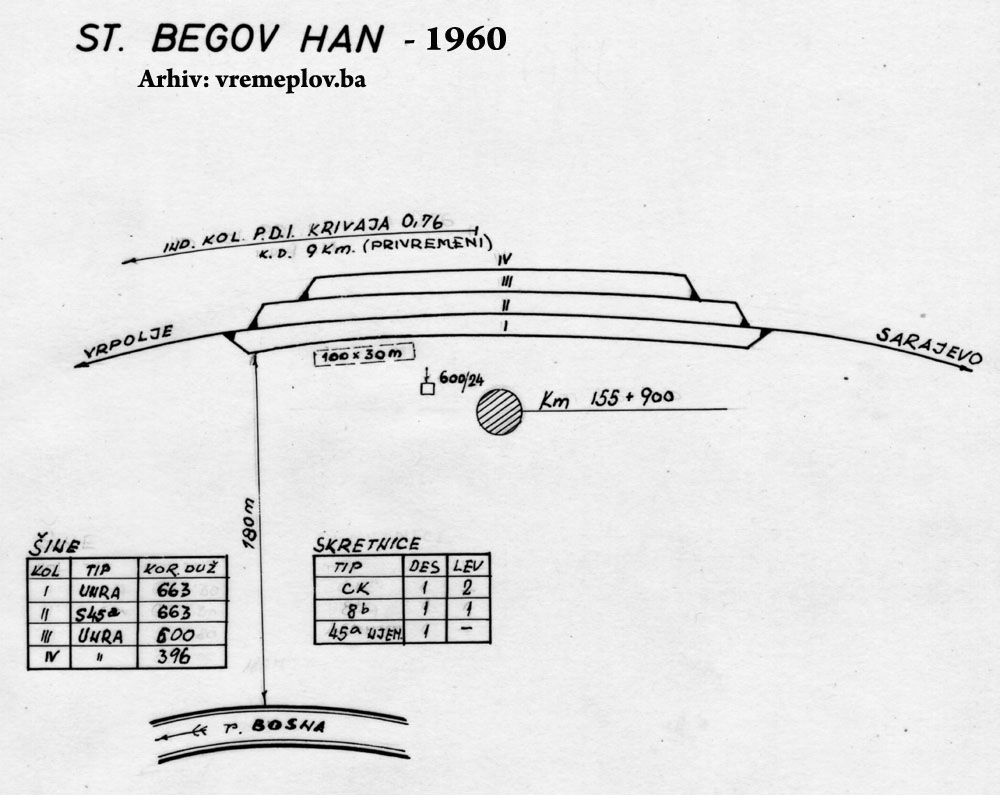
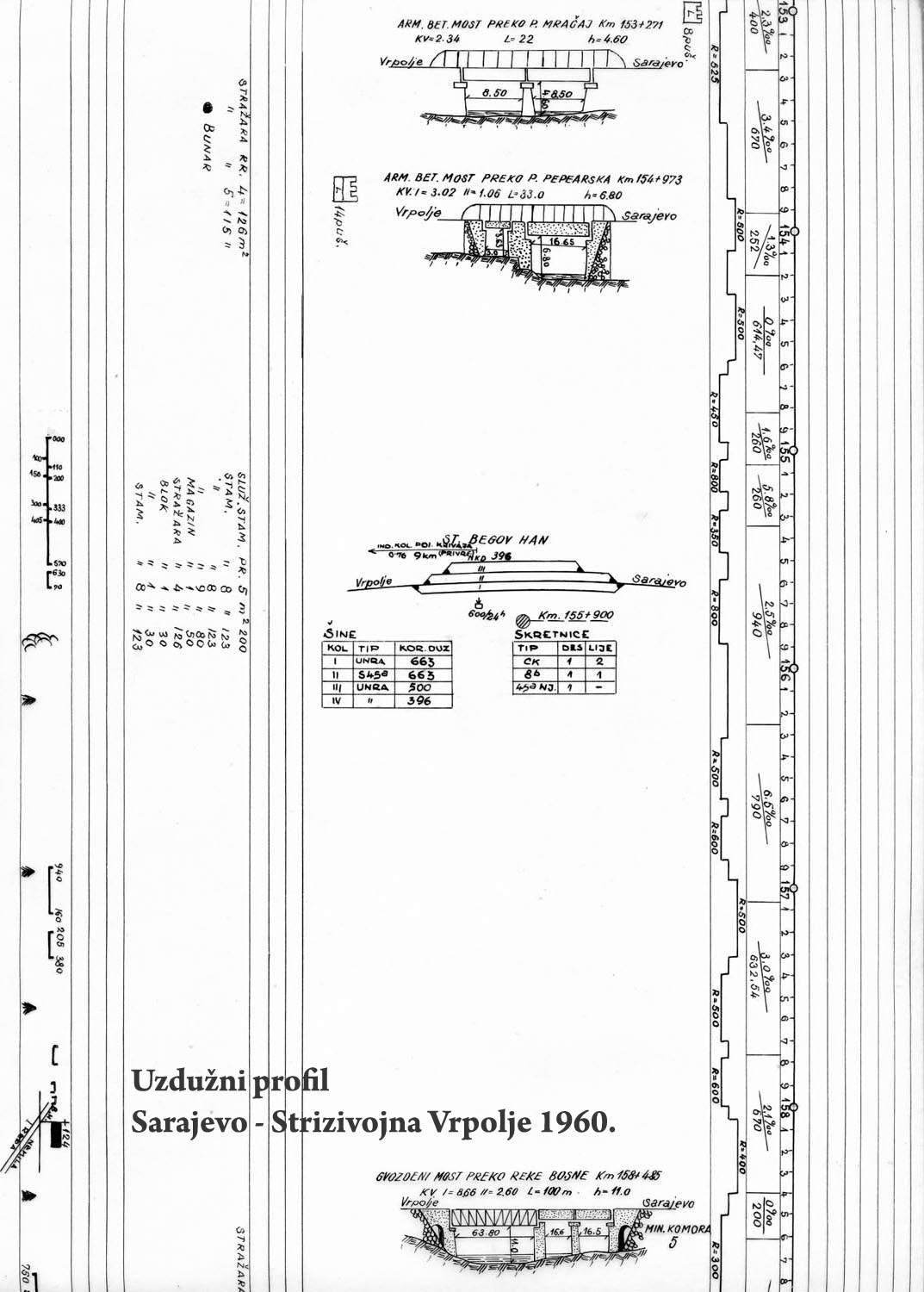
At the end of the track was a storage yard for the log mass delivered by wooden cranes (Holzrutscheriese) from the slopes of Mount Debelo Brdo. The structure (Rollbahnenflügel) was built in Kovanići and transported to the field. Little is known about the fate of this railway after 1918, and there are no data on when it ceased operation. However, based on a sketch, specifically the “Begov Han Station Scheme” (1960), it states that alongside the IV track of standard width, a “temporary” industrial track (width 760 mm) was drawn and runs toward Želeća station, spanning 9.0 km. The owner (operator) of this industrial railway is P.D.I. “Krivaja.” Since the distance to Želeća station is 6.8 km, it is likely that the remaining 2.2 km led along the ‘old track’ of the “Želeća potok” railway to the junction with the turntable.
**Business Operations of “Bosna & Konz.” After the End of the War (1914)**
The operations of the company “Bosna & Konz.” fell into difficulties due to the events and circumstances surrounding the so-called Balkan crisis and the partial mobilization of personnel and livestock teams (1913), as well as the beginning of World War I (1914). After the war ended (1918), the Industrial-Trade Joint Stock Company “Bosna” gradually transitioned into the ownership of domestic capitalists (over 80% of share capital), mostly from Bosnia and Herzegovina. In 1919, the long-term contract from 1911 was terminated (as were all long-term agreements of foreign firms in Bosnia and Herzegovina), and then in 1921/22, a new twenty-year exploitation contract was signed between the company “Bosna & Konz.” and the Ministry of Forests and Mines for the same contractual area. In 1923, a supplementary agreement was concluded, which added some servitude sections from neighboring villages to the contractual area.

Sale of the company “Bosna & Konz” in favor of Našička d.d. in Begov Han
As we mentioned, the state, through nationalization (1919), took possession of the majority of the enterprise “Bosna & Konz.” The new shareholders (domestic bourgeoisie) had neither the interest, willingness, nor the ability to increase the company’s production, but instead engaged in speculation and quick wealth accumulation. As a result, the company struggled hard to survive and had little chance for profitable market placement of its products. Since foreign capital, in the 1920s, became very distrustful of investments and lending to the Bosnian-Herzegovinian economy, and domestic banking circles were unable to finance independently, the sale of the company’s assets and capital would follow.
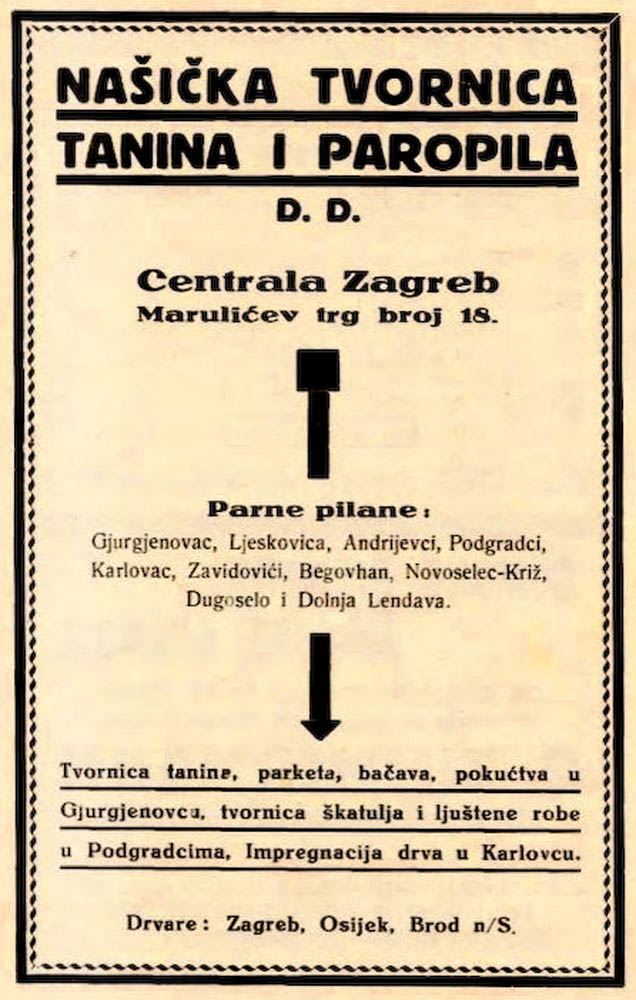
In 1927, the company “Bosna & Konz.” purchases the Našička d.d. firm, with the transfer of rights to utilize forest lands based on signed long-term agreements, as well as the buyout of all transportation communications with mobile equipment and sawmill facilities.
The company Našička d.d. was founded in 1887 by a group of Hungarian, Italian, and Swiss entrepreneurs near the town of Našice (Kingdom of Slavonia). It quickly grew into a large enterprise because its joint operations extended across trading companies from Hungary, Czechoslovakia, Austria, Germany, Romania, and Yugoslavia, which were engaged in forest exploitation and the production of wood assortments.
After 1918, on the territories of the successor states of Austria-Hungary, “Našička Tannery and Steam Distillery Inc. in Zagreb” united in 1921 into a huge Holding (Holding company – Union des exploitations forestières de Nasic Geneva) and became the largest large-capital forestry enterprise in the Kingdom of SHS/Yugoslavia. The headquarters of “Našička Tannery and Steam Distillery Inc. in Zagreb” was located in Budapest, and the core capital of all its subsidiaries was concentrated in Switzerland (Geneva).

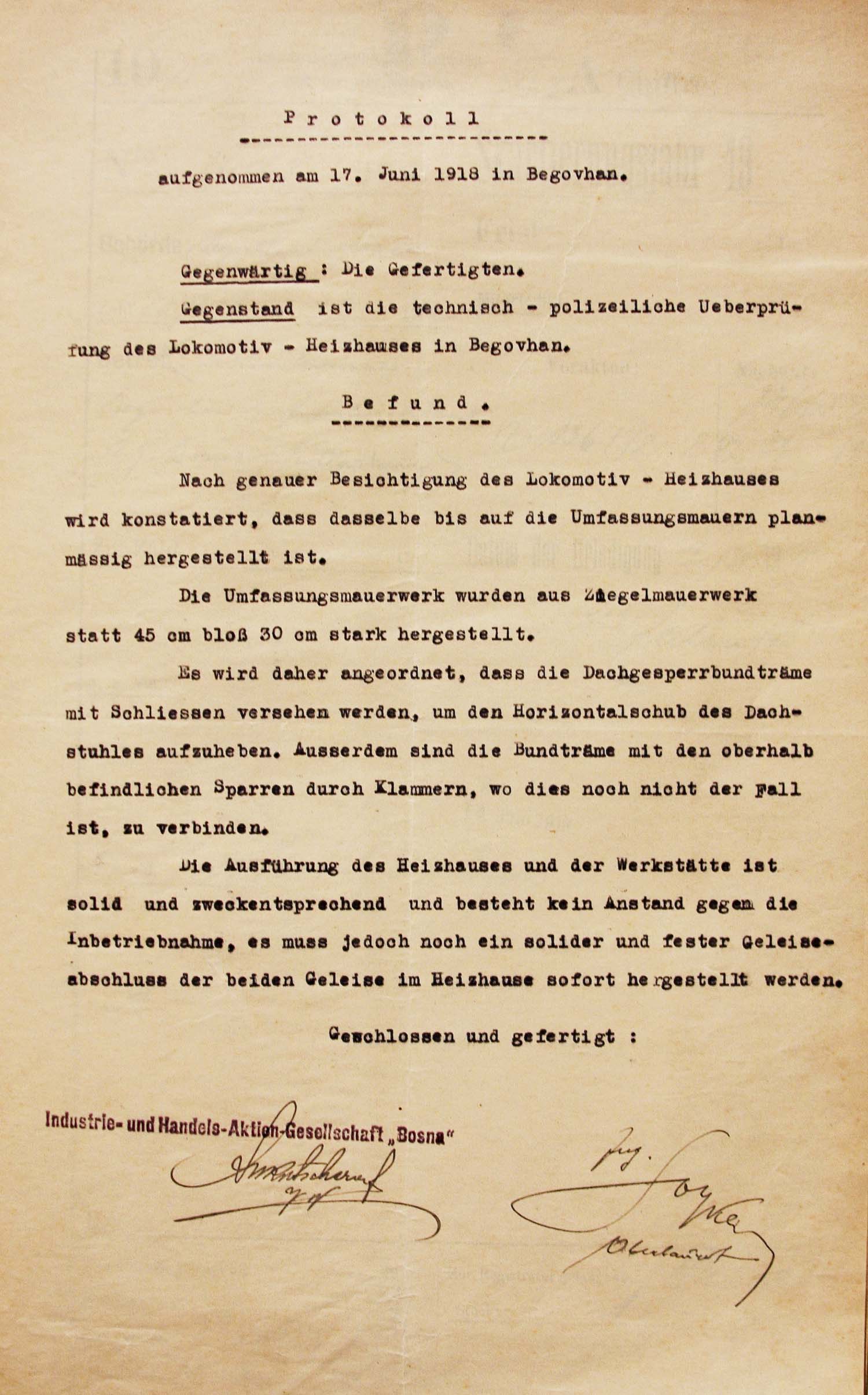
At the time of purchase, by Našička d.d., in the sawmill facility in Begov Han, there was an installation alongside a steam engine rated at 360 horsepower, consisting of 5 gates, of which 4 were full and 1 was a small-residue gate, along with the necessary number of drive and auxiliary machines. The ownership includes the construction land with an administrative building and residential facilities (Worker’s Colony in Begov Han) and other auxiliary structures. Among the transported equipment were 3 locomotives, 35 trucks, and 6 two-axle “Lowry” wagons. These two-axle wagons, in logistical terms, served for the shipment of raw materials and worker transport. The total number of employees ranged from 500 to 800 workers, depending on the season.
During the Kingdom of SHS/Yugoslavia (1918-1941), in the forested area of Nemila, both of these companies utilized approximately 880,000 m³ of coniferous and broadleaf timber, while about 220,000 m³ of unused wood remained unexploited, all due to the Great Economic Crisis that lasted in the Kingdom of Yugoslavia from 1929 to 1936.
Private water-powered sawmills in Begov Han
It is worth mentioning that several private steam sawmills were established at this forestry administration site in Nemila. At the beginning of the twentieth century, Ibrahim Džinić from the Doglodi municipality built the first water-powered sawmill, located near the Bistričak stream. Based on short-term contracts, he cut timber in the Bistričak forest area and transported the wood to the sawmill using animal-powered ‘taljiga’ (log hauler). The sawmill was engaged in craft production, offering various types of construction, hewn and firewood for the local population.
Seeing the competition from the newly established company Industrial-Trade Inc. “Bosna” (in 1913), he decided to sell the sawmill. Vaso Jokanović, a landowner from Tuzla, purchased the sawmill in 1914. The new owner soon modernized the sawmill to increase its capacity for processing wood by installing one “Venetian” gate and two circular saws. The necessary timber was supplied through auctions in the Bistričak forest area. The sawmill owned by Vaso Jokanović remained in operation until the April war of 1941.
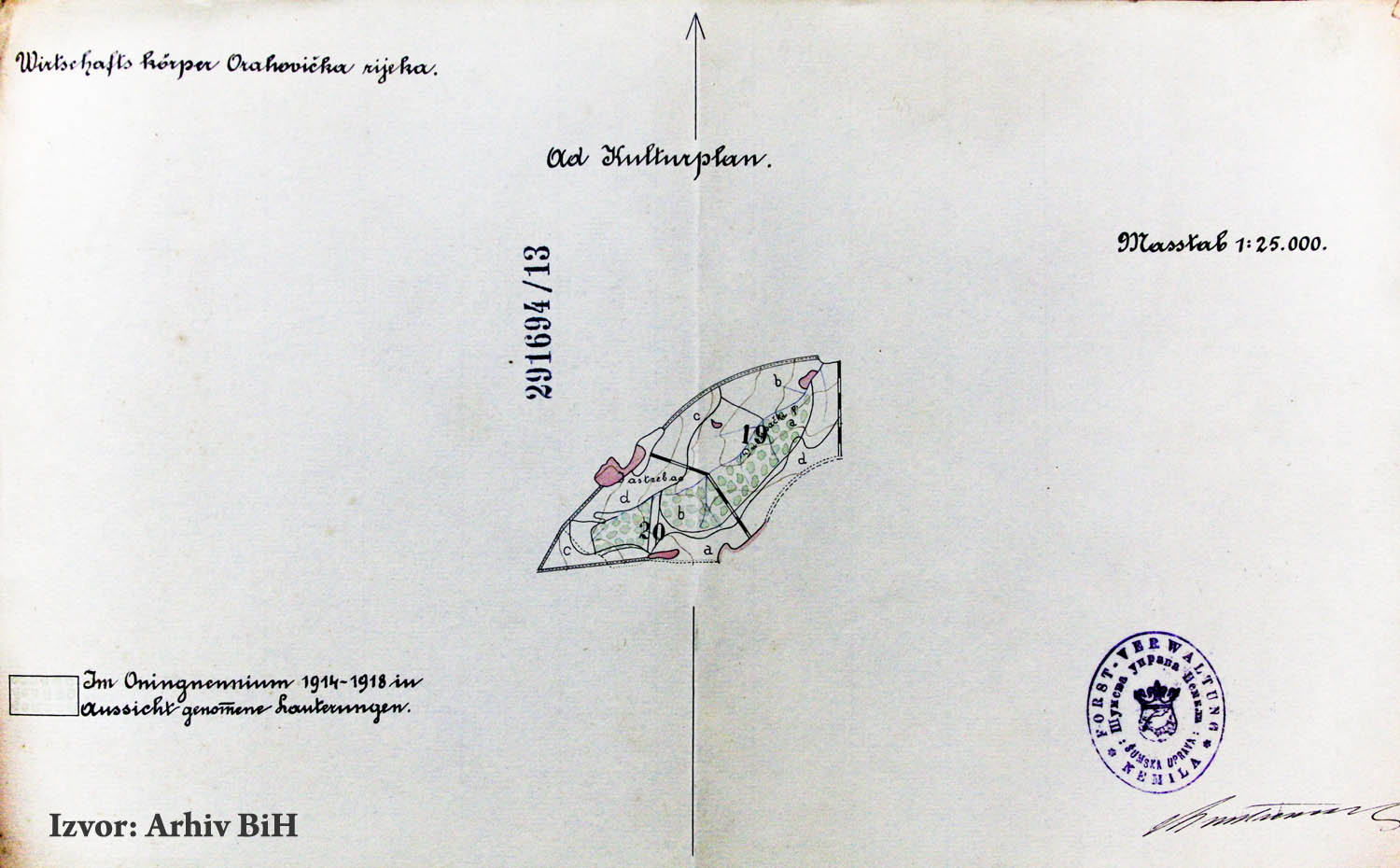
On the right bank of the Orahovačka River, in the municipality of Nemila, Franz Baumgartner built a water-powered sawmill in 1932. The mill was equipped with one ‘Venetian’ gate and one circular saw, and besides producing construction lumber, it also served in sawing ‘merematno’ wood. The necessary timber was supplied through auctions from forests in the area of the Nemila Forest Directorate.
On the right bank of the Pepelarska River, near its mouth into the Bosnia River, a water-powered sawmill was erected in 1932 by a trader from Begov Hana, Đulbeg Zaimbegović. He entrusted the management of the sawmill to his son-in-law, Mustafa Ajanović. Inside, there was one ‘venetian’ gate and one circular saw, processing logs into finished products for broad use in construction. The necessary sawn timber was supplied through auctions from the forests in the Pepelarska River area. The sawmill operated until 1945.
In 1939, Jovo Pejanović from Bistričak built a water-powered sawmill on the Bistričak stream near its mouth into the Bosna River. The sawmill was equipped with one Venetian-type gate with a single circular saw. The necessary lumber was supplied through auctions from the forested area of Bistričak.
The operation of these small sawmills did not quite proceed as their owners had envisioned. Namely, no mill could secure short-term contracts to ensure an adequate supply of sawn timber. The only exception was Vase Jokanović’s mill, which obtained a concession area in the Bistričak forest region based on the Law on the Protection of Domestic Wood Industry from 1929. The other mills were forced to go through a timber auction process, which was very unfavorable for them, as the auction prices were drastically higher compared to prices through direct contracts.
Immediately after liberation (1945), the private steam sawmills listed were subjected to ‘state coercion’, meaning their assets were confiscated and converted into state property, later (in 1948) being nationalized and transformed into social ownership. The further fate of these mills, of local importance to Begov Han, is unknown and has not been researched.
Begov Han in the Vortex of World War II
April 1941. The territory of Bosnia and Herzegovina was occupied by the German Wehrmacht. With the help and under the protection of the occupying forces, the so-called Independent State of Croatia was proclaimed, which would include the territory of Bosnia and Herzegovina within the newly created state. Of great interest to the German occupier was the exploitation of forests and the timber industry, especially for military needs. In this regard, the most important timber industrial enterprises were handed over to and managed by the German army, among them the company “Našička d.d.” in Begov Han and Zavidovići.

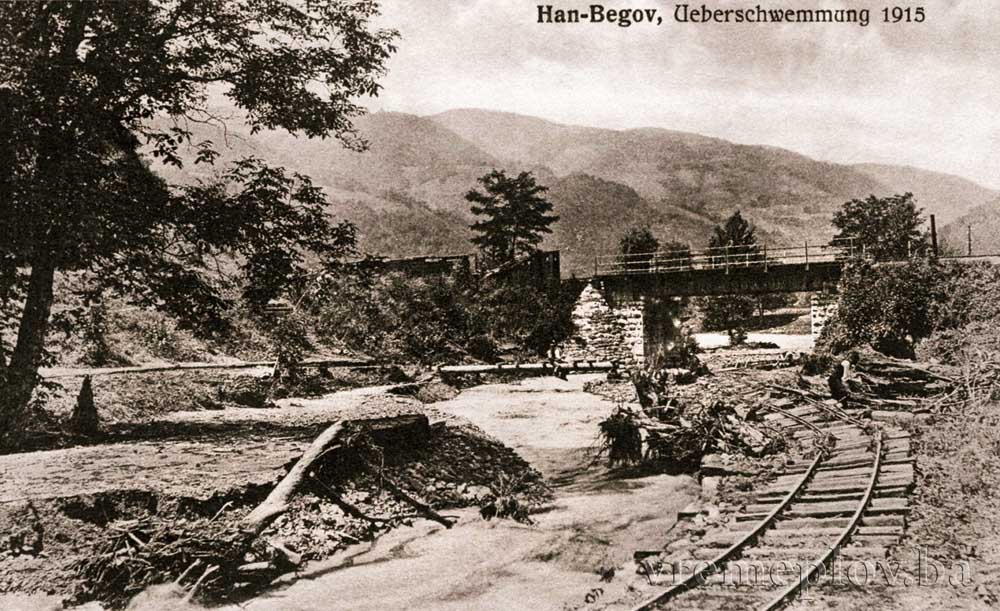
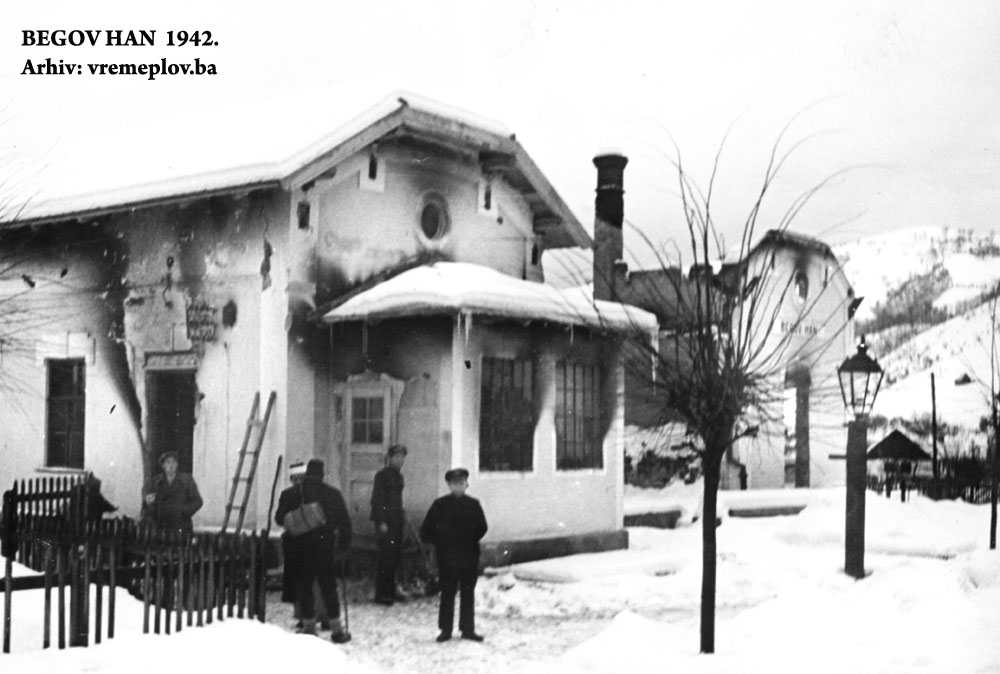
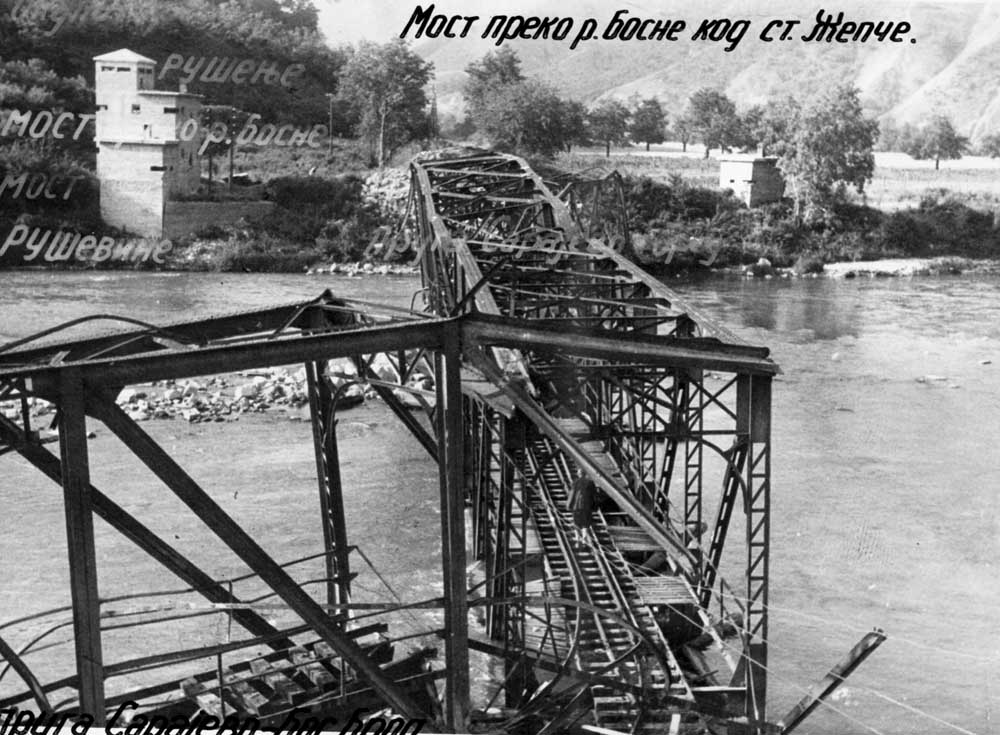
The Communist Party of Yugoslavia appeared on the scene as the organizer of the uprising against the German occupiers and the Ustaše authorities. Already in the second half of 1941, an uprising erupted along with the start of military operations. In February 1942, the Partisan battalion from Zenica entered Begov Han and, after a brief fight, defeated the enemy. On the same day, they completely burned down the sawmill and all the cut timber prepared for transport to Germany. In several places, they mined the railway, set fire to the train station building, and mined and burned the wooden part of the bridge over the Bosna River on the forest railway route Begov Han – Bistričak. Throughout the war and until the railway was abolished in 1952, traffic was maintained on the section from the place at the mouth of the Bistrički stream into the Bosna River to the Bistričak station. The part of the railway from the confluence to Begov Han, specifically to the sawmill, remained non-operational due to the broken bridge (1942), which was never rebuilt or put back into service.
Commencement of Production in the Post-War Period (1945)
After liberation (1945), during the country’s rebuilding period, sawmill production will be established but with reduced capacity. Namely, with the nationalization starting in 1946, all movable and immovable property of the company “Našička” d.d. in Begov Han is nationalized and transferred into state ownership. In the early fifties, instead of state ownership, the company is administered by a worker collective, and with this act, it becomes social ownership, representing a new ownership relationship. The management of production is taken over by P.D.I. “Krivaja” from Zavidovići (June 1946) and inherits the forest exploitation area Nemila-Pepelari and Nemila-Bistričak.
This small industrial site will play a significant role during the construction of the Youth Railway line Shamac – Sarajevo (1947). It will selflessly provide services for securing sawn timber, and freight wagons and steam locomotives for logistical support to youth brigades in the field.
Forest Railway to the Excursion Site in Bistričak
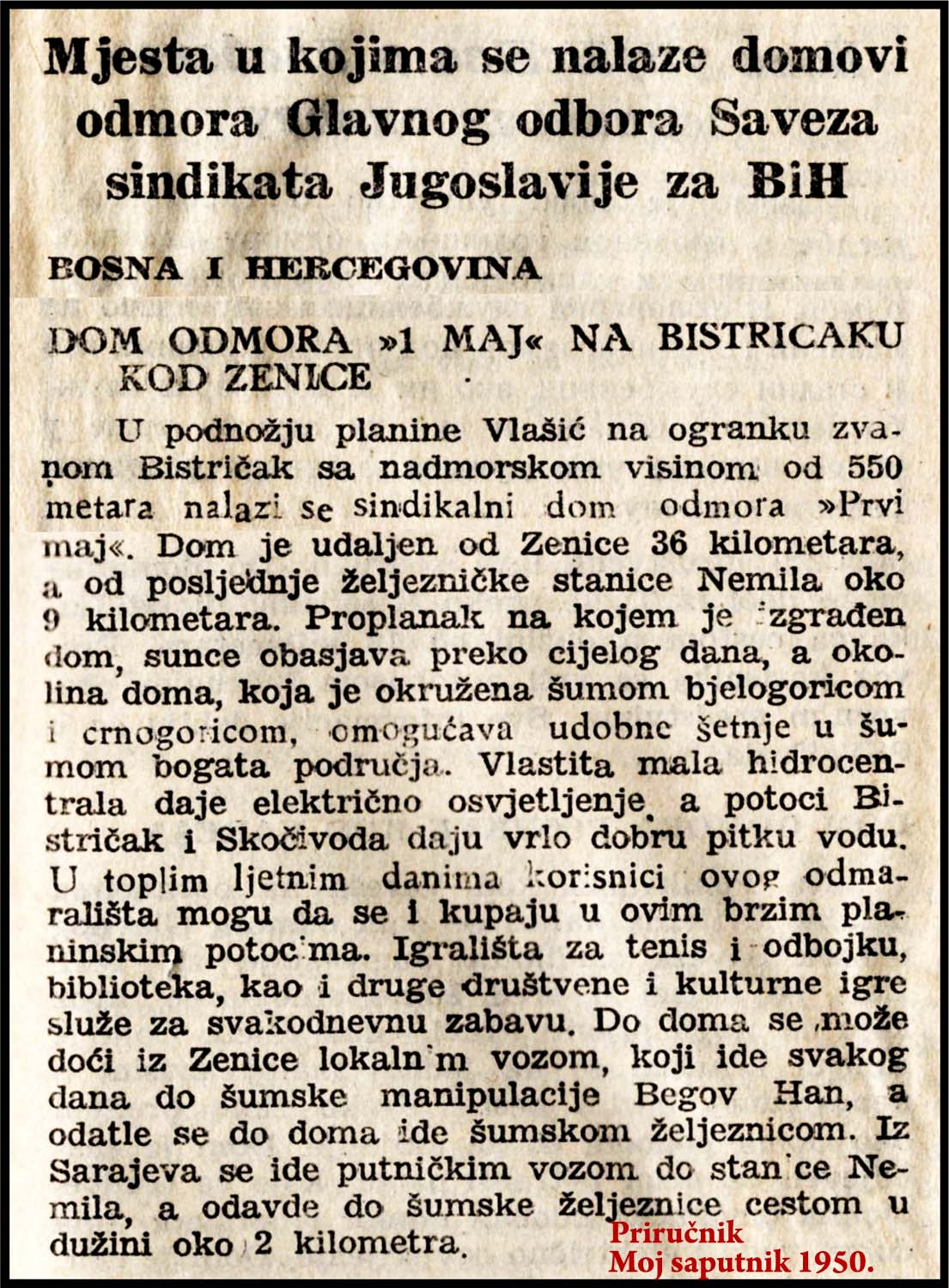
After the war (1948), the collective Željezara Zenica decided to build a workers’ (union) holiday resort in Bistričak. According to the project, the building will be constructed on a clearing surrounded by forest near the railway station. The architectural design combined stone and wood, with the ground floor made of stone and the two upper floors of wooden logs in a mountain style, with the interior in a log cabin style. The work was carried out by steelworkers, and in the summer of 1949, the facility was ceremoniously handed over for use under the name of the Union Rest House “Prvi maj” (May Day).
For the transportation of workers and other nature enthusiasts, a forest railway was used until its abolition (1952). Its starting point was near the road bridge over the Bistričak stream, at the mouth of the stream into the Bosnia River. After its abolition, the lower track machine was repurposed for the construction of a local road. With the construction of a standard gauge railway (Youth Railway Šamac – Sarajevo, 1947), the narrow gauge railway from Doboj to Zenica (built in 1879) was also discontinued and dismantled. This railway was part of the main route connecting Bosanski Brod – Sarajevo (Zenica – Sarajevo, 1882). The planned route for the standard gauge (1435 mm, first in 1947, second, double in 1987), but at a higher level, crosses over a reinforced concrete bridge (L=25.10 m) over the Bistričak stream near the former ‘temporary’ station of the forest railway, called Ušće – Bistričak. From this bridge heading towards Zenica, approximately 70 meters away, a railway tunnel was drilled in 1947, 175.20 m long, bearing the name “Bistričak”. Near the bridge (on the left bank of the stream), at the request of the local community, a railway stop named “Bistričak” was built for local passenger trains traveling the route Zenica – Maglaj – Zenica.
Construction of Standard Tracks at Begov Han Station
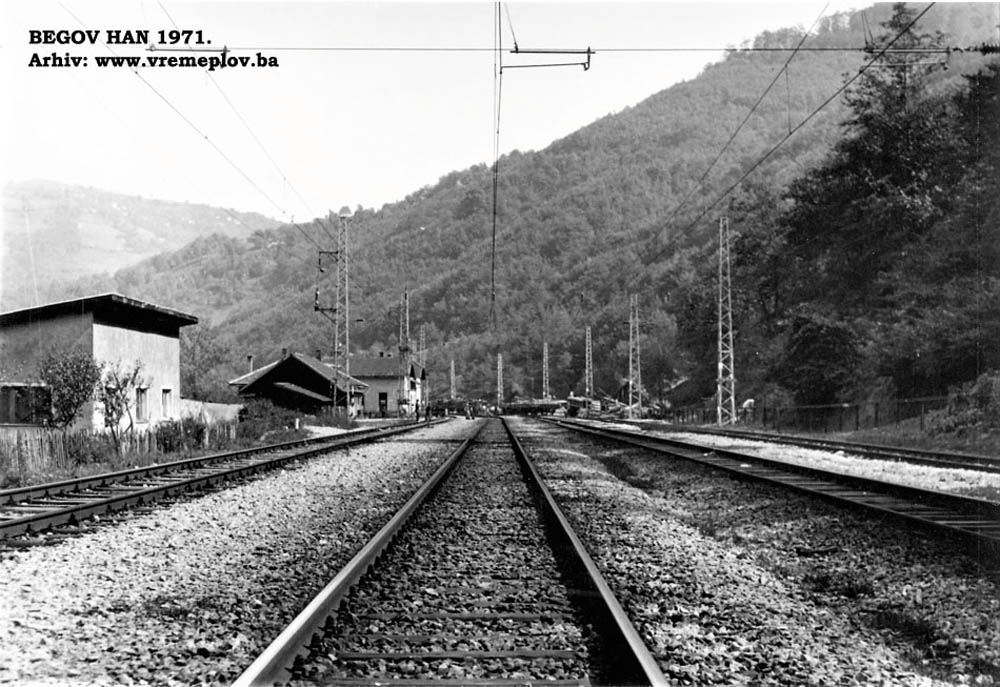
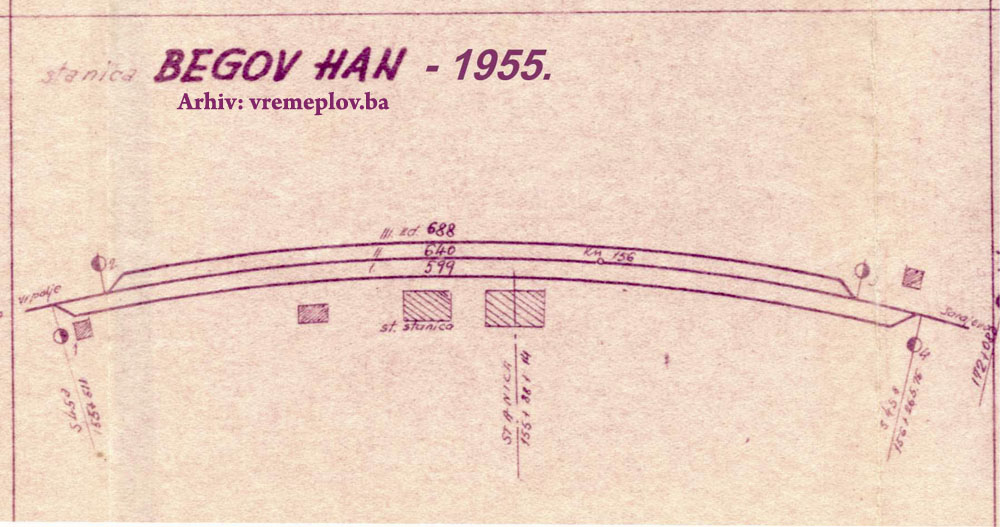
With the construction of a standard track (1947), the then village of Begov Han will receive a strong boost for faster development and transformation into a larger settlement. At the railway station, beside the passing track, two more standard gauge tracks will be installed. The first for passing and crossing trains, and the second as an ‘industrial’ track for freight transfer. By the end of 1959/60, the station’s infrastructure expands; in addition to the passing track and the existing two tracks, a third track of 396 meters in length is built to serve for transferring goods from the ‘temporary’ industrial narrow gauge track (760 mm) owned by P.D.I. “Krivaja”.

Along with the modernization of the railway traffic through Begov Han, a public main road (on the left bank of the Bosna River) will pass, contributing to faster social and economic development of this region. The reason for the abolition of the narrow-gauge track connected to the network of industrial tracks (on the right bank of the Bosna River) was that the sawmill enterprise shifted its focus to transportation of goods by road. The connection with the main road (on the left bank) will be established by constructing a road bridge as a public good, serving both industry and the residents of Begov Han.

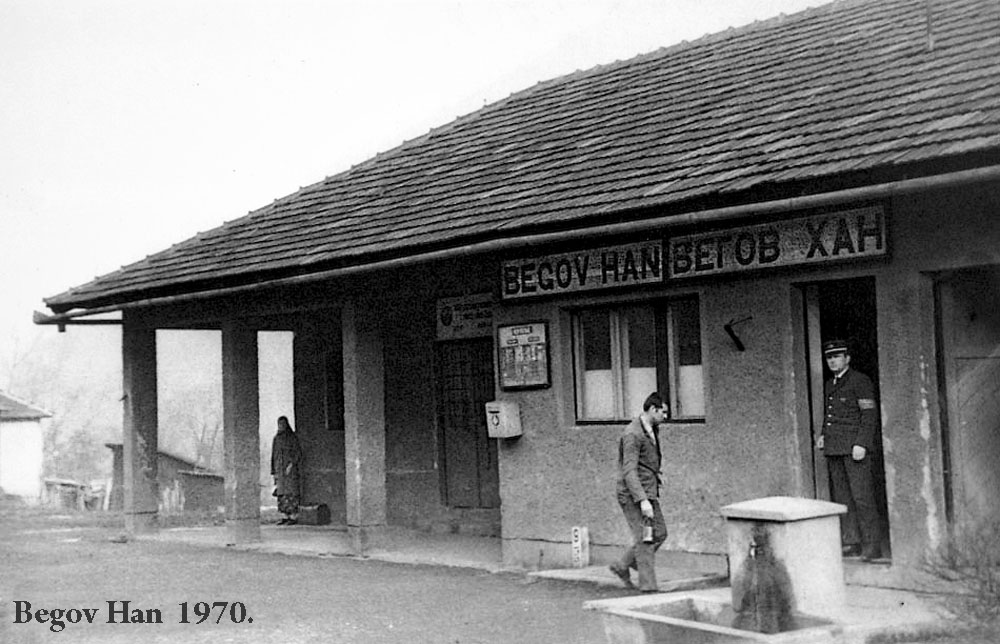
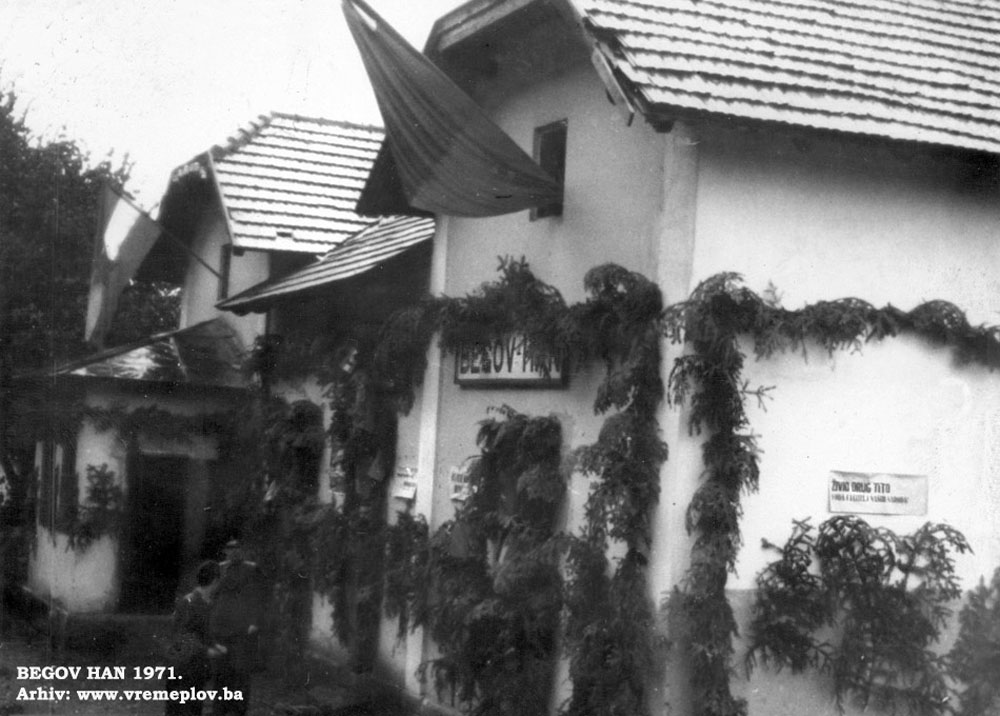
With the launch of the double-track railway from Zenica to Doboj (in 1978), station tracks are dismantled, and Begov Han loses its status as a railway station. The building with auxiliary facilities is declared part of the official premises, and part of it is converted into a residential unit. From the site of the old railway station and northward for approximately 1,500 meters, a suitable stop, “Begov Han” (in technical terms, a solution for the double-track railway) will be constructed for the dispatch and reception of passengers in local passenger traffic.
Information on Industrial Locomotives
Finally, a few words about the data on steam locomotives that operated on the aforementioned forest railways.
According to the description of industrial locomotives at the Railway Directorate in Sarajevo from 1932, which were in service at Begov Han and owned by the companies Industrial-Trade Inc. “Bosna” and “Našička” Ltd., they are:
Locomotive of the series (boiler number) 7391/1917. / Orenstein & Koppel – Berlin. Served at the steam sawmill in Našice (Neuschloss, Nasicer Tanninfabrik, Dampfsägewerk) under the name “Slavonia”. From 1928, it was transferred to work for the same company “Našička” d.d. in Begov Han. After liberation (1945), it served in the P.D.I. “Krivaja”, P.D.I. “Maglić”, and the Sawmill “Sutjeska”.
Locomotive of the series (boiler number) 3093/1912. / MÁV, Budapest. Initially named “Gaglin 10” while operating in the Bistričak forest area, from 1918 it was renamed “Bistričak.” Since 1928, it was transferred (loaned) to Zavidovići to the company “Našička d.d.” from the former firm “Gregersen’s Forest Industry A.D.”. Specifically, “Našička d.d.” purchased in 1927 all transport communications and fleet as well as all other construction facilities with steam sawmill equipment from the “Gregersen Forest Industry A.D.” in Zavidovići. Up until the outbreak of World War II (1941), it belonged to the local station (company’s boiler room) in Begov Han. After liberation (1945), the locomotive served the Public Railway Company “Gostović” and the Forest Management “Krivaja” until 1964 when it was decommissioned.
Locomotive of the series (boiler no….) 2411/1890. / Krauss & Co., Linz. It was owned by the company “Morpurgo & Parente” and operated on the narrow-gauge railway line “Usora – Pribinić” (1886-/1896.), before transferring to the ownership of the Land Forest Railway “Usora – Pribinići” (Landesärarische Waldbahn Usora – Pribinic, 1896-1918) and was named “Bosna”. In 1916, it was purchased by the Industrial-Trade Joint Stock Company “Bosna,” and it operated under the name “1-Bosna”. This small locomotive, with two coupled axles and weighing 8.8 tons, was the main driving machine (switcher) in the industrial yard area of the company’s sawmill in Begov Han. At the time of the 1932 census, in the remarks column, it was listed as “Canceled” without specifying the year.

During further research, there were locomotives that operated ‘occasionally,’ or were ‘borrowed’ for justified technological reasons.
First, “Nasička d.d.” was the owner of a sawmill in Zavidovići, with a network of forest tracks in the Gostović mountain area, and a sawmill in Begov Han. As a result, upon request from both plant managers, they could freely carry out ‘exchange’ of locomotives. Secondly, as P.D.I. “Kravaja” managed the sawmill in Begov Han, some locomotives of the rolling stock from Zavidovići were occasionally engaged in this area until the narrow gauge track was abolished (1952), and these included:
Locomotive of series (boiler number) 2412./1889, year / Krauss & Comp., Linz.
Owned by the company “Morpurgo e Parente” Trieste (“Usora – Pribinić” 1891/1896) and later owned by the Land Forest Railway “Usora – Pribinić” (1896/1918), it was named “Usora.” It was temporarily engaged (in 1917) on the route Rollbahn “Želeća Potok” owned by Industrial-Trade Ltd. “Bosna.” After the war (in 1918), its track of disappearance is unknown.
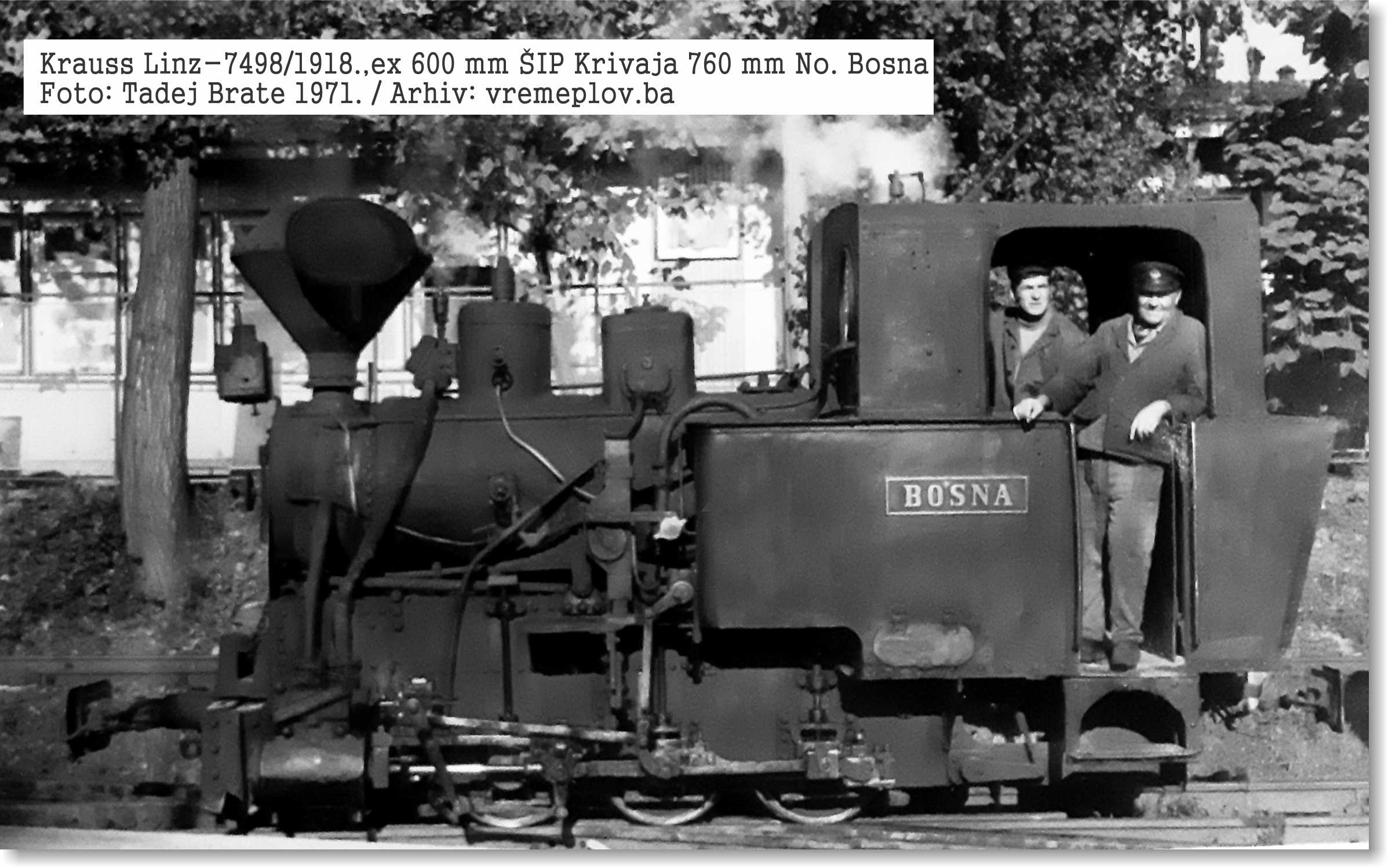
Locomotive of the series (boiler number) 7498./1918. year / Krauss & Comp., Linz. This locomotive is still displayed today as a museum exhibit in the railway depot in Rajlovac near Sarajevo (1976./77. year) under the name “Bosna.” Since 1918, it was owned by the coal mine in Črnomelj (Slovenia) and transported industry on a narrow-gauge track of 600 mm. In 1939, owned by “Našička d.d.” (reconstructed drive axles to a width of 760 mm) in Zavidovići, it occasionally operated for the needs of the sawmill in Begov Han. After liberation (1945), the locomotive was owned by Š.I.P. Krivaja in Zavidovići until 1973.

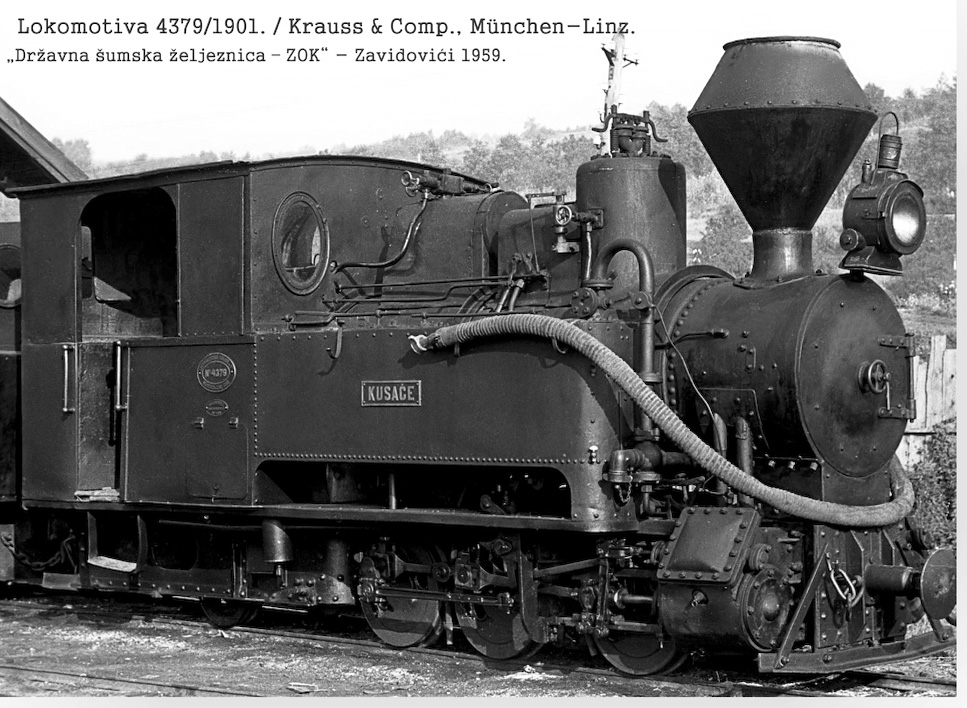
Locomotive of the series (boiler number) 4379./1901. year / Krauss & Comp., Munich-Linz, is known by the name “Kusaće.” Since 1918, it was owned by “Bosanska Šumska Industrija Ajsler i Ortlib” in Zavidovići until the liquidation of the company (1934), when it transferred to the ownership of SHIPAD, and from 1949 to 1973, it was owned by the company “State Forest Railway – ZOK,” when it ended its operational life. It has been displayed as a museum exhibit within the “Krivajina Vila” grounds. According to some sources, as a ‘loaned locomotive,’ it performed hauling duties from the industrial yard of the sawmill to the station in Begov Han (1945 – 1947).

Finally, as a curiosity, a few words about the unique industrial locomotive that operated on the forest railways in Begov Han. This concerns a type of locomotive as a single steam engine of this kind not only for Bosnia and Herzegovina but also for the former Yugoslavia.
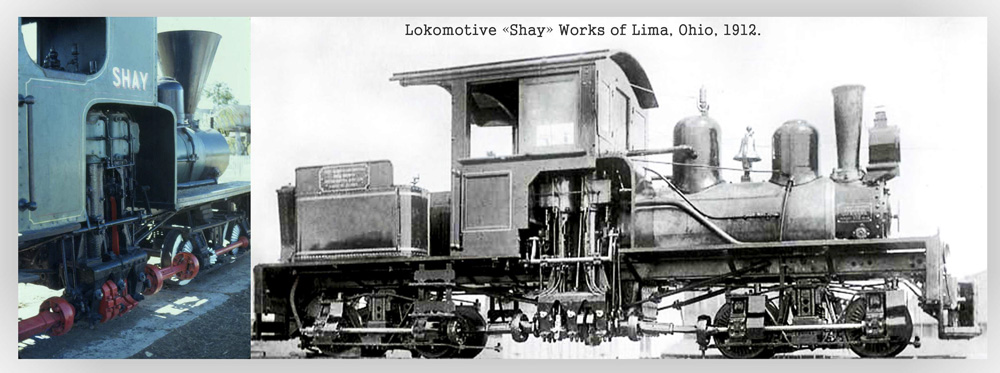
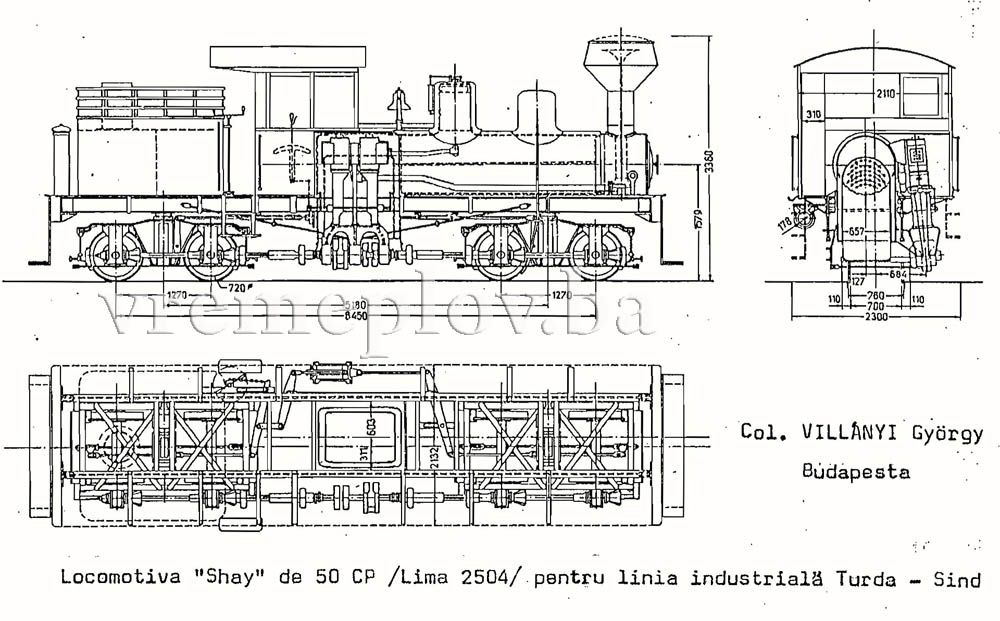
Locomotive of series (boiler number) 2504, manufactured in “Lima Locomotive Works of Lima, Ohio” – USA, in 1912. It is known (as a product) under the name “Shay locomotive”. In technical terms, the drive axles with gears were designed and patented by Ephraim Shay, and most were built for use in the United States of America, primarily in North America.

The locomotive belongs to class ‘A’ with two cylinders and with 0-4-0 axles that are driven by a separate conical gear. The boiler pressure is 11 bar, the maximum speed is about 18 km/h, and it weighs approximately 18 tons. It was equipped with a steam pump, which allowed the water reservoir to be refilled from a nearby stream. It was suitable for forest operations like timber harvesting and in mining, and could operate successfully on steep or poor-quality tracks.
The concept of the steam locomotive with gears is designed so that the steam cylinders with pistons are placed vertically and mechanically connected to the ‘drive shaft,’ or crankshaft at the wheel height, whose ends had ‘prismatic’ joints or spiral conical gears. The conical gear transmits the drive to a gear of larger diameter on the so-called ‘crown wheel,’ which is mechanically attached to the locomotive wheel. The direction of rotation of the drive shaft would be changed via a mechanical gearbox, allowing the locomotive to run in any direction. In short, these types of steam engines did not have joints with side rods connected to the driving wheels, as is common with many series of European steam locomotives.
The first owner of locomotive Lima 2504 / 1912 was Karl Petrachek from Vienna for Lokomotivfabrik Krauss & Co. Linz, Austria, in 1912. Since it was not sold, it remained in storage until mid-1917, when it was transferred to Torda, Transylvania, Hungary (Austro-Hungarian Empire) to the “Torda Cement” factory. The factory never used it, and it was stored until early 1918. After the war (1918), it was disassembled into seven parts (except for the boiler and the locomotive’s trunk) and moved to operational testing for the Local Railway Salzkammergut (SkgLB), a narrow-gauge railway of 760 mm, on the route Bad Ischil – Salzburg. Since it did not impress the management of SkgLB (due to its low speed), they abandoned its purchase and stored it in a nearby locomotive depot until 1923.
His last journey to the new owner concludes in Bosnia (1923) at the “Bosna & Konz.” company in Begov Han (1925).
It can be assumed that it was delivered as part of the reparations contingent (war indemnity) to the then Kingdom of Serbs, Croats, and Slovenes, or to the Railway Directorate in Sarajevo. In any case, it is not known how much time it operated within that company. By examining the document “Inventory of industrial locomotives at the Railway Directorate in Sarajevo from 1932,” it is not listed among the company’s fixed assets. The last data from other sources states: decommissioned before 1940.
This modest research paper, which we have presented in this article, is concluded with sincere gratitude to the employees of the BiH Archives in Sarajevo, without whose assistance in recommending the use of available library materials and permission to present the aforementioned sketches and plans, this would not have been possible.
Note:
Downloading a part (up to one-third) or the complete text is permitted in accordance with Article 14 of the Code of Print and Online Media of Bosnia and Herzegovina.
If another media outlet wishes to use a part or the entire original text, it may do so exclusively with written permission from the portal vremena.plov.ba.
After obtaining permission, the source must be cited as the portal vremena.plov.ba and, at least once, a link must be published under which our text is available.